
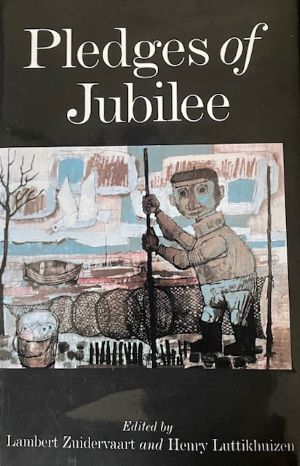
Most of us have been graced in our schooling years by especially remarkable and beloved teachers. No teacher was more remarkable and beloved in the lives of many in the Dutch Reformed academic community than Calvin Seerveld, who taught for thirteen formative years at the brand new Trinity Christian College in Chicago and then for twenty-three years at the Institute for Christian Studies in Toronto, where, even after his retirement, he remained an influential presence. Cal died on August 5, and his memorial service was held in Toronto on September 13. What follows, to honor him here, is my own affectionate tribute as an early Trinity student, written as a “Publisher’s Preface” for Pledges of Jubilee, a Festschrift dedicated to Cal upon his retirement in 1995, edited by Lambert Zuidervaart and Henry Luttikhuizen and published by Eerdmans.
We always liked, my Trinity car-mates and I, to wind up driving beyond Cal Seerveld the last mile or two to school, as we occasionally did. There was first of all the car itself, a white Nash Rambler that in the heyday of flamboyant tail fins and the Chrysler Imperial suggested less a vehicle designed for adventure, let alone soaring flight, than, in the words of essayist E. B. White, a badly laid egg—stubby, ill-formed, and decidedly earthbound.
The beauty and fun were in the irony, because the lone occupant of this mundane anti-car did in fact seem to ramble dreamingly along, looking to the left and to the right out the window, and sometimes—even as he drove—down at the seat beside him, surveying, we imagined, some choice page in Dooyeweerd’s New Critique of Theoretical Thought.
In other words, the picture fit a myth we students were happily cultivating about a man who did seem to us extraordinary. The car in its resolute plainness was nothing less than a summons to rethink our cultural values, and the man—well, we knew that what we saw outside the window as mere random grass, Seerveld was perceiving through the powerful unifying eye of a Weltanschauung!
Cal came to Trinity Christian College not only early in his teaching career but in the very first year of the college itself, and the adventure of studying with him fit wonderfully a general atmosphere of academic embarkment. The school was new, the faculty idealistic and superb, the curriculum aborning, and the student body small, only thirty or so of us at most. This frequently gave us first-year students a gift that ordinarily comes only to juniors and seniors—small classes and the heady possibilities of the seminar and tutorial.
For many of us, an astonishing number of these classes were with Seerveld. The student body was small, but so was the faculty, which meant that Seerveld was pressed into service teaching not only all the philosophy (a core requirement for all four semesters of the then two-year college), but also history and even German. I recall that during one semester I had Cal for three out of four courses.
Seerveld’s teaching more than one subject, while unusual, never seemed to us unnatural. For one thing he was splendid at them all. But, also, his approach in whatever course was always pervasively interdisciplinary. To take from him in the same term both ancient philosophy and ancient history, as I did, was constantly to be shown in each course the resonances between the pre-Socratics, Plato, and Aristotle on the one hand and Greek religion and the Greek arts on the other. Cal was intensely concerned with the incultured character of ideas—how the culture shaped the ideas and how the ideas shaped the culture.
The ideas of the culture were always presented to us through original sources. I can’t recall any textbook for Cal’s classes—only a mountain of paperbacks. Cal insisted on his own selective and rigorously perspectival approach to his subjects. A glance at the catalog descriptions for his courses invariably spots the words, repeated as a Leitmotif, “a critical exposition of the texts.” From Plato to Lucretius; from Tertullian to Aquinas; from Calvin and Luther to Giovanni Pico della Mirandola and Pietro Pomponaazzi (sonorous Italian Renaissance names we loved to mouth); from Locke to Compte; from Kierkegaard to Heidegger—the exposition needed to be direct, immediate, and fair. But one never approached the texts neutrally out of mere intellectual curiosity. Ideas, no matter how attractive, were deeply rooted in presuppositions, and everywhere there lurked for the unwary Christian the dangers of accommodation. Unlike St. Augustine, Cal was not enthusiastic, as I learned in an early paper, about trying, like the Israelites, to take the gold out of Egypt. One needed the discerning and critical eye of faith, and, in particular, of deep Reformational commitment.
I don’t suppose that Cal hated anything more than he disliked academic indifference or disinterestedness. He had no room for laziness or, heaven forbid, for the cultured dilettante. Ideas were a matter of life and death. Perhaps his greatest gift to us who were his early students, and to students throughout his career, was the overpowering sense he gave that all our work, in whatever sphere—from fish mongering in West Sayville on Long Island (where he was proud to come from) to studying philosophy—profoundly mattered in God’s kingdom. Going to college wasn’t a frivolous thing, and failing to do our work wasn’t simple malfeasance but sacrilege. And we worked terribly hard—prodigious reading assignments, a good many papers, and exams that could take as long as four hours, if you had enough diligence (or fear) really to tackle the two or three epic questions. Even then, one didn’t so much finish the test as abandon it at some point you had to live with.
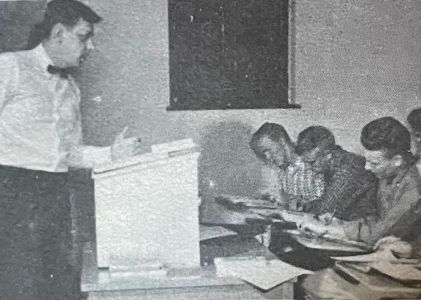
Cal acted and looked the part of his intellectual passion—the edge of his lecturing hand cleaving the air before him, the sharp little intake of breath, perhaps as he moved from exposition to critique, and even, let it be affectionately said, the look of his clothes. The bow tie he often wore seemed a natty anomaly against a field of sartorial rumple, and one of his jackets—a grey corduroy, I believe—was for months torn open the shoulder joint, with the stuffing leaking out. Clearly this was a man who wrestled with the angel to gain his wisdom, and we had better pay attention.
Cal’s passion for ideas was matched by his concern for those students for whom these ideas were supposed to matter. Which was all of us. He didn’t simply present his material, for us to follow as best we could. He meant to communicate it. Classes rarely ended on the hour, but only after the last student who stayed behind with questions finally drifted off. For a man pent up with all the things he wanted to get across, Cal was gratifyingly patient with queries and naive challenges that must sometimes have tried his soul.
Not all of our instruction came from Cal in the classroom. He was also generous in his counsel over coffee or in the hallway, though we always felt in his manner a slight (but not unappealing) urgency about time, as though his angel might be waiting in the wings.
And there were those marvelous chapel talks, in particular Cal’s own un-prettified and riveting translation of Scripture, some of which made their way into books. Take Hold of God and Pull was one such book, and these translations did just that, pulling us along as well into a worship unlike anything we had ever encountered before. “Beauty exalts, but beauty also lulls,” C. S. Lewis once cautioned about the lofty eloquence of the King James Version. Seerveld’s translations decidedly did not lull, in the craggy grandeur, the raw physicality, the jarring syntax, and the plain-spoken vernacular with which he struggled to produce a dynamic contemporary equivalent to the Hebrew and the Greek.
Nothing, it can be said, that Cal Seerveld ever did managed to lull, though much of it came with a spirit of play. I have noted his patience with querying and long-winded students. One small—but of course instructive! —exception comes to mind. “Please,” Seerveld once implored at the beginning of a class, “hold your questions until I’m finished. And then make sure your questions are pertinent.” At the end of the lecture, silence. Finally, when even one of his more voluble nuisances sat on his hands, came the gentle, good-natured professorial voice, “And what about you, Mr. Pott? Silenced by pertinence?”
Header Image: The original Trinity Christian College.

9 Responses
Jon, I did not have a close relationship with Cal but my husband did. He loved to read Seerveld’s books and to see him if this was possible. We lived originally in New Jersey but moved to Iowa and to Dordt and my husband had a few summers of contact with Cal. His speaking and books were amazing so I understand my husband’s love of Cal. My husband is prematurely dead after a car accident but gained much from Seerveld. He used Seerveld freely in teaching Engineering at Dordt and in his teaching Chemistry and Physics at Eastern Christian High School.
I had Dr. Seerveld’s introductory philosophy class in 1964 as an idealistic young person fascinated by the idea that all the world belonged to God. But even more memorable is the invitation he and his wife gave to me to accompany them to a symphony concert. A generous whole-life approach that I have never forgotten.
Dr Seerveld’s brilliance was wasted on most 18 year olds. Until they were 30 and finally “got it.” He was all things good, a gentle force. Those who knew him and/or were exposed to his teaching/writings were blessed. Thanks for your pertinent remembrance, Jon.
Thanks for this tribute, Jon. I did not have the opportunity to have Cal as a teacher, but listening to his prophetic and passionate presentations about the place of art and aesthetics has had a profound influence in my life.
As Ann noted already, Dr. Seerveld’s brilliance was wasted on most 18 year-olds, and to be sure this one among them. But so also his relevance and his inspiration. After I lurked on the edges of Philosophy 101 and 102, he would have had no reason to keep me in the hopeful column. But all was not lost! Thirty-five or six years later I was able to show him a fruit of his diligent labor at Trinity. While visiting Grand Rapids, I took Dr. Seerveld on a tour of the affordable housing work of ICCF Community Homes. He needed no coaching to see the design integrity of our single family houses. In talking with him about architectural beauty as a core element of housing justice, I saw an appreciative gleam in his eye. I trust that through his many years he was able to see (or hear or read) much more fruit of his very special labor. Thank you God for the gift of Cal Seerveld.
Thank you for this apt tribute. I was not aware of his passing, but I’m so glad that you capture so well the heart of this man. Seerveld’s influence in my life and thought has been significant not by personal contact but by reading his primary sources!
Some of my favorite college memories were reading out loud and with close friends, those chapel messages (for God sake, run with joy and take hold of God and pull).
I think Seerveld’s thoughtful legacy resides well in the hearts of those whose reformation flame cannot, and will not, be extinguished in these challenging times.
Thank you for writing such a good tribute
A beautiful tribute. My Dad spoke highly of Cal Seerveld and had many of his books on his bookshelves. My memories are more through the shared stories of his daughter Aanja, my roommate on the NSPICE program through Dordt. I listened to the service and saw glimmers of a friend from years gone by.
Dear Jon,
Though written thirty years ago, your tribute is as relevant as it was then, and will remain an exquisite, eloquent homage to an extraordinary professor. Thank you!
Jack
Thanks, Jon, for this wonderful tribute. My introduction to his manner and mystique came by way of a letter sent to all students with a summer reading assignment in 1965 to immerse ourselves in the book of Ecclesiastes, which would be discussed at the student orientation at a campground off campus. I’m fairly certain Seerveld signed the letter. He certainly led the discussion with his unique cadence and engaging personality. We knew we were in for something special. In Philosophy 101 he challenged the notion that we are to do “all things in moderation,” which he felt was heresy to the faith. Christians are called to live fully in all things. And then I saw it on display when the faculty intramural basketball team took the court against our student team. Athleticism was not his gift, if I recall correctly. But I never saw anyone play basketball with such gusto and enthusiasm. Maybe Michael Jordan. In all things, Cal Seerveld lived what he believed.
And thanks, RJ, for the photo of the old golf course clubhouse which served as the Administration Building, chapel, cafeteria, and many other functions in Trinity’s earliest years.