
I am certain, because it piqued my anxious imagination, that I first heard the phrase “reconciliation ecology” from my friend Dave Warners (co-author). It’s at least partly an allusion to the phrase “restoration ecology,” which was by then recognized as a subspecialty of applied ecology, even having its own academic journal. Its goal is scientific support for restoring biodiversity and ecosystem function.
The problem with restoration ecology is that, although populated with dedicated researchers and practitioners, it struggles to make its case in the broader North American culture.
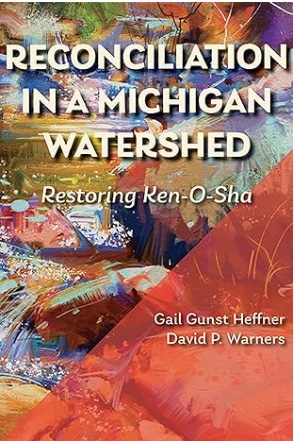
This new book by Gail Gunst Heffner and David P. Warners addresses that issue and is an absolute joy for the hopeful direction it offers. My review copy is all marked up with notes and highlights, and having read it twice, I can report that it gets even richer on second pass. It too is about restoring biodiversity and ecosystem function, but it probes deeper into human worldviews and their effects on both degradation and restoration.
Plaster Creek (Grand Rapids, MI) is the “Ken-O-Sha” in the title. That Heffner and Warner choose to use the Ottawa name (translation “Water of the Walleye”) presages their centering of human history and cultural significance in its Indigenous roots. It is also of a recognition that the reconciliation of the human-nature connection and relationship that is more associated with Indigenous worldviews offers an alternative to the rigorous commodification and conquest attitudes of white settlers and, regrettably, most of their descendants.
The book is ostensibly an expansive report on the authors’ efforts (with volunteers, students, and community members) to restore a degraded urban stream to better ecological health and the authors get there with careful retelling of the historic, cultural, ecological, and human contexts that enabled the stream to become degraded and how their team, Plaster Creek Stewards (PCS), navigates those contexts to restore the human-nature connections to enable the stream to recover.
Key to the restoration story has been the co-founding of the Plaster Creek Stewards group by Heffner and Warners. The PCS group is an affiliation of watershed stakeholders, students, and volunteers who provide a collective energy and (literal) muscle for the restoration work.
Reconciliation in a Michigan Watershed is well-written and enjoyable to read. It has 13 chapters organized into three thematic sections: 1) recognizing the problem, 2) acknowledging our (settlers and descendants) complicity, and 3) committing to restoration. The treatment is rigorous in an academic sense, with a liberal (though unobtrusive) use of footnotes that link to a reasonably extensive bibliography, encompassing literature, poetry, news sources, and scientific journals. There is a table of contents and an index of topics to aid in orientation.
Reconciliation in a Michigan Watershed draws on scholarship from a wide variety of disciplines, including geology, human history, ecology, sociology, policy, and even faith traditions (to name a few). Indeed, this could have been simply a successful academic book that makes all the necessary interdisciplinary linkages, first explaining the degradation of Ken-O-Sha and then supporting its movement towards restoration within a philosophical framework of reconciliation.
The book is all that, for sure, but what sets it apart is the truly tactile blending of personal stories (from the authors, as well as volunteers and watershed residents) and a clear sense that the authors invested themselves in the restoration work and the people connected to it. You get stories of their apprehension and missteps in public engagement, of the discovery or rediscovery of ecological richness and rare species, of a living memory of both the good and the bad. You read this, and you know something intimate about the creek, something that can only emerge because the authors write from firsthand experience mucking about, both literally and metaphorically, in the socio-ecological realities, and because of an unspoken but clear love of the place.
I think this is a singularly important book. The term “reconciliation ecology” originates from one of those thought-provoking pieces that can be found in academia. The sort of thing that one reads and maybe offers up as a discussion topic in a student seminar, where we sort through abstractions in a self-satisfying way. This, though, is an example of the idea put into emerging successful practice with all the granular detail about wins and losses, and the dirt under one’s fingernails (again, real and metaphorical) is hard won.
Reconciliation in a Michigan Watershed, the book and the idea, is a next step in the authors’ scholarship in re-considering the stewardship paradigm for Christian creation-care discipleship. Both authors were contributors to 2019’s book, Beyond Stewardship (Calvin University Press), where an interdisciplinary group of Christian scholars assembled to consider moving beyond the transactional/detached nature of the common stewardship paradigm (God wants me to care for creation, so I must care for it) to a paradigm of interrelationship and communion between Creator and creation. It’s easy to see the intellectual and spiritual connections between the two books and how the authors’ experience with PCS informed their thinking.
It’s telling and a little damning that Plaster Creek became “West Michigan’s most contaminated waterway” in the very backyard of Calvin University, an institution that rightfully prides itself on rigorous Christian Scholarship located in a city (Grand Rapids) closely identified with robust Reformed and Calvinist traditions. It speaks to a blind spot in the expression of Christian faith and, likely, a pathology in worldview. Gail Gunst Heffner and David P. Warners make a wise and accurate diagnosis and offer the most promising treatment that I am aware of – reconnection.
It’s a wise book and an important book. Highly recommended.
Note: This review originally appeared in Perspectives on Science and Christian Faith: Journal of the American Scientific Affiliation.

2 Responses
Even though it is a small step in reclamation of a tiny piece of earth, sky, water, and their inhabitants, it has become a beautiful story of creational care. Thank you for bringing it the attention it deserves, perhaps to embolden others to look around their neighborhoods and communities with hope for what can be.
Thank you Tim for this piece about Plaster Creek and restoration. One church, First Presbyterian Church in Traverse City, Michigan, includes this statement at the beginning of all their worship bulletins:
Land Acknowledgement (Condensed)
The land upon which our church stands is home to the
Anishinaabek peoples, specifically the Odawa, Ojibwe, and Bodewadmi tribes. We are grateful for their stewardship of this land and the Lake Michigan watershed for centuries.
We lament and apologize for the violence of all our spiritual ancestors upon the Indigenous people and the land and water of this region.
We commit our time, energy and resources toward engaging with Indigenous people in a mutual effort to enrich all life together on God’s earth.