
At Christmas of 1948, I was seven years old. Growing up during the war, I was used to scarcity. We did without a car because my Dad donated our tires to the war effort. As to toys, we mostly made do with homemade ones. And after the war was over my Dad’s pay didn’t allow for much by way of new toys.
One night in early December 1948, my Dad informed my brother and me that he had heard Santa Claus was really going to come this year and make up for all the shortcomings of the war years. We were delighted and imagined all the marvelous toys which jolly old St. Nick would leave for us, especially after all the years of deprivation.
At school the next day I told my friends about the return to the pre-war form of Santa Claus. They were interested but skeptical. My best friend, Howard Garber, was sympathetic but mildly querulous. Benny Finkel didn’t think much of an obviously Gentile grand-elf who was going to bring me, among many other things, a Lionel train set. Dov Wartofsky did not comment at all about my rendition of the Protestant virtue of being good and then being rewarded by Santa Claus.
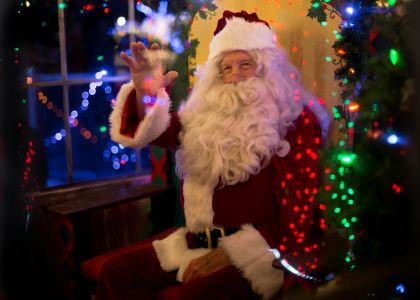
On the 6th of December, my father told my brother and me that it was the feast of St. Nicholas, a day that had been their major celebration day back in Newfoundland. He said that this was the day to write our letters to Santa. On a large sheet of lined yellow paper, I wrote my letter to Santa Claus. I asked for a Lionel train set, a hockey stick, and, so as not to appear greedy, a puck. We got a large envelope, and addressed it to: Mr. Santa Claus, The North Pole. How much postage was needed? My parents assured me that an ordinary stamp would do. My brother and I marched out the door, letters in hand. Reaching the street, I hailed Dov Wartofsky and informed him of our doings. He came along to the street corner and witnessed our triumphal mailings. Walking back home, Dov asked about how the Santa Claus system worked. My brother and I explained it and replied affirmatively to his question as to whether was this only for the goyim (non-Jews), or if Jews could participate too.
About a week later Dov came up the street to visit me. I could see he was disturbed about something, so I asked him what was wrong. He replied that his parents and his uncle who lived with them (one of the dozen or so people on our street with concentration camp numbers on the inside of their forearms) had told him all about this business of Santa Claus. It was strictly for the qoyim, he was told. Reluctantly, they had told him the truth, but had made him promise that he would not tell me. They had no desire to hurt or upset me. After all, my family was a good gentile family, and while practicing Christians, we were nevertheless respectful of Jewish religion and culture. I was to be allowed my little fantasy, but Dov was to beware. If he would receive presents at the festival of lights, they would be from his parents. If my parents wanted to disguise their gifts to me as having come from Santa Claus, that was to be their private matter in which Dov was not to interfere. But this knowledge was too great for Dov. He had to tell me, and in two or three long sentences he blurted it all out.
I received this information in stunned disbelief. I shouted back that it was all a lie. Dov, even though American-born, replied with a gesture brought from central Europe: a raising of the shoulders and opening of the hands, a pursing of the lips, and the rhetorical question – “Would I lie to you?” He went home, leaving me alone in my room, the most forlorn Protestant in Boston. Was it possible that the Wartofsky’s were right, that the whole Santa Claus thing was a big charade? But why would my parents do it? I had to find an answer. My father would not be home until six, the usual time. The Westminster clock in the front hall chimed 5:15, which assured me of a private moment with my mother in the kitchen. I ran into the kitchen and hugged her tightly, and I relayed the Wartofsky disclosure.
She looked at me very seriously, and said, “I suppose it had to come to this someday. When your father and I bought this house before the war, there were very few Jewish people here. As the war began, and especially since its end, everything has changed. Aside from the O’Driscolls next door, who are Catholic, we are the only Gentiles for blocks. We understand, and have tried to have you and your brother understand, that Jews in Europe have been through an awful time recently, so we must be sympathetic and non-critical of Jewish ways. Our neighbors are good people, and we must respect them, even in their differences. But they are different. They don’t believe what we believe. They don’t believe that Jesus was the Messiah. And, although Jesus and Santa Claus are different, it is a matter of our beliefs. You’ve got to believe, Ronnie, and your Jewish friends don’t believe. That’s the difference.”
That conversation transformed my muddle into stark clarity. Belief was the key, and I was a believer. The next day, I sought out Dov Wartofsky and repeated my mother’ s points as faithfully as I could. Dov replied that he didn’t care much about Jesus, but he was interested in Santa. “Let me get this straight,” he mused. “Do you mean that if I believe in Santa that he will be real enough to come down my chimney and fill my stocking and bring me presents? ” I assured Dov that it was not only true, but that I had it on the highest authority: my mom.
Christmas week approached, school ended, the pageant at St Paul’s Episcopal Church was practiced and performed, gifts were wrapped, and the tree was put up, the latter, as always, with Howard Garber’s help. His parents were only partly observant Jews who didn’t mind Howard joining us for the festivities.
On Christmas Eve afternoon, I did not see my neighborhood friends. A few of my mother’s relatives were going to join us the next day for Christmas dinner, so much needed to be done. After all that, we went to the early family service at St Paul’s Church. We returned home for the ritual fruitcake and port wine. Some was to be left near the fireplace for Santa to have a quick break. In church, we had heard a Christmas story from St. Luke’s Gospel, chapter 2, verses 1-20. At home, my mother, who read with theatrical expression, read Clement C. Moore’s classic, “The Night Before Christmas.” As I went to bed on that delightful and welcome evening, I had no idea that there would ever be a contradiction between the stories which began with such familiar and comforting lines: “In those days a decree went out from Caesar Augustus that all the world should be taxed,” and “T’was the night before Christmas and all through the house, not a creature was stirring, not even a mouse.”
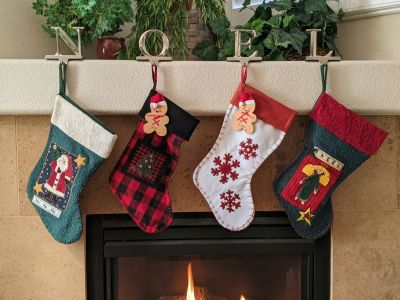
I forget if Christmas was white that year in Boston, but it still was a great day for my brother and me. My stocking on the mantle contained a variety of sweets and a hockey puck. Under the tree was a Lionel train set from my parents and a hockey stick from Santa. The socks from Aunt Ruth neither thrilled nor fit me, but they had come in a package from Newfoundland with a stamp of King George on it, and that was good enough for me. The turkey was in the oven, and the unique smell of sage filled the house as we began to set up the train, which I hoped to show my cousin Billy after lunch. In short, from my seven-and-a-half-year-old view of things, it was the best of all possible worlds.
It was eleven o’clock and the relatives were not expected until one. The train was set up and working well when the doorbell rang. It was Dov Wartofsky. I bade him come in, with a bubbling recounting of all the things I had received from my parents and Santa. I was unaware, at first, of how grim Dov looked. He would neither come in nor speak, but merely beckoned me to follow him like some ghost of Christmas-past. I threw on my coat and followed him down the street, his deliberate steps forging in my mind, like Jacob Marley’s, a chain I would wear for life.
Sensing by now that there was something very wrong, but not knowing what it could be, I followed Dov into his house. There on the fireplace mantle hung a stocking; not a proper, Gentile red and green stocking, but one ordinary blue sock. It was fixed to the mantle by a thumbtack, and it hung as limp and unfilled as imaginable. It was empty! Before I could speak, Dov spoke in quiet anger: “You told me to believe and it would be so. I believed and look what happened. Nothing! Nothing!”
I don’t remember either leaving Wartofsky’ s house or coming down Kenwood Street, but I must have done so, because I was soon in our kitchen, demanding to speak to my mom. I relayed, or rather blurted out, the inexplicable condition of Dov’s blue sock. My father, cutting carrots at the counter, looked at my mom with a look of pain and uncertainty, which confirmed my worst fears. My mom hugged me and said gently: “I suppose you had to find out some day. It’s like that with Santa Claus. He comes to children, not grown-ups, and when he doesn’t come any more, you don’ t mind it so much. I only wish that you had found out about it in another way, like your brother, Donnie.”
I replied in disbelieving anguish: “You mean, it isn’t true, the whole thing isn’t true? The letter, my believing, the glass of port wine left on the mantle for Santa; you mean the whole thing isn’t true? And what’s more, Donnie knew too?” “Yes dear,” was my mom’s feckless reply. I left the kitchen silently. I was not followed to my room, as my parents sensed correctly that this was my own private grief. Anguish and anger gave way to a feeling of loneliness. I realized that something had been lost, both in my relationships and in my ability to trust. Somehow, nothing would be the same again, but what that meant I couldn’t tell just then. My mom called to me and told me quickly that she was sorry I was hurt, but it would have to be tomorrow that we would talk. The relatives would soon be here, and I was needed to help set the table.
When we did speak on St. Stephen’s Day, the day after Christmas, I still felt rather numb, but I wanted to know why they had done it. I could see that they, too, were shaken by what had happened. They related their own experiences growing up in the then-British colony of Newfoundland, where there were English customs about Christmas. “Father Christmas,” or “St. Nicholas” had existed for them, but, unlike the American Santa Claus, he did not have knowledge of children’ s behavior, did not come down a chimney, and did not bring gifts beyond a few candies and nuts. Above all, one did not believe in him. Yet, when they had come to America, they were determined to do things the American way, and Santa Claus was part of the package. In short, why had they done it? They had done it for me because I was an American.
I never asked them the most difficult question, and perhaps it never occurred to them. Perhaps they thought that my hurt was on the level of trust between them and me. It was that, but I soon came to forgive that part of it. For me, the difficult area to overcome was the conjunction of Santa and Jesus as objects of belief. Was belief in Jesus also only for children who knew no better?
I am no longer bothered by that question. I am a church member who believes that Jesus, born in Bethlehem, is who the church has said he is, and that such a belief makes all the difference. Nevertheless, no Christmas season comes without my recalling that shattering of my little world. Several years after that fateful Christmas, attending the bar mitzvah of Howard Garber, I heard him say in the ritual words that today he became a man. By my reckoning, I had become a man during the Christmas of 1948.

8 Responses
Ever the great story teller, it brings me back to your classroom in the mid ‘70’s at Calvin where you held the entire class spellbound each day. Thanks for this beautiful story!
What an amazing story of revelation of the true and the not-so-true. When our grands were little they knew they could not go into the back storage room in the lower level because the elves were very busy working in there during December. Now that they are all high school and college age, your story will prompt some questions of how and when they dropped the charade of Santa. Thank you for a beautiful story of trust, faith, and community.
Thank you, Ron, for this painful, powerful, poignant l reflection of when you became a man. I am grateful that the deconstruction of your Santa Claus myth did not lead you to reject the Christmas story of a Christ who really came. May thelat Gift richly bless you richly bless you again this Christmas.
Thank you prof Wells, this was a great story and gives us a lot to process. As a high school teacher of 41 years I know it is much more difficult to unteach something than it is to teach something new, and that leads me to wonder how much damage is done when parents allow their children to believe something that is simply not true. You raise an important point by connecting belief in Santa and belief in Jesus, if we may grow out of the one, may we grow out of the other? It is a minor thing,. but the Christian school performance I recently attended had us sing The First Noel where we see a star that shines twenty-four hours a day and wisemen who seem to come to the manger. In church I was asked to sing about three kings and cows lowing at the manger. I don’t think we need to teach young children beyond their level to understand, but we should’t teach them things that are wrong. I am always amazed at how many parents get upset if anyone tells their child the truth about Santa, don’t they understand the long range consequences?
It was fascinating to read how you and your parents negotiated the transition between make-believe and real-believe. It’s interesting to me that the culture made parents think that being an American meant being getting your children to believe the Santa myth. It was also interesting to me that the Jews thought it was important for their children not to participate in the Santa myth. Makes me wonder why the majority Christian culture did not feel the same way.
My young, farmer, Midwestern parents never let us believe in Santa. For one thing, they thought it would cause distrust between them and my siblings and me when we found out the truth. But I suspect the bigger reason, even if they never admitted it, was that they worked too hard to provide those Christmas presents to let a fat man in a red suit take the credit. The Protestant work ethic wins again.
Thanks for sharing that poignant story.
Neither my husband or I were raised with the Santa Claus myth, so when we had our own kids the statement was “presents come from those who love you.” And yeah, my kid was THAT kid in the class who caused the crisis of belief for other kids.