
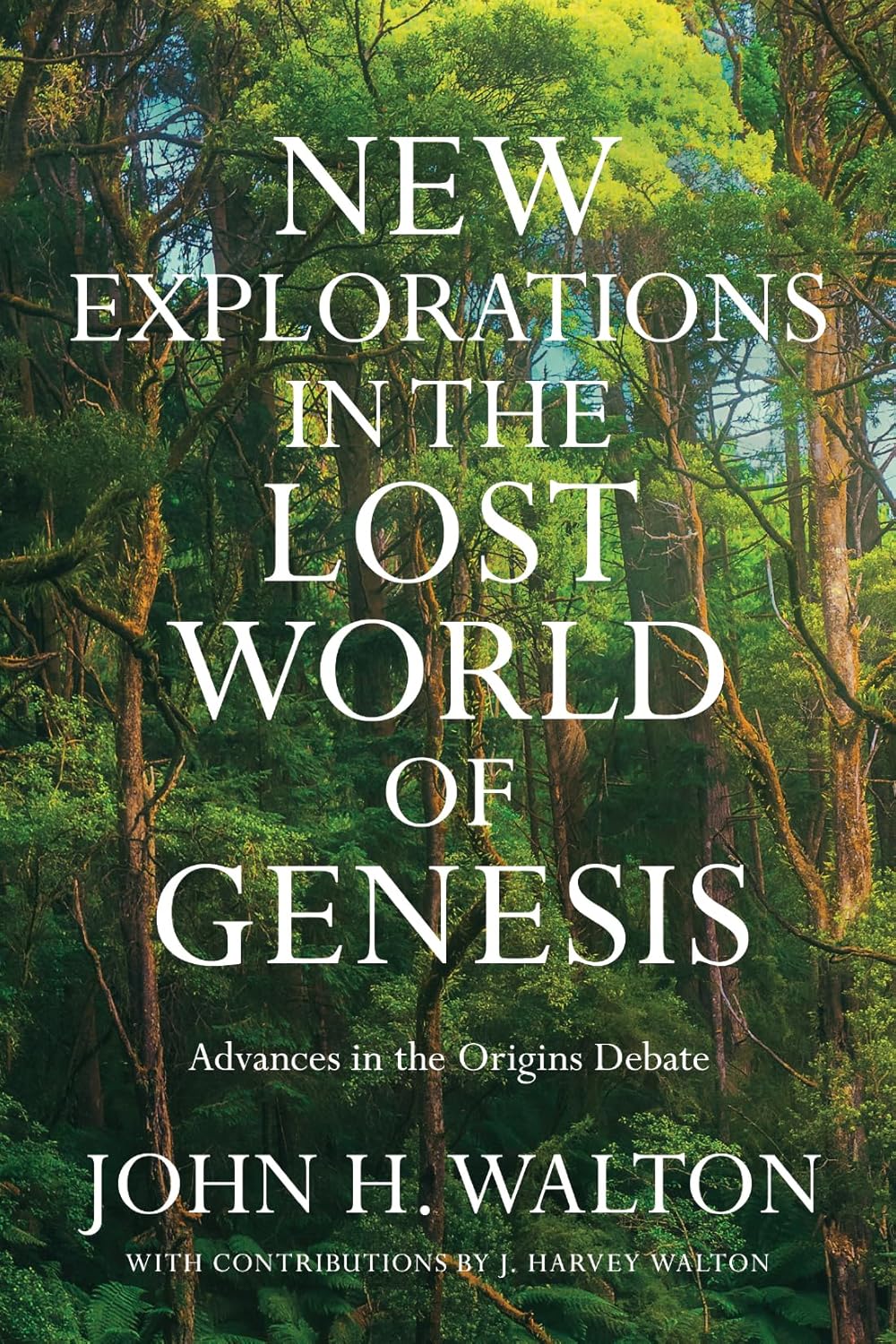
For over a decade, John Walton’s books The Lost World of Genesis One and The Lost World of Adam and Eve have shaped readers’ understanding of the ancient Near Eastern world and its implications for modern scientific origins debates. But more than simply engaging the creation/evolution debate, these works explored questions related to interpretation of Genesis through ancient eyes, the theological purpose of a seven-day creation account, the historicity of Adam and Eve, and the history of interpretation of the creative narratives.
John H. Walton’s New Explorations in the Lost World of Genesis: Advances in the Origins Debate, written in collaboration with his son, J. Harvey Walton, serves as both a synthesis and a maturation of arguments Walton has put forth for more than a decade. This book revisits familiar claims from Walton’s Lost World series while responding to critics, clarifying misunderstandings, and extending his discussion into areas that continue to generate theological ripples and debate. Walton’s guiding conviction remains consistent: “Scripture has been written for us but was not written to us.” As such, Walton continues to posit that faithful interpretation of Scripture requires disciplined attention to the cultural, literary, and cognitive world of the ancient Near East.
Walton structures New Explorations in a way that allows readers unfamiliar with his earlier work to grasp his prior positions while still being able to follow the progression of his arguments as he develops new ideas and responds to questions and criticisms of his reasoning. Each chapter begins with a summary of earlier material, followed by Walton’s “new explorations.” In some cases, these developments are modest – though potentially paradigm-shifting for Walton – while in others they represent more significant revisions or expansions. Each chapter concludes with an extended section addressing frequently asked questions, functioning as Walton’s response to common objections raised against his earlier interpretations. It is also worth noting that despite the book’s title, New Explorations in the Lost World of Genesis, Walton limits his focus almost entirely to Genesis 1–3.
Central to Walton’s approach is the conviction that proper interpretation of Scripture requires understanding the “cultural river” in which the text was originally written and received. Walton articulates that we need to read the Bible as its human authors intended it to be read. He insists, “If you would like to go beyond a superficial summary of the Old Testament and understand it in all its fullness, the material from the ancient Near East is essential” (30). Modern readers, he notes, are in a completely different “cultural river” and are “… outsiders trying to penetrate an insider-to-insider communication” (33), risking misinterpretation without ancient Near East insights. Walton argues, “The Bible is not sufficient in and of itself to bring understanding of those cultural issues that can be necessary for sound interpretation” (45) and that “We are constrained to read this way because the quality of authority we attach to the Bible depends on it. We cannot feel free to use the Bible to pursue our own questions or agendas” (56).
Walton acknowledges in the introduction of this book that this approach can appear elitist. A lingering difficulty in Walton’s approach is that it can appear to suggest that Scripture, even as interpreted by Paul in Romans, remained fundamentally misread for thousands of years until modern access to ancient Near Eastern cultural information clarified its true meaning. Walton’s tone does not convey this as such, but the implication is that much of the church’s interpretation of Genesis (and the subsequent theological implications, therefore) is incorrect. Yet, he acknowledges historical interpretations’ persistence, observing that “… many of those interpretations of the past continue to find support in the church today because they have enjoyed some level of consensus for so long” (59). Nonetheless, Walton recognizes that the history of interpretation reflects an ongoing balance: “The interconnection between tradition and continuity has always been balanced in the church with new insight and innovation” (69).
Much of Walton’s focus in New Explorations is on defining what Genesis 1–3 affirms and what it does not address, emphasizing that the text is silent on many issues modern readers often expect it to resolve. It is this boundary-setting, rather than any single conclusion, that is most likely to generate controversy or confusion, particularly when readers approach the text from differing theological and interpretive assumptions. According to Walton, Genesis 1–3 presents a narrative in which God establishes order from a state of nonorder. Adam, understood as an archetype representing agrarian humanity, and Eve, representing communal humanity, serve as wardens in the Garden of Eden, which Walton situates within the divine realm. The serpent, a chaos creature not associated whatsoever with Satan, leads to the archetypal Adam and Eve becoming godlike and trying to establish their own order. As such, humanity is barred from the Tree of Life and exists in the consequences of trying to establish order that differs from God’s order.
Conversely, Walton argues that Genesis 1–3 does not address a wide range of questions frequently imposed upon it. He contends that the text says nothing about material creation and asserts that the peoples of the ancient Near East showed little interest in material origination (110). Genesis does not describe the physical mechanisms of creation, biological origins of humans, or the historicity or individuality of Adam and Eve. It does not portray creation as a state of perfection, nor does it affirm human immortality. Genesis 2 does not depict a desirable condition for humanity (143), nor does Genesis 3 articulate original sin, punishment, or the Fall in the traditional sense. According to Walton, Genesis 3 is not about sin or the Fall at all. The text does not establish gender roles, describe Sabbath rest, or explicitly present the familiar creation–fall–redemption–restoration metanarrative. In Walton’s estimation, many longstanding theological conclusions drawn from Genesis 1–3 are unwarranted because the text simply does not speak to them. Only by recognizing the contours of the ancient Near Eastern “cultural river,” alongside the biblical text itself, can this be properly discerned. In short, Walton concludes that generations of biblical scholars and theologians have asked more of Genesis 1–3 than the text was ever intended to give.
Ultimately, Walton presses readers toward a single hermeneutical imperative: read the Bible as its human authors intended it to be read. “Genesis is what Genesis is, regardless of the scientific theories that dominate the discussions” (230) — and, by implication, regardless of later theological frameworks or interpretive debates. This is no easy task. Yet Walton recognizes that interpreters “stand on the shoulders of giants,” dependent on tradition while also responsible to see what earlier readers could not. Faithful interpretation, therefore, requires both attentiveness and openness. In this spirit, Walton’s approach resonates with Michael Graves:
“The toleration and even appreciation of diverse readings of Scripture provide ample opportunity for Christians to show each other love and humility. To tolerate other interpretations does not mean to agree with them, and toleration does not imply that there is no correct answer. Seeking to understand how others read Scripture demonstrates humility because we recognize that we are not infallible. Since our own knowledge is imperfect, we must be teachable in order to reach the truth. Furthermore, genuinely listening to the opinions of others shows that we love them. If we want others to listen to us, then we should listen to others.” The Inspiration and Interpretation of Scripture

3 Responses
Excellent review! These sentences alone: “According to Walton, Genesis 3 is not about sin or the Fall at all. The text does not establish gender roles, describe Sabbath rest, or explicitly present the familiar creation–fall–redemption–restoration metanarrative.” entices me to read this book. Thank you!
Wow. Especially the paragraph listing matters that Genesis 1-3 does not address is so important for so many theological discussions right now. Saying that Genesis 1 does not teach a pre-fall perfect creation is mind-bending and paradigm-shattering for many of us who just assume a pristine creation when we say “Creation-fall-redemption.” This is an ongoing discussion we need to have . . . and a discussion that John Schneider and Dan Harlow started years ago. Thanks, John and Dan.
Last paragraph speaks volumes, beyond discussion of the book, about reading/interpreting/applying scripture and also about relationships among the Body.