
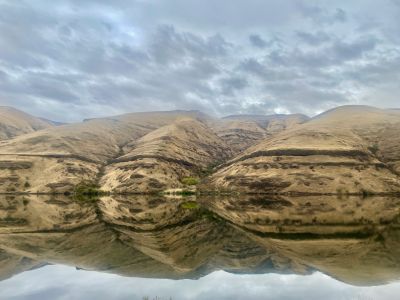
I live in Oregon, widely recognized as a “blue state,” with a majority of progressive-leaning voters who care about environmental matters. The Snake River forms the northeastern border of Oregon, with Idaho on the other side. Idaho is commonly regarded as a conservative-leaning “red state,” and conservatives are often tagged as being less-interested in creation-care.
But I’d like to think that even though the two states have different laws and perspectives about the environment, they could still build bridges toward caring for the Snake River together. Even more, I’d like to think that both conservative and progressive Christians can work together in caring for all of creation.
I have this hope because my biology-teaching father was a conservative Christian who also cared deeply about the environment. Those who knew him could tell you stories of going on hikes with him as he explained how God created the world to work together, and how we’re part of that eco-system. I have a vivid adolescent memory of accompanying him on the first Earth Day in 1970 to clean junk out of the once-neglected falls in Sioux Falls, South Dakota. It was the same year my faith in Jesus came alive. In my mind, love for Jesus and love for his creation went hand-in-hand.
But perhaps many readers of the Reformed Journal are skeptical of my hope. You have tried to talk to your conservative Christian friends about climate change or protecting endangered species or whether and to what extent human behavior is hurting creation…only to be met with scoffing. It can be maddening.
In conversing with resistant conservative Christians, it probably won’t work to start with details about polar icecaps, the fate of some endangered salamander, or a timeline of how quickly things are deteriorating. Until they believe caring for the environment is part of our calling as followers of Jesus, then no amount of data or research will move them. So, to me, the place to begin is whether or not these matters should be of concern to Christians at all.
So let’s consider some conservative Christian presuppositions that are often twisted in a way that causes them to be indifferent or hostile to environmental matters. A blog last fall by Deb Rienstra wisely named some of these unfortunately-twisted presuppositions. For instance, an anthropocentric attitude can make Christians feel as if other elements of creation (like tigers, tiger lilies, and the Tigris River) don’t matter much. An individualistic perspective often causes us to only consider whether our house or community has clean water, thereby ignoring the water needs of other people (or later generations). Or take dualism—why bother with physical things when what really matters is the spiritual issues of being right with God? Then again, we might be so opposed to pantheism that we want to stay as far as possible from anything that smacks of worshiping creation.
And here’s two more presuppositions that Rienstra did not mention. (1) Some eschatological viewpoints cause Christians to shrug off environmental problems because it’s all going to be destroyed when Jesus returns anyway. (2) Some perspectives on what it means to trust God lead some to deny that there’s even a problem. Since God’s in control, they say, there is no crisis (like global warming), and thus no need to listen to those alarmist environmentalists crying wolf.
One could argue that these conservative presuppositions are to blame for this lack of environmental concern. But if we do that, then the only way forward is to try to get conservatives to think like progressives. I’m not sure that will help much. While it’s sometimes possible to argue another person into changing their presuppositions about life and faith, that only happens rarely. More often, everyone digs in their heels and talks past each other. But in the meantime, no bridge gets built.
So with the hope of building a bridge, I’ve tried to look at this in another way. I asked myself, what it would look like for conservatives to keep their conservative presuppositions about creation-care, but untwist them? Is it possible to build an environmentally-friendly bridge based upon conservative presuppositions (like anthropocentrism, individualism, dualism, etc.)? So, as a thought experiment, I want to invite the readers of the Reformed Journal (at least temporarily for the sake of this experiment) to refrain from criticizing those conservative presuppositions and instead use them to make a case for creation-care. For some of us this will be easy, because we already think along these lines, but for others of us it may be a stretch—everything in us might be saying, “No, no, no, that’s the wrong way to look at it.” But give it a try.

Anthropocentrism. Let’s suppose that God’s relationship with humanity actually is the primary reason God created the world, and that we are the crown of creation, the kings and queens whom God appointed to rule over the world. One of the chief elements of being made in God’s image is that he calls us to have dominion over creation (Genesis 1:26-28). If we have dominion, then our instinct should be to take care of the place that God has given us to rule, instead of ruining it. But since we no longer live in Eden, we have to be very aware that sin has corrupted us, the very ones who have been charged with ruling the world. As Jesus pointed out, sin causes leaders to rule over others in an abusive way, but it’s not to be that way among us (Matthew 20:25-27). So if we want to be great in the kingdom of God (which includes the entire universe), then, instead of serving ourselves, we must serve other people and all of creation.
Individualism. One of the great things about the gospel is that we’re not a nameless unit in an anonymous aggregate of humanity. Jesus knows and loves each of us by name. To each of us individually, Jesus gives acceptance, security, and a purpose for living. And the Lord gives all this individual attention to each of us, not so we’d grow to be self-centered brats, but so that we could bless others, who are also deeply loved by God individually. This extends to our family, church, workplace, community and even to creation itself. He calls us as individuals to join him in paying attention to the other individuals around us, even the individual elements of creation. That last point might seem odd, but Jesus told us that God’s eye is on the sparrows, which is how we know his eye is on us too (Luke 12:6-7). God has uniquely situated us as individuals to join him in caring for creation.
Dualism. It’s pretty common for Christians to distinguish between what’s physical and what’s spiritual. Some want to erase the distinction, while others want to create a hard wall between them. But however we make a distinction between the physical and the spiritual, they are always supposed to be interacting with each other. What we do with our bodies affects how we relate to God on a spiritual level, and vice versa. God calls us to take care of both physical matters (like feeding the hungry and caring for creation) and spiritual matters (like proclaiming the gospel and worshiping). For ourselves, we might prioritize one over the other, and even boast that our prioritizing is better, but the truth is, God wants us dealing with both.
One verse that might make us think that we should underemphasize the physical would be Colossians 3:2: “Set your minds on things that are above, not on things that are on earth.” That verse could sound like we should ignore physical things (like creation-care) and focus on winning souls. But the phrase “things that are on earth” does not refer to physical matter, because if it did, we’d have to stop eating, sleeping, paying bills, procreating, and more. The context suggests something else, for in verse 5 Paul defines what he means by what’s “earthly”: fornication, impurity, passion, evil desire, and greed (which is idolatry). And a few verses later he adds some more “earthly” things: anger, wrath, malice, slander, abusive language, and lying. As embodied spirits, we’re supposed to pay attention to the earth (after all, God does), but not with the sinful “earthly” attitudes listed by Paul. That has many implications, and one of them is that we are not following God when idolatrous greed causes us to abuse God’s creation.
Fear of Pantheism. The urge to worship creation has long tempted fallen humanity (Romans 1:25). Most of us have become sophisticated enough to refrain from bowing down to rocks or trees, but it’s still tempting for people to think of creation as so wonderful that it’s divine (which is what pantheism is). We rightly contend that for us to worship creation would be like a husband falling in love with the book his wife wrote, all the while ignoring her. The book is a wonderful expression of his wife’s wisdom, talent, and love, but the wife herself is more important than the book. But the opposite dynamic would also be a problem. What would we think of a husband who said he loved his wife, but he either ignored his wife’s novel or ripped it up and tossed it in the trash? We’d wonder if his love was real. God also wonders if our love is real when we ignore or mistreat God’s created handiwork. We dare not love creation more than the Creator, but neither should we mistreat what God has so wonderfully made.
Eschatology. One day Jesus will return and we will rejoice to live with the Lord in a new heaven and new earth. Although there are different ways to describe this coming newness, some verses (like 2 Peter 3:10) imply that this current world will melt away, destroyed by fire. This verse might make us think, “Why bother taking care of this planet if it’s all going to go up in flames?” But one thing we should remember about the return of Jesus is that it will be a Judgment Day. On that day, we all have to answer to the Lord for how we dealt with the things entrusted to us, like our families, the gospel, and God’s created world. Jesus told us parables about this. In one parable he rebuked a servant who did nothing with what the master had entrusted to him (Matthew 25:14-30). In another he punished a servant who mistreated fellow servants and wasted the master’s resources (Luke 12:41-46). Our salvation may not depend on how well we did, but please note that the unfaithful servants in Jesus’ parables were severely rebuked. If we are abusing people made in God’s image and ruining a world made through God’s wisdom, then perhaps the Lord would say to us, “Alas for you who desire the day of the LORD! Why do you want the day of the LORD?” (Amos 5:18). If we can’t even appreciate or care for the current earth and its inhabitants, why would we want a new heaven and earth, and why would we expect God to give it to us? Salvation is by grace, and grace sets us free to do the Master’s will.
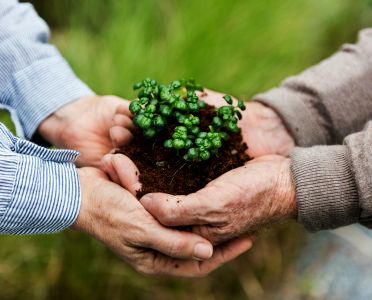
Trusting God. Let’s say that the environmental alarmists are wrong and that the environment is actually in good shape and in good hands—God’s good hands. Even then, we still have reason to take care of the environment. If my car is running well, I don’t say, “Things are going so well with my vehicle that I don’t think I need to change the oil next year.” If I’m in good health, I don’t say, “You know God has made my body work so wonderfully well that next year I’m going to switch my diet to all junk food and forget about exercise.” Likewise, even if the environment is going well, we still want to do our part in taking care of God’s creation. Why should anyone wait until there is a genuine crisis to do the right thing? There may be cyclical patterns that God built into the planet that humanity will have to work around, but if there’s anything we humans are doing to stress the system, we want to make sure we change our ways. I’m not filled with anxious fear, for I trust God will work it all out, but I don’t want to forget my God-given responsibilities in all this either.
—
Okay, enough of that thought experiment. I hope it’s been helpful. My aim is not to argue for or against these conservative presuppositions, nor to persuade anyone to adopt them. Rather, I want show that it might be possible for progressive and conservative Christians to at least agree that we need to take care of God’s creation, even if we come at this calling from some very different foundational presuppositions. We will likely not find unanimity on how to tackle every specific issue, but we have to set our face like flint in finding common ground in living on this common ground called Earth.
