
Part of a Sunday series on Sunday evening worship.
Memories, bane, and blessings.
For the vast majority of my life I’ve been a oncer. Happily so. Sunday worship was mornings only.
As a oncer, I wasn’t privy to the rather smug, insider adage. “Oncers become noncers.” I’m glad to say, I’m counterevidence.
While I haven’t been especially appreciative of the claim that “oncers become nonecers,” I have always had a chuckle at Jim Bratt’s somewhat adjacent observation that the prime social/cultural role of the Reformed Church in America has been to serve as a bridge from an ethnic enclave to mainstream America, a generational process that typically moves from Christian Reformed to Reformed to Episcopalian to jogger. Yet, as Jim wryly notes, “some overachievers are able to accomplish the entire process in a single lifetime.”

In my earliest years, I did attend evening worship — though my memories are hazy. This was the far south suburbs of Chicago in the early 1960s. My dad was the pastor. I can see shiny chrome fans, towering on either side of the chancel, whirring, trying in vain to cool us off on hot summer evenings. I recall waking up on a crimson, velvet pew cushion in an empty sanctuary. The service was over. From Fellowship Hall came the low buzz of conversation. I toddled down to join the festivities where we got to drink 7-Up from little glass bottles!
How was it — it seems amazing — that even as very young children, my sisters and I could sense there was something different going on, a warmth, a camaraderie, in this service? Not strict. Not stuffy. We sang more. But we could never figure out why we needed a man waving his arms and keeping track of the hymn verses with his fingers in order to sing in the evenings. In the morning, we seemed to sing fine without him. Conjecturing what he would do if a hymn ever had 11 verses would make us snort and howl with laughter.
A few years later, we landed in secular, outdoorsy, suburban Seattle. Here, even in the 60s and 70s, you counted yourself fortunate if people attended worship twice a month. The notion of an evening service seemed like trying to make water run uphill. Nonetheless, for the first couple of years my parents hung on to their Midwestern scruples. On Sunday evenings our family ventured out to the rare church that held services. Two churches, two sets of memories, stand out.
Harvest Time Gospel Church was a Pentecostal congregation — one suburb over and one economic class down from home. My parents, while firmly Reformed, were also “charismatics” and relished opportunities for this more spontaneous, emotive worship. Plus, rather than lead, they could simply participate.
I noticed the casual clothing, the people rougher around the edges. I remember nothing of the preaching, nor any “Pentecostal gifts.” But I do remember the music. We joked that the organist had a side-gig at the roller rink. She would literally bounce up and down the bench playing simple, upbeat music. I can still sing many of the songs. Often they were direct quotes from Scripture.
With 50 years of hindsight, I now see that I was witnessing the genesis of what would become “contemporary worship.” Praise bands hadn’t yet replaced organs. But the come as you are, stand, sway, and raise your arms, a free and entertaining atmosphere, it was all there.
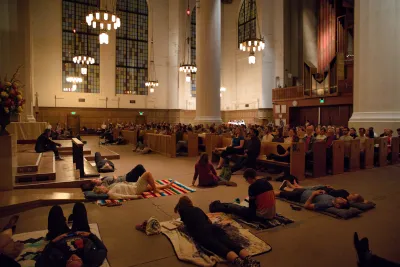
Other Sunday evenings took us to the opposite end of the spectrum. We’d head into Seattle for Compline at St. Mark’s Episcopal Cathedral. In the decades since, Compline at St. Mark’s has become a cultural phenomenon, a place to be seen. But even in my day, I remember university students sprawling and sitting on the floor.
As a nine-year-old, I was a little less enamored by the hushed, monastic ambiance. A men’s choir would file in solemnly and chant the end-of-day service. While they chanted, I would use my newly acquired multiplication skills to calculate how many window panes were in the massive structure. Counting light bulbs in the chandeliers was another reliable time-passer. When everyone suddenly stood for the chanting of the Creed, it was always a hopeful sign that we were nearing the end.
I sense, now, that something good and significant was seeping into me at both Harvest Time and St. Mark’s. Both were foreign to my Sunday morning experience. But more than 50 years later, I still carry appreciation for what I encountered at these places.
I’m grateful for my parents’ eclectic choices. At some point, they must have given up on finding evening worship. Or perhaps we kids raised too much resistance as we grew?
Here’s the thing, though. Now, in retirement, I’ve become a twicer.
Sophie and I are regulars at a Wednesday noon Eucharist. It’s a small gathering, four to ten in attendance. I’ve said before, only half-jokingly, that partaking of the Lord’s Supper seems to give me the grace to be somewhat more Christ-like for around the next 48 hours or so. Between Sunday and again Wednesday, that covers a good portion of the week.
Oncers don’t always become noncers. Sometimes, late in life, we even become twicers.

2 Responses
St.Marks in Seattle. Beautiful evensong service. Beautiful church on a hill overlooking the city.
I appreciated your comment about “enjoying” the evening service. For many years, when I was a girls’ club leader, a youth group leader, a pianist, a worship committee member, there were few Sunday mornings when I wasn’t involved in the service somewhere. It came to the point where I dreaded Sunday mornings because they required getting to church an hour early to practice something and then staying afterwards to practice something else. But the evening service! Usually, I could sit back, relax, take it in, not having any responsibility to provide anything. It was truly a blessing.