
Some mornings, before going out, I ask, “Alexa, what’s the temperature outside?” Her answer helps me know what to wear. The other day, on a whim, I asked, “Alexa, how do I look?” After politely reminding me to turn on the camera, she said, “Just a second.” Then, as I posed, she responded, “You’re still sporting that green shirt and glasses. Still looking as good as ever.”
Unmoved, I turned off the camera. “She” is an “it,” after all, however much its creators want us to think otherwise. Admittedly, there is a lot an it can do these days, but I’m still confident no AI Chatbot can accomplish what language in the hands of a gifted writer can.
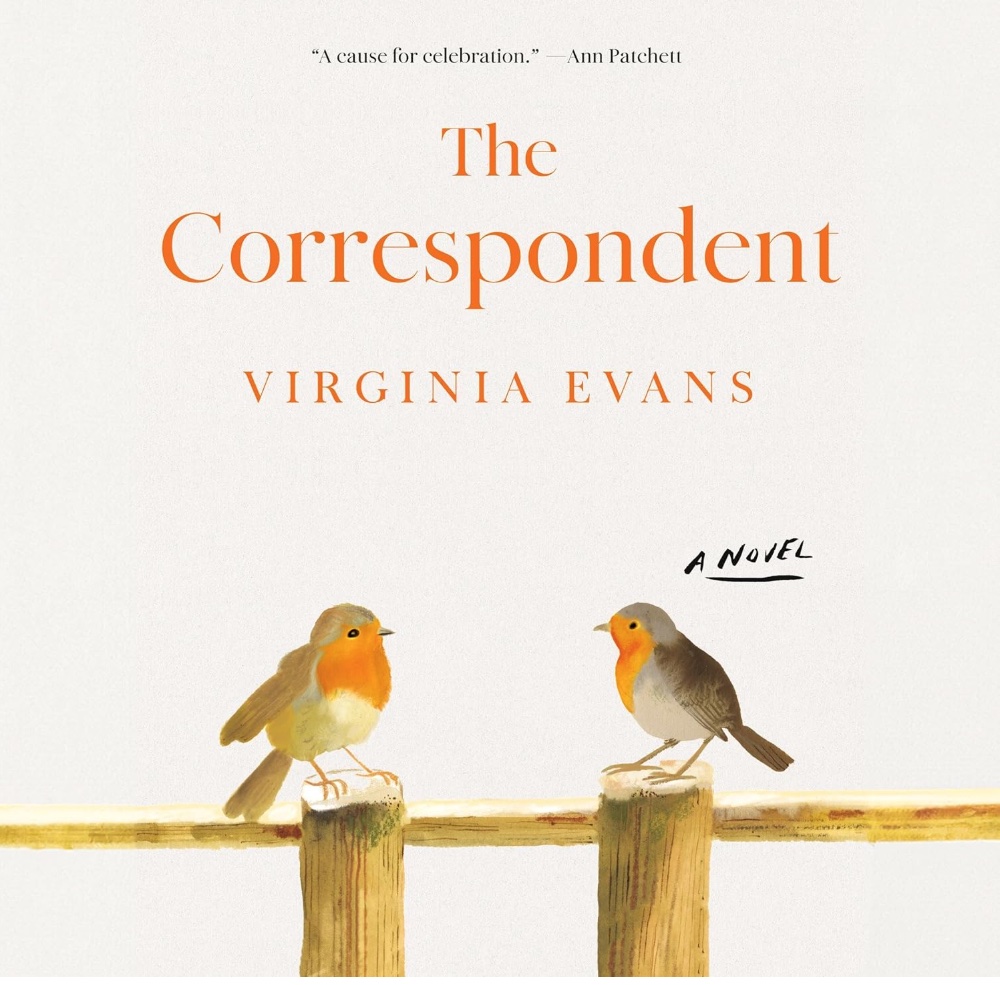
The Correspondent, by Virginia Evans, is a case in point. It’s an epistolary novel (a novel in letters) about Sybil Van Antwerp, an anachronism who still corresponds through hand-written letters to a host of friends, acquaintances, and complete strangers. Evans’ novel is at once quirky and tragic, relatable and mysterious, carefully crafted and full of wonderful plot surprises. However, what happens because of Sybil’s correspondence is truly remarkable: souls are healed.
This is the first novel by Virginia Evans, who is from the East Coast and holds a Master of Philosophy in Creative Writing from Trinity College, Dublin. Her acknowledgements page, something that can reveal an author’s capacity for gratitude, ends with simply, “James 1:17.” Make of that what you will, but it reinforces the fact that this novel celebrates how words that speak the truth in love have weight–the weight of commitment, the weight of incarnation.
Sybil will remind some readers of Olive Kitteridge: a smart, blunt septuagenarian who is refreshingly unguarded in her opinions. Unlike Olive, Sybil maintains a lifetime discipline–a mission, really–of writing letters with a fountain pen and special stationery from England. When she must, she exchanges emails. No matter the format, Sybil’s letters address important themes–such as family dysfunction, deep grief and loss, dementia, loneliness, unexpressed guilt, and the solace of family and friendship.
Readers who are skeptical of epistolary novels may find themselves drawn to The Correspondent. It’s hard to put down because every turn of the page carries a surprise: to whom is the next letter addressed? Who’s responding? Each letter pulls a thread that, stitched together, reveals the fabric of Sybil’s life. Is it her lifelong friend, Rosalie, who has saved boxes of their correspondence since high school? Or, Fiona, the distant daughter who, as Sybil decries, lives “HALFWAY ACROSS THE EARTH” but still has “plenty of advice to give me, not the least of which is that I ought to sell my house.” Or, Mr. Theodore Lubeck? He’s the aging, watchful widower next door, who leaves gifts of cookies and flowers at Sybil’s door, and whose letters, though brief, are full of grace and sincere offers of help to his elderly neighbor, who, for all his kindness, keeps her distance.
Or is it Basam? He’s the young father from Syria that she meets over the phone while she, an adopted daughter, inquires about the DNA testing kit her children have given her as a Christmas gift. Sybil’s deeply offended by the gift, but her curiosity compels her to go through with it; later, when she finally sends her sample in, she emails Basam, a well-educated Syrian in California, who, to make ends meet for his family, is currently working the phones at The Kindred Project. She writes, “I hope you still work here because I have decided to send in my spit to see what kind of mutt I am.” She then requests that her sample be disposed of properly, because she fears “they would take the DNA of an old woman like myself and God forbid, try to clone me.” That begins a long correspondence between them, during which Sybil tries to help her new friend, Basam, realize his calling as an engineer. Adding urgency to each letter is that she is progressively going blind, for as independent and secure as she wants her readers to believe she is, Sybil is lonely, and these letters, her lifeline.
Central to Sybil’s story is a grief that she has carried for a lifetime but has shared with no one–not even her ex-husband and children. Finally, near the end of an achingly poignant letter where she has shared the truth, she writes, “My grief has been an unbearable noise in my head for decades, and yet now, finally, I have written this letter to you and I’m surprised to find it is finally quiet.”
There are more correspondents and much more to Sybil’s story, not the least of which is what the DNA test reveals. But the beauty of this novel is that, in the end, we see the power of language to heal the human soul–Sybil’s, yes, but also others who are the recipients of her correspondence mission. So healed, we witness people gradually step out from behind their letters to enjoy flesh-and-blood relationships together.
Even a writer like Sybil, however, after a lifetime of letter writing, knows that ultimately “there’s no bottom to a person.” All serious writers over the centuries who have plumbed the human soul–Shakespeare, Austen, Berry, and now Evans–recognize this truth, which, in this age of AI and the extravagant claims of its creators, ought to both humble and comfort readers and writers.
For, as Sybil wisely concludes, “If I wrote a letter a thousand miles long it would not be able to express the universe of the human soul.”

9 Responses
Most of my books are downloaded onto my Kindle for easier transport and to relieve already overflowing book shelves, but downloading this book seems an act of sacrilege. Your review just made my book bag a bit deeper for the road trip and time in Arizona. Thank you for this introduction!
This book was so good and different and reached emotional places many books do not. Thank you for the great review. It’s a nudge to read again which this book deserves.
Thanks Mark. Excellent review of a detailed and delightful read. Sybil is a wonderful fully human character.
A great review of a wonderful, heartwarming and poignant novel.
What a terrific job of offering us the world of the work without evaluating it for us. Thank you for giving us the “feel” of her work so we can decide whether or not “it’s one for us or not.”
I just finished this book and found it very moving. For me, it showed how communication moves toward communion, when we can trust in the truth and allow it to set us free.
I loved this book. And I love your review of it, Mark. Took me right back into the pages and the heart of the story.
I just started reading the book this week and I’m captivated – but trying to read slowly and savor it.
Because I love Olive Kitteridge I’ll be reading this book.