
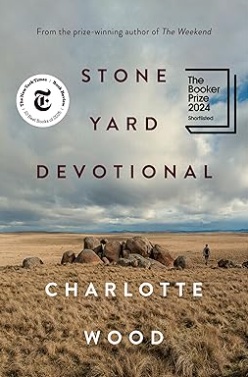
This is a novel, a work of fiction. Yet it defies neat, tidy genre classification. It sometimes seems like a memoir of a midlife woman in crisis. Or, it reveals a murder mystery. Or, it narrates an unsettling mouse infestation. Or, it sings a requiem for endangered ecosystems. Or, it offers the hope, only partially fulfilled, of a long-delayed repentance. Or, as the book’s title indicates, it is a devotional, an expression of an unusual faith.
The author, Charlotte Wood, is an Australian writer with several books to her name. This book, Stone Yard Devotional, was published in 2023 and shortlisted for the Booker Prize in 2024. Wood’s affinity to the Australian landscape is evident throughout the book. Even more, her ability to attend deeply to all the contours and particularities of life makes this book surprisingly powerful and generous in spirit.
The book is narrated in the first person by a pilgrim seeking peace. She abandons her life and her dying marriage in Sydney and enters the convent-owned guest house on the Monaro Plains, a desolate region in southern Australia. Her emotional exhaustion is so profound that at first she only sleeps and eats, and then gradually begins to enter into the worship life of the convent. She considers herself an atheist, but begins to feel the gift of the community’s life. She reports, “The silence is so thick it makes me feel wealthy.” She recognizes the awkwardness of this gift and says, “You do not announce on Facebook that you, an atheist, are leaving your job and your home and your husband to join a cloistered religious community. I mean you could, and it might be a better way than I chose, which was not to announce anything to anyone.”
The quiet, healing regularity of the convent is interrupted by three dramatic visitations that evoke the tradition of biblical visitations for readers attuned to this rubric. First, the bones of Sister Jenny arrive, a member of the order who was murdered some years before in Thailand. Her remains had only recently been discovered, and they are now returning home for her final resting place.
Second, Helen Parry arrives, a formidable nun who accompanies the bones of Sister Jenny. Her arrival arouses sudden, painful memories in our narrator. Helen Parry and she had been schoolmates as children, and Helen, a child already suffering neglect, had been cruelly bullied. The narrator had been a part of this and now feels the pang of remorse and guilt. There is no satisfying scene of repentance and forgiveness, however. Old memories and hurts remain. Only partial healing happens as Helen has “other, deeper forgivenesses to consider, or to decide against.” The complex layers of human experience defy easy formulaic solutions.
Third, there is an apocalyptic infestation of mice. This event does not come solely from Charlotte Wood’s imagination. There are periodic mouse plagues in this particular region of Australia, thanks to British ships that introduced this invasive species in the 18th century. Wood’s descriptions of the mice who invade pantries and bedrooms and granaries and hallways in the nunnery are vivid and relentless. The mice increase from two to thirteen, then to hundreds, and finally to mountains of dead mice, buried by heavy machinery in the back pasture. They migrate en masse to the piano in the parlor and run across the piano strings, producing a strange and discordant sonata in the middle of the night. The nuns fight back with brooms and shovels and traps.
The book unfolds slowly, echoing the regular pulse of the liturgical hours observed by the nuns. The story also reaches back to long-ago griefs and betrayals in the narrator’s life that gradually yield new insights and understanding, although not fully healed. Charlotte Wood’s writing is superb. She surprises the reader with precise, deft, and often humorous descriptions. Nuns “toddle” to the chapel, mice “shiver” along the corridors, vacuums “roar”, and a pelican “rows the air” as it lands on water.
It is an odd story, surely, the story of an unnamed narrator in a remote place. Not much happens, really. A box of bones, a scourge of mice, a jolt from the past. But the author’s skill is to take these fairly odd elements and craft a book of deep wisdom, insight, and recognition of the layers and complexities of human experience. Simone Weil once said, “Attention is the rarest and purest form of generosity.” This is what Wood achieves: a book of intense attention. The narrator, for example, realizes how grief is a constant undercurrent in her life when she is sweeping. Sweeping the floor is the mundane task that opens up memory and insight. She says, “As I swept, it came to me that my inability to get over my parents’ deaths has been a source of lifelong shame to me.” These are the sorts of epiphanies that regularly occur in the book, not in dramatic and climactic ways but in quiet attentiveness. The book explores the power of attention, a power that usually goes unheralded and thus often unacknowledged.
The two epigraphs at the beginning of the book aptly capture the novel’s unique beauty and weight. The first is by Nick Cave, an Australian singer/songwriter. Referring to the challenges of the COVID pandemic, he said, “I felt chastened by the world.” This comment points to the knowledge that can be won by attending to the quotidian events, patterns, and people in one’s life. The second is by American writer Elizabeth Hardwick, who said, “This is what I have decided to do with my life just now. I will do this work of transformed and even distorted memory and lead this life, the one I am leading today.” Attentiveness and care can certainly include distorted memory, but also can lead to transformation and peace. This book charts the winding path from anxious despair to a life fully felt by one woman willing to pay attention.

4 Responses
Okay, Leanne, gonna try this book.
Yes, a wonderful book. Thanks for this fabulous review.
Simone Weil wrote a little essay called “Morality and Literature” in which she takes to task our modern tendency to grant literature inordinate moral authority. She thought that most literature reinforces our self-serving fictions and only works of true genius give us “something equivalent to the actual density of the real.” I don’t know whether Weil would call STONE YARD DEVOTIONAL a work of genius, but reading it left me with a vivid sense of the infinite patience needed to get beyond our illusion of self-knowledge and our assumptions about who other people are. It’s a novel worth taking along when traveling in case one’s marooned with a bunch of people one needs to grow to love.
Ohhh. A new book for me. Thank you, Leanne