
In the picture, a black and white headshot, it’s her expression that stands out. Her lips in a taught straight line, her brow slightly wrinkled in a complex of emotions—serious, perplexed, afraid, determined. She stands in front of a wall of horizontal bamboo poles and holds a framed black slate on which her name is written in chalk, and she wears a printed outfit with puffed shoulders, maybe a dress.
The picture is my wife’s refugee picture, taken when Sy was five years old in the Ubon refugee camp, Thailand.
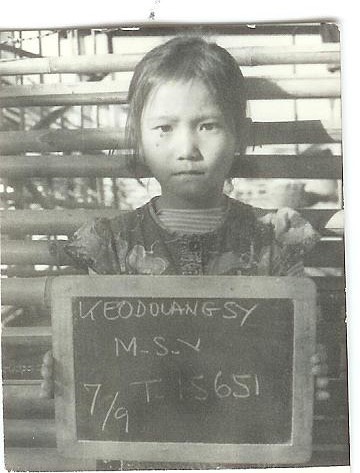
On February 5, the forty-sixth anniversary of landing in Edgerton, Minnesota, she made it her profile picture on Facebook.
I feel like I know that look. She doesn’t remember what she was feeling, but I think it could have something to do with the dress. In a refugee camp where she got into fights with boys, carried her older brother home piggyback after he got hurt, and fled terrified from phi (ghosts) and right into a scar on her knee, for someone to force her to pose in a dress for American sponsors no doubt cramped her style. “If they don’t want me for me,” that five-year-old may have instinctively thought, “maybe they don’t deserve me.”
Of course, I’m projecting, and anyway I’m not sure I should go back to the well on this picture. Over the years, it’s gotten a bit of mileage. In 2006, we sent it to Good Morning America to get Sy on a segment called “Dancing with the Moms,” a dance contest leading up to Mother’s Day. Back then, we used it to pull on America’s heartstrings. Here was a mom who had been a refugee, the picture said, truly an American Cinderella story. It worked. She got on the show, made it all the way to the finals.
But today, in 2026, it takes courage to post that picture. Today, we would not send it to Good Morning America, and I’m hesitant to write about it.
In recent days in Minnesota, though she’s been a U.S. Citizen for forty years, Sy keeps her head down. We’re hesitant to go to Minneapolis, to visit my new grandniece and to stop at our favorite banh mi place, Mi-Sant, in suburban Roseville, because of a chance run-in with ICE. She’s even hesitant to take her mom shopping to the local community of Worthington, one of the most diverse places in Minnesota, because her mom—despite also being a citizen for 40 years—speaks accented English.
So I’m surprised she posted this picture. She’s told me her strategy during this time: keep your head down; don’t offend anyone. If you do, they could report you.
They could report you.
They could report you.
They could report you.
Who’s “they”? Anyone with a grudge, who doesn’t like you or what you stand for.
What does that sound like? Where does that sound like? When does that sound like?
Nonsense, you say. She’s overreacting.
Sy doesn’t care what you say. She’s a refugee. She knows how to watch out for herself and for her loved ones. And who to trust.
But here I am, the white husband, once again making a post out of her experience, making a symbol out of her story.
I’ve made this mistake before. Once, one of mother-in-law’s friends came to visit us from Canada. In Laos, this woman had been studying medicine and was ready to take the exams to become a doctor when the Royal Lao government fell. In her new country, Canada, due to language and other barriers, she became a health care aid, what we would call a “CAN” stateside.
My dad was also visiting at the time, and to interest him in the story, I framed it in a way I knew he’d appreciate: The woman before him had sacrificed being a doctor for freedom in, well, the West.
It worked. Dad was suddenly very interested. “So you gave up being a doctor for freedom?” he asked her.
I saw Sy’s brow furrow. She was upset.
“Oh come on, what was the big deal?” I asked her later.
I had flattened the story, she said, made it simplistic and palatable for Dad, the way he wanted to see it. I had made it about “freedom” so he could somehow (did I mention she was from Canada?) feel heroic by association. The reality was so much harder, the story so much more nuanced.
I don’t want to make that mistake again. In the current political climate, I don’t want Sy’s story or her picture to be used like that.
As an example of someone who followed the rules.
As a success story, an American dream story, from refugee to homeowner and taxpayer.
As someone who played the game as it’s supposed played, as someone who just had to work doubly hard as everyone else, to be “twice as good,” but see? It could be done. Why didn’t everyone just do it this way?
I don’t, in short, want it to be used in support of current events in Minnesota. “There are so many good stories,” people will say. “It’s the bad ones that ruin everything.”
No. There was never any guarantee that Sy would get to where she’s gotten now, a successful physical therapist, former coach, and short-term Good Morning America darling.
There’s never any guarantee.
There’s only investment—investment in humanity. Sy’s story is fairly ideal in this way: a group of supporting families committed thirty years and more of their lives to supportive friendship with Sy’s family. But for her, it still meant wearing hand-me-downs and eating government cheese, getting called names while biking down the street and playing high school sports, and being failed by her first clinical supervisor and told she was a victim of her passive culture.
But even the good part of the story—deep community relationship—is not what I want to focus on in this present moment. The truth is, if Sy’s refugee camp picture were taken in 2026, I know people would read her picture in other ways:
“Communist.”
“A suck on good American taxpayers.”
“Someone from a sh*ithole country. Don’t let ‘em in.”
The truth is, we’ve eliminated the possibility that Sy’s story can happen in America today. Under the Trump administration, though the refugee vetting system was widely considered strenuous and sound, the United States admits a record low number of refugees. Today, Sy’s family would flat out not be granted asylum.
More to the point, I hear people who we used to consider friends and neighbors muttering under their social media breaths, “Good.” Or, just as poignantly, I hear people say nothing and thereby indirectly supporting the witch hunt in Minneapolis, which targets people of color and people with accents, which causes the girl in the picture to not live freely in her own country where she’s a 40-year citizen.
What bothers me about the reactions to Sy’s refugee picture is the historical amnesia of it. The Emma Lazarus poem on the Statue of Liberty, “Give me your poor, your tired, your huddled masses yearning to breathe free” applied to virtually all our ancestors. But now, we’ve allowed certain forces to stop us from reading people through their need or even their stories. Instead, we read them through their race and country of origin. Law is blind, we say proudly. I say you can keep your law if it’s blind.
Perhaps that’s where this essay needs to end, with the problems we have with seeing. “Belief, in my own case anyway,” said Flannery O’Connor, “is the engine that makes perception operate.” O’Connor means that seeing is not believing. Rather, what we believe shapes what we see. Thus, our beliefs determine what we see in the picture of a refugee girl: a charity case, a potential convert, a threat, a chance for us to be a hero, a suck on American taxpayers, a symbol.
I wanted to end that last sentence with “a human being.” But I didn’t. Because apparently it’s not that simple.
And that’s why it takes courage for Sy to post her refugee picture on Facebook. Not because it’s an eye test but because it’s a belief test, with her own person on the line. What do we—each of us individually—believe about America, about law, about refugees? And what does it cause us to see in her picture, in all the pictures of all the humans we will see today? What does what we see tell us about us?

4 Responses
Oh thank you for this. Thank you for offering it. The Pharisees asked, “Are we blind?”
Thank Sy for her courage in reminding us what we say we believe in.
My Minnesota heart breaks. There are no words….
Thank you for this deeply personal reminder that people are not symbols and assumptions equal prejudice. I wish I didn’t need it, but I do.