
I have found myself doing that very modern spiritual practice of scrolling, thumb flicking through the oracles of our day: Instagram and Facebook. I’m not even sure what I’m looking for.
Answers?
Context?
Someone to help me make sense of a world that feels loud, fractured, and unmoored?
Recently, I came across two posts that felt like a parable; two voices responding to the same world, the same pain. Both from pastors I know.
The first was from a white pastor; I’ll call him Pastor Chad. Chad is thoughtful and deeply concerned about what he sees happening in our country. He was angry. Angry at Christian nationalism. Angry at MAGA. Angry at America. So angry, he confessed he didn’t know what he believed anymore.
But as I listened, I recognized something underneath the anger, something more tender and more familiar. Grief. Bewilderment. A sense of powerlessness. The frustration of realizing that his words, which once carried weight, no longer seemed to influence people in the same way.
Then I read the comments.
Other well-meaning progressive white folks rushing in to soothe and affirm:
“I’m with you.”
“I’m your ally.”
“This is all so messed up.”
And I noticed something stirring in me. A different kind of anger. But I couldn’t yet name why.
So I kept scrolling. Surely there had to be more wisdom buried in the feed. And there was.
I came across a sermon: “Wisdom Was There When Your World Broke,” by Rev. Shomari Tate.
Pastor Shomari responds to the same world as Pastor Chad, the same chaos and grief. But instead of anger, what poured out from his lips was something else entirely. Something deeper. Something steady. Something like living water.
Early in the sermon he says, “I’m beginning with scripture, because scripture is strong enough to endure the weight of whatever we are going through.”
As I listened, an image came to mind.
We angry white Christians sound like we have lived with a faucet: immediate and reliable, but suddenly that faucet has been shut off.
But Pastor Shomari sounded like someone drawing from a deep, cool well.
A well dug by ancestors.
A well shaped by survival, suffering, scripture, and song.
A well that did not appear overnight but was there when the world broke.
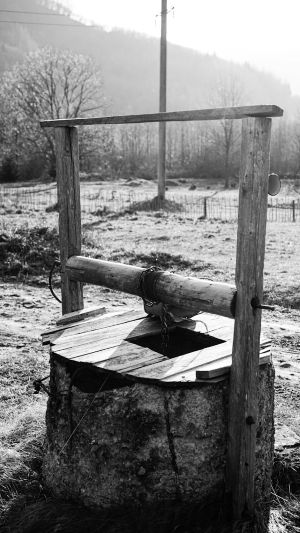
Because the water to a faucet can be shut off by others.
But a well, if it is deep enough, won’t run dry.
And suddenly I understood my anger.
Because I was witnessing two kinds of spiritual formation and only one prepares you for how to show up when your world breaks.
Make no mistake. Your world will break. And when it does, you will be prepared in one of two ways: with a well, or with a faulty faucet.
A word about anger.
Anger has had something of a reputation problem in Christian circles, especially for women. We tend to associate anger with sin. When I was younger, I was terrified of feeling angry. I would stuff it away like an impulse-buy sweater: something I liked in the store but thought looked terrible on me once I got it home.
Part of me sensed anger couldn’t really be that bad. But I never knew what to do with it once it showed up.
Over time, though, I learned how to channel it.
Because the truth is, anger is simply a feeling, not a flaw. It isn’t something to suppress; it’s something to pay attention to. A signal. A messenger.
It became a motivator for change; the thing that pushed me to have the hard conversation I might otherwise avoid.
I like the way the NRSV translates Ephesians 4:26: “Be angry, but do not sin.” Anger and behavior are not the same thing.
Once I gave myself permission to feel anger, I discovered not only liberation, but activation.
And so I return to those two Facebook posts and the anger I felt.
Why was Pastor Chad’s anger making me angry?

And more importantly, what was I going to do with it?
It goes back to that faucet and the well.
What we are witnessing in our country may not actually be a sudden worsening of our condition. It may be a revelation of how sick we have been for a very long time.
For many, especially Black people, people of color, and other marginalized communities, the fracture lines of America have never been hidden. They have lived with the discomfort, the instability, the injustice from the very beginning. Over generations they have had to cultivate spiritual resources deep enough to survive it.
But for many white, privileged people like me, this feels new.
It feels shocking.
Destabilizing.
Infuriating.
It is the experience of discovering that the faucet you trusted your whole life suddenly doesn’t work.
America right now is a bit like discovering mold in a house.
Some people have been living in mold-infested rooms for years, suffering headaches, fatigue, shortness of breath, trying to convince others that something is wrong with the house. But the people in the sunny rooms upstairs couldn’t see it, couldn’t feel it, so they didn’t believe it.
Then one day the mold spreads.
Suddenly the people who never noticed it walk in, take one breath, and say:
“Something is terribly wrong here. I can’t live like this.”
They are infuriated by the conditions and uncomfortable with their own discomfort. They behave as if their discovery is brand new, because it finally affects them.
But others have been living like this for generations.

What feels like a new crisis to some is, for others, simply confirmation of what they have always known.
And here is the deeper truth: God has been present in that house all along.
God has been faithful to communities who learned long ago that the systems around them would not protect them, communities who learned to dig wells of faith deep enough to survive suffering, injustice, and disappointment.
But here is the part that confronts me most.
Just because others have dug deep wells of faith does not mean the rest of us get to drink from them now that our faucets have stopped working.
Wells take time to dig.
And part of what I am witnessing right now, among privileged people encountering communal discomfort, perhaps for the first time, is a desperate desire to escape that discomfort as quickly as possible.
Sometimes that impulse sends us rushing toward wells we did not dig and do not have permission to draw from.
It can look like seeking affirmation from people of color. Expecting them to stop and listen without regard for their time or emotional energy. Expecting them to lead the charge without first asking what they actually need.
I have seen this play out even within my own church, Oakland City Church.
We are a diverse congregation, racially, ethnically, and economically. Recently after a vote for elders and deacons, a newcomer raised concern because both new leaders were white men.
The question was fair. Representation matters.
But what emerged in the conversation that followed revealed something deeper.
For many of the women of color in our church, the most pressing need right now is not representation, it is rest.
They are tired.
Tired not only from carrying the weight of injustice for generations, but from the intensified pressures of this particular moment, pressures that require them to advocate, explain, and defend their own dignity again and again.
What they need most from their allies right now is not more demands on their leadership, but space to breathe.
Space to rest.
And the gift they offer when they tell us this is not small. It requires humility from the rest of us to listen well and to receive that wisdom without defensiveness.
We cannot draw from their wells in this season.
And truthfully, we never could.
That realization is where my anger lives.
Because it exposes something uncomfortable in me and in many people who look like me.
We are outraged now because the conditions are finally affecting us. We are shocked by a reality others have been naming and surviving for generations.
And yet, in our shock, we sometimes reach for the very wells we never helped dig.
Wells shaped by suffering.
Wells sustained by faith.
Wells cultivated over generations of trusting God when the systems of the world failed them.
When we failed them.
When I failed them.
That kind of water does not appear overnight.
So now the question becomes:
What am I going to do with my anger?
Because alongside the anger rising up in me, there was something else too: exhaustion and disillusionment.
Exhaustion with the shock-and-awe pace of the news cycle.
Exhaustion with trying to be a Dietrich Bonhoeffer kind of pastor, or even a Mr. Rogers, when most days I feel more like Judy from The Righteous Gemstones.
Exhaustion with a job that demands spreadsheets, interviews, and last-minute sermon rewrites when what I really want is to offer care or show up to a protest.

And then there was the disillusionment.
Does a protest even matter?
What difference does it make if I spend four hours holding a sign?
Is it even possible to talk with people who have succumbed to Christian nationalism?
Is there any grace left for people who are still learning, still growing?
Is there any grace anymore?
So what is a pastor carrying all this anger, exhaustion, and disillusionment supposed to do?
For me, the answer arrived in Lent.
But this year I abandoned my usual disciplines. No fasting. No devotionals.
Instead, I began reading.
Because if I could not simply draw from someone else’s well, then I had better grab a shovel and start digging my own.
Digging not just for knowledge, but for understanding.
Not just for understanding, but for empathy.
Because what I am learning is this:
The antidote to apathy and disillusionment is not simply self-care. It is empathy.
Self-care might help me survive the moment.
But empathy forces me to see beyond myself, to recognize the lives, histories, and struggles that existed long before I arrived here.
Empathy widens the well.
And the wider the well becomes, the harder it is to turn away.
Reading has been bringing me back to the very reason I became a pastor in the first place.
It reminds me that the call of Micah 6:8: to do justice, love kindness, and walk humbly with God has always been a lonely road.
But it is also a purposeful one.
An abundant one.
My anger is far from gone. If anything, the flame burns hotter now.
But it feels different.
Not rage for rage’s sake, but something closer to what the prophets carried: a Spirit-filled fire.
And I am beginning to see something clearly.
What we do matters.
The small things matter.
Every act of resistance matters, not only outwardly, but inwardly.
Because every time we act, we are training something within ourselves.
We are forming the kind of people we will become.
Just this past Sunday, I felt that truth in my bones.
As I stood up in worship to invite the congregation to pass the peace, the news cycle was still echoing in my mind. Violence. War. Suffering. Threats of genocide.
And yet, in that moment, we were about to pass peace.
So I said:
“Over the past few weeks our government has killed thousands. In just a moment, you and I are going to pass peace to one another. The world wants you to believe that this does not matter. But I am telling you, it does. Passing peace matters. Worship matters. Because what happens in these sanctuary walls shapes us. It changes us. It is practice for how we show up in the world. So pass Christ’s peace here in a way that changes your heart and changes the heart of the person you share it with.”
And that’s when I saw it.
I do not need to be Dietrich Bonhoeffer.
I do not need to be Mr. Rogers.
I do not need to become Judy Gemstone.
I just need to keep showing up as Beth Carroll.
The more I read.
The more I pray.
The more I learn.
The more I listen.
The more I keep showing up,
The deeper my well becomes.
And the deeper my well becomes, the more I trust that God will keep filling it.
I do not need the faucet anymore.
I never did.
I have a well.
I have a fire.
And I trust that God created me—and many other angry women like me—not to burn the world down,
but to burn as light within it.
