
Once upon a time, when I was a pastor in a church, I wrote a short song for my congregation called, “Broken Pieces.” I’ll spare you the repetition of words and phrases and give you the bones of it:
Broken pieces… held together by You.
You make something beautiful, so beautiful to see.
Broken pieces… held together by You.
You make something useful, so useful for the world.
This song is a reflection of my enneagram type’s default posture toward the past. All the pieces of our lives and histories – broken and unbroken – can and should be incorporated into our presence and calling in the world. I am a rememberer and a collector, a journaler and a recorder. A preserver. When it comes to interactive liturgical artwork, I am all about mosaics made of pottery shards and quilts made of fabric remnants. When I first learned about kintsugi – the Japanese art of repairing broken things with gold – I am sure I cried happy tears. Broken pieces put back together to make something beautiful and useful.
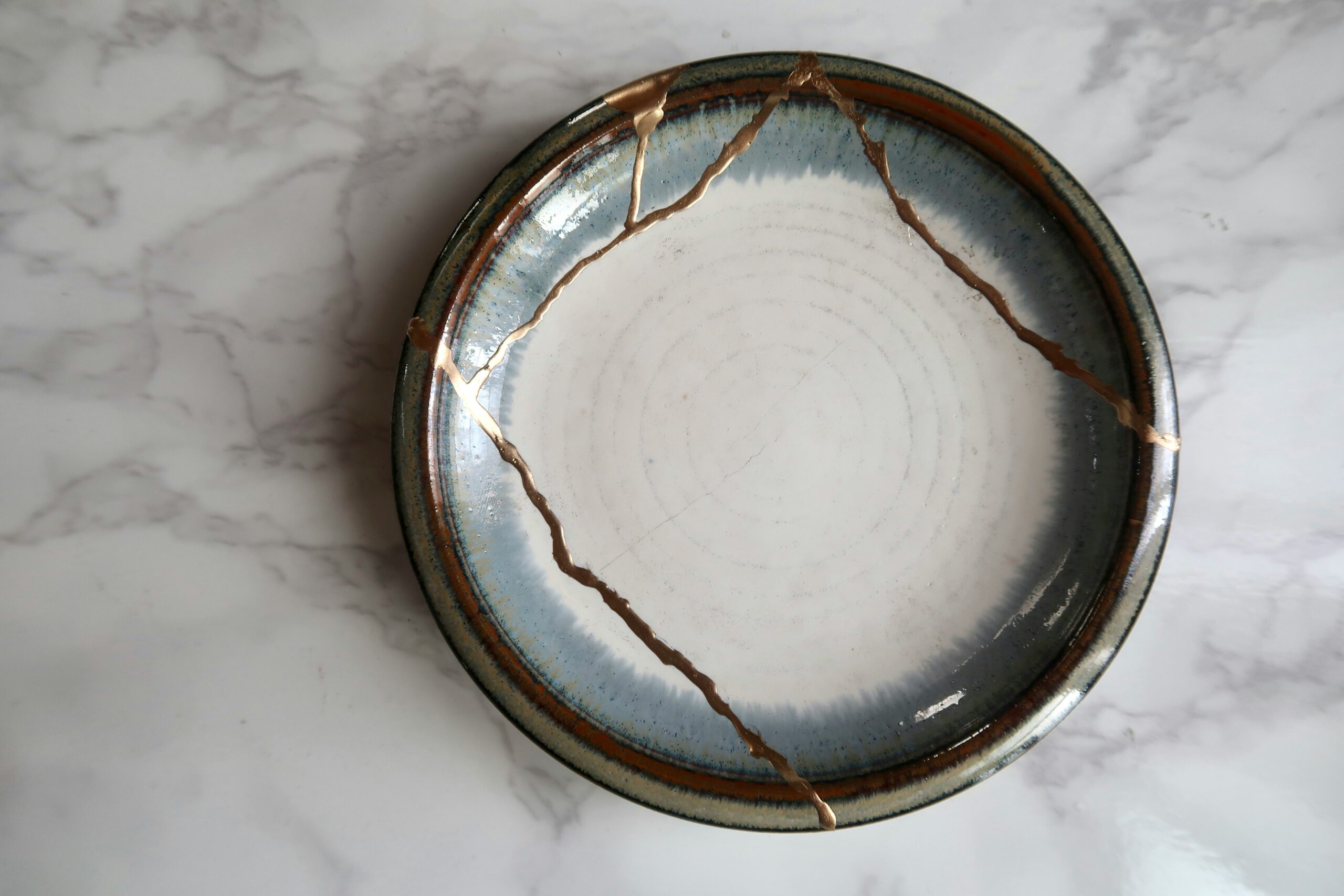
Unsurprisingly, I love the bit in Our World Belongs to God (a contemporary testimony in the Christian Reformed Church) that grieves that the church has “become a broken communion in a broken world” and marvels “that the Lord gathers the broken pieces” to do the Lord’s work.
As a university chaplain whose ministry focuses on grief support, I talk with my students about the importance of integrating their experiences of death and loss into their lives. We do not move on from our grief, we move forward with it. We gather the broken pieces.
And as a long-term care chaplain, supporting residents with Alzheimer’s and dementia, I find comfort in the God who remembers us even when we forget, who collects our tears in a bottle, and “whose mind enfolds all finite acts and offerings” (from When Memory Fades, by Mary Louise Bringle). God gathers all the pieces.
Broken pieces of our lives – when integrated by ourselves or by God into our individual stories (or into the larger story of the whole world) – form narratives of truth and goodness and beauty.
But sometimes we need to leave the broken pieces behind.
I’ve been reading some of John Roedel’s poetry and these words caught my eye recently:
Me: Hey God.
God: Hello, My love.
Me: I’m falling apart. Can you put me back together?
God: I would rather not.
Me: Why?
God: Because you aren’t a puzzle.
Me: What about all of the pieces of my life that are falling down onto the ground?
God: Let them stay there for a while. They fell off for a reason. Take some time and decide if you need any of those pieces back.
Me: You don’t understand! I’m breaking down!
God: No – you don’t understand. You are breaking through. What you are feeling are just growing pains. You are shedding the things and the people in your life that are holding you back. You aren’t falling apart. You are falling into place. Relax. Take some deep breaths and allow those things you don’t need anymore to fall off of you. Quit holding onto the pieces that don’t fit you anymore. Let them fall off. Let them go.
What I heard in these words was an invitation to stop trying to integrate all the things, all the people, all the experiences. This poem invites me to give up my addiction to spiritual, mental, and emotional hoarding. There is a time to gather broken pieces, but there is also a time to scatter them. There is a time to remember, but there is also a time to forget.
In fact, in order to remember well, we must forget some things.
Charan Ranganath writes in When We Remember:
We tend to think of memory as something that allows us to hold on to the past, when in fact, the human brain was designed to be more than simply an archive of our experiences. Forgetting isn’t a failure of memory; it’s a consequence of processes that allow our brains to prioritize information that helps us navigate and make sense of the world. We can play an active role in managing forgetting by making mindful choices in the present in order to curate a rich set of memories to take with us into the future.
Letting go of some of the broken pieces of our lives isn’t necessarily a failure to integrate. Leaving the broken pieces behind is sometimes a mindful and necessary choice to curate a life of truth, goodness, and beauty for our own flourishing and for the purpose of growing our capacity to love others according to our shape and purpose.
What are the broken pieces in your life? Which pieces are less like broken bones that need to be reset or repaired and more like the crusty dragon-skin of Eustace in The Voyage of the Dawn Treader, needing to be shed and discarded? What does your record book look like? Which record of wrongs must be developed and curated in order to pursue loving justice for the oppressed and which record of wrongs needs to be erased and forgotten for the sake of another version of love? Which old wine skins need to be exchanged for new? What do you need to let go of in order that the new creation might break through like the dawn breaking on the horizon?
“Forget the former things,” Isaiah calls out with a voice like the sunrise. “Do not dwell on the past. See, I am doing a new thing! Now it springs up; do you not perceive it” (Isaiah 43:18-19)?

7 Responses
I really loved this blog. Thank you for the reminder to let the broken pieces lie for awhile. And that there is a time to gather and a time to scatter. What good advise.
This is such a meaningful way to frame deep change in our lives. And hopeful. And freeing. Thanks for the permission to just let go of some broken pieces. It’s hard for me to imagine the new thing God might be doing as American democracy cracks and crumbles before our eyes. Thanks for reminding me God is doing a new thing there too!
I’m trusting God here, too, D.Kelderman. Hard work.
So beautiful. So true. Thank you.
This was great! I too like to remember the past and integrate it into my life today. And since my past has been relatively pain-free, the past for me has mostly been something to celebrate. But your piece helped me see that it’s not some painful broken pieces we may need to lay down to follow Jesus, but also good whole pieces. I note that when Paul talked about leaving the past behind in Philippians 3, it was mostly good things — his heritage and his moral track record – that he was learning to count as loss. So thanks.
Ah, this spoke to me, Heidi. I remember you asking me during a discussion time recently what my kairos moment was, and I said knowing it was time to delete a particular file as a symbolic letting-go of my rumination on a broken friendship — one of my most life-altering experiences. What’s interesting too is that not long ago the husband of this former friend posted that same Roedel poem on FB and tagged his wife in it. And to be honest, I took it personally — and not well! I thought, “I am not a piece dropping off this person! I am not something that was holding her back and needed to be shed!”
But after I got over that initial reaction, and again upon reading your article, I realized it’s true, we all have to go through this process. Those questions you ask in the second-last paragraph are challenging and necessary. Thank you for writing this; it really resonated.
My spouse will be the first to tell you about my hoarding/holding on tendencies; I think my conscious brain does something similar, holding out hope that things might be surprisingly useful for something else in the future. In reality, we’re often trying to walk into walk into a place with our hands and arms impossibly full, not yet coming to terms with how some of those things are not needed for the new place or the next step, and that it’s ok to have arm and hand open to what we need or what we might be able to do now that we’re not clutching ALL the old stuff.
Now I know what therapy will be about for a few weeks!