
Editors Note: This is the first of three responses to Roger Nelson’s post yesterday on adult children and faith.
A number of years ago I had a significant conversation with my son Tom. He, his wife, Sophie, and their twin sons live in Gatineau, Quebec. Tom teaches history at the University of Ottawa and Sophie is a member of the Canadian Parliament. Every Christmas season, they make the long trek to Holland, Michigan, and for many years we would attend the midnight Christmas Eve service at Hope Church that culminates with partaking of the Lord’s Supper. The whole service is a celebration of the mystery of the incarnation, the Spirit infusing the womb of Mary and infusing the bread and wine to be the body and blood of Christ.

One year, Tom pulled me aside after the service and said that he would not be joining me in worship anymore. He explained that when he heard the words: Send your Holy Spirit, we pray, that the bread which we break and the cup which we bless may be to us the body and blood of Christ, he realized that they represented an ancient world view that he no longer shared. The belief that there were moments in which the spiritual and material worlds coalesced no longer made sense to him, and the ritual had lost all meaning.
I walked away from our conversation with a welter of thoughts and feelings. I was proud that he had the integrity to live his deepest values and express them to me, even when it might have cost him something in his relationship with me and others. I knew he was committed to striving for peace and justice in society and the created order, values that he had absorbed growing up in the church, but I was unsettled that he no longer found these values fortified by participation in the life of the church. I was concerned that he had made his peace with a disenchanted world, a world closed in on itself, one that Matthew Arnold once hauntingly described as having “neither joy, nor love, nor light, nor certitude, nor peace, nor help for pain” (Dover Beach).
Tom is not the only one leaving church. I have many friends and family who grew up within the circle of the Reformed faith and have now moved to the periphery and beyond. I find that a few are departing the church because they have experienced some form of spiritual abuse, but most are departing because they no longer experience worship as a source of life-enhancing power, and, therefore, no longer find the church compelling or necessary. The number of people leaving American churches of all denominations is growing. Looking back on the half-century,1975-2025, historians will be tempted to contrast it with the Great Awakening and label it something like the Great Departing.

None of this is new or surprising. The disenchantment of the material world has been ongoing in the West for hundreds of years and seems to gain momentum with every advance in the sciences. In the light of these advances, believers increasingly struggle to explain how God is present in the unfolding of the cosmos and to imagine how all things end well. One witness to this spiritual struggle who has influenced me is Leo Tolstoy.
Having become disillusioned in mid-life despite his fame and fortune, Tolstoy began to question his faith and contemplate suicide. In his short book, A Confession, he told the story of how he lost his faith and found it again. Early in the book, he recounted an encounter with a man he called S. because it gave expression to his own disenchantment:
A certain intelligent and honest man named S. once told me the story of how he ceased to be a believer. At the age of twenty-six, while taking shelter for the night during a hunting trip, he knelt to pray in the evening, as had been his custom since childhood. His older brother, who had accompanied him on the trip, was lying down on some straw and watching him. When S. had finished and was getting ready to lie down, his brother said to him, “So you still do that.” And they said nothing more to each other.
From that day S. gave up praying and going to church. And for thirty years he has not prayed, he has not taken holy communion, and he has not gone to church. Not because he shared his brother’s convictions and went along with them; nor was it because he had decided on something or other in his own soul. It was simply that the remark his brother had made was like the nudge of a finger against a wall that was about to fall over from its own weight. His brother’s remark showed him that the place where he thought faith to be had long since been empty; subsequently the words he spoke, the signs of the cross he made, and the bowing of his head in prayer were in essence completely meaningless actions. Once having admitted the meaninglessness of these gestures, he could no longer continue them.
Disenchantment is not just a topic we can discuss and debate; it is a power that shapes our lives, taking up residence in heads and hearts and influencing our thoughts and actions. It affects our families and all our relationships.
I was not sure what to say to Tom on that Christmas Eve years ago and am not sure now what to say in response. Disenchantment is a power that has shaped me as well. I struggle to see how God is present in the bread and wine, and I wonder in the midst of our failing politico-economic system and the pending environmental collapse how all things work together for good. Yet, I continue to walk to the table and partake of the elements. Why? How do I explain it to Tom and to the rest of my disenchanted family and friends?
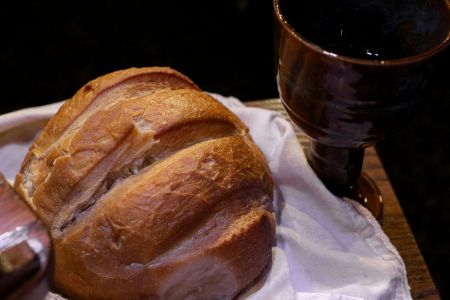
Among the hallmarks of the faith that we in the Reformed tradition have emphasized, an important one is missing, at least important to me. God is holy and good, but God is pre-eminently invitational. God says, Come! I have set a table before you (Psalm 23). Taste and see that I am good (Psalm 34).
Jesus says, Follow me! You may not, indeed cannot, fully understand where I am going, but trust that I am leading you to a world that is fuller, deeper, and richer that you have imagined it to be. Follow me for I am a door that opens to a pathway that will take you further up and further in, a pathway to a world of such sweetness that your deepest longings will be satisfied.
At root, the Christian gospel is an invitation, and Christian existence is participation. The ritual of the Lord’s Supper expresses the essence of the gospel. God says: Come for all things are now ready. The ritual invites us to see that just as Christ is present in the elements, Christ is present in the world. When we offer help to the outcasts, downtrodden, sick, and detained, the “least of these,” we commune with Jesus. When we gather as the church, despite all the Sturm und Drang of our life together, we are the body of Christ in the world. When we make peace with the created order and absorb its energetic beauty, we experience the glory of God that fills the earth.
Living in a disenchanted world among disenchanted believers, my response is to repeat the invitation: Come to the table, taste and see.

11 Responses
Could it possibly be, Tom, that your son is closer to God, based on his genuine expression and thought process, than so many regular attendees who have never yet interrogated their “faith”? Is he actually “seeking God” rather than practicing conformity or obediently adopting a cultural identity? This is not a pathway I personally recommend, but I suspect that God respects the journey and the integrity. One of yesterday’s responders suggested that this spiritual wandering (my term) was more common among “progressives.” Perhaps so, but I cannot logically conclude that conformists are any closer to God because they attend worship twice or adhere to the church’s markers. Better “churchies,” yes. Better disciples, not necessarily. Must some of the church’s coercive, threatening, and addictive habits die so the church can be reborn? Is it not an insult to God when the gospel is reduced to an eternal life insurance policy? Is this what Gen Z is telling us?
Thanks to you and to Roger (yesterday) and Debra a week ago for naming what every parent and grandparent wrestles with.
Yes, RZ, your description of faith conformity rings true to me. To paraphrase Socrates, the unexamined faith is not worth having.
Thank you. For your openness and Tolstoy’s story of S. Your essay puts a finger on questions I’ve been asking, but didn’t quite have the words for.
“At root, the Christian gospel is invitational” – what a hopeful insight – thank you, Tom.
Thank you for this, especially “Christian existence is participation”. Participation, not just in the spirituality that one can experience by reading, by praying, by immersion in the Word, but in a body of flawed believers. Each week we all gather to be reminded, through Word and sacrament, that we must see Christ in all, even those we avoid in our own congregations, as well as those we so easily demonize in this world of division. Last week we were reminded, in beautiful words, that “the feast of the cross is the appetizer for the supper of the Lamb”.
Those who have walked away from organized religion are missing the immense joy found in this foretaste of the feast that is coming. An observation, not an answer or path to follow.
Like you, I struggle with this. I cling to Jesus’ warning that “unless you become like a little child, you cannot enter the kingdom” and the consequent confidence that true faith (trust) is childlike and therefore not subject to the intellectualizing of materialists. On the other hand, I have experienced the miraculous power of Jesus in my life, so it is impossible for someone to convince me that he is not real and alive and powerful, any more than I could be convinced that the sun does not shine. For my own adult children, I pray for them to experience the power of Christ. I collect the testimonies of intellectual atheists who have been open to reconsidering their faulty assumptions about reality, concluding that the “ancient world view” is actually superior to the one that has captured so many 21st century skeptics. There are so many such converts. It’s too bad that most modern materialists do not pay any attention to their compelling reasons for coming to faith.
Two out of four sons no longer have a church family and one is married to a pastor. I share your experience. Been reading Brueggemann’s Prophetic Imagination. Helps my own disconnect with mystery, at least to the point I can keep up with Him. T
Thank you Tom. I believe I may have gone through some of those disenchantment times too, and gratefully, now in my mid-seventies an appreciation of mystery and awe have again become my everyday acquaintances. I am grateful.
I actually remember, Tom, sitting in one of your OT classes at WTS and listening to a thought that was new to me. You reminded us that primitive peoples were hardly lacking in intelligence or understanding. In fact, I began to see that they perceived things perhaps we no longer could in our post enlightenment and science informed lives.
I recently watched a Netflix documentary called “Surviving Death”. It bolstered my current understanding that there is so very much we do not know, yet can stay open to as wonderful surprises.
My father was a biology teacher who taught science (including evolution) in the public school, but also was filled with wonder at God’s creative power in the world around us. To use your terminology, he was “enchanted” by what God has done and does in the world today. His scientific child-like faith had a positive influence on my life. In addition, my early Christian years among Pentecostals (who were not name-it-and-claim-it-types) also helped me see and be “enchanted” by a God who is at work all around us. I know neither of these factors guarantees that an adult son or daughter will follow Jesus, but they were helpful to me.
No ready answers here, only one of the most thoughtful and sensitive reflections on generational challenges for the church today that I have read. Yesterday’s opening essay from Rog Nelson also. Looking forward to the ones in the pipeline.
Tom, thank you for your participation this conversation. I love your witness here to the power of disenchantment. I love your words about the table. Conversation about these ideas is so important. Thank you.