
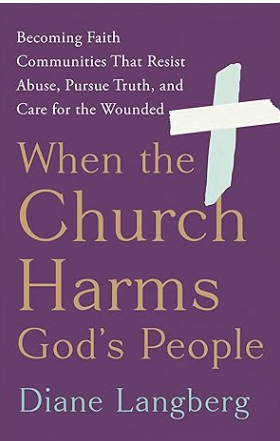
I started reading When the Church Harms God’s People over six months ago. Typically, it takes me two or three weeks to read a book from the time I open the front cover to the final page. This book, however, was one I often needed to put down and set aside, and come back to it when my head and heart could take it up again. Sadly, the book’s title is a reality that too many people, including myself, have experienced firsthand. In both my personal and pastoral life, I have experienced, witnessed, and held space with others who have been deeply hurt, traumatized, abused, and wounded by pastors, Christian leaders, and the broken systems present within many Church communities.
Diane Langberg, PhD, author of When the Church Harms God’s People, is a well-known and respected trauma scholar and psychologist. Over her 50 years of experience, she has repeatedly encountered the reality of Christian communities and the Church causing tremendous harm, abuse, and brokenness in the lives of people who initially sought out care, healing, and safety from the Church, only to be met with pastors or Christian leaders who became perpetrators of evil and brokenness instead.
In this book, Langberg uses both candor and compassion to speak directly to pastors and Christian leaders about the reality of this brokenness within themselves and within the Church. Using the helpful metaphor of sheep and wolves, Diane encourages Christian leaders to first “identify the wolf within.” Her premise is that to recognize and see clearly the wolves in the Church and within Christian communities, we first need to “tend to our own wolfish tendencies before God.” She offers a very helpful list of questions (pages 41-42) that can be used to help readers reflect on themselves and ask the necessary and challenging questions about their understanding of and relationship with power, empathy, confrontation, gender roles, stress, and their own hiddenness from God and others. The questions alone make this book a worthwhile addition to a pastor’s library.
Drawing on the work and words of Fleming Rutledge, James K.A. Smith, and Eugene Peterson, this book is grounded in both Scripture and the wisdom of thoughtful, wise pastors, theologians, and philosophers. Langberg’s words are direct, challenging, and incredibly pastoral. With a chapter dedicated to “A Message to Victims,” she offers genuine kindness, care, and encouragement to people who have suffered abuse. She follows that message in a separate chapter, titled “A Message to Shepherds,” which should be required reading for all seminarians and pastors.
I had to confront some difficult memories and experiences within my own story before I could finally reach the end of this book, but it has been a helpful and healing journey for me along the way. When the Church Harms God’s People is a necessary and important book for leaders of Christian ministries, pastors, elders, and deacons. If I were leading a Consistory, shepherding Elders, or serving on a Safe Church Team, this would be required reading as a training tool every time new members joined the team.
Please note, this book recommendation comes with a trigger warning for those who have experienced spiritual, sexual, emotional, or physical abuse in their lives. Please take care of yourself as you read this book, if you choose to do so.
Additionally, I recommend an upcoming conference in April 2026, taking place in Dallas, called Restore. It is a conference where Langberg has been a speaker in past gatherings. For more information about the conference, please visit www.restore2026.com. The invitation offered on the Restore website says this: “Join hundreds of abuse survivors, advocates, allies, and church leaders next spring for a two-day event centered on community, connection, and healing. Leading voices in clergy sexual abuse, trauma, church reform, and other vital topics will provide insight and in-depth sessions.”
In conclusion, here is a blessing that Langberg shares at the end of her book. If the Church has hurt you, may this prayer be one of peace, encouragement, and a reminder of God’s loving kindness for you, today and always.
For When You’ve Been Hurt by the Church
by Kate Bowler and Jessica Richie
God, you saw me walk away.
I had to.
For what was supposed to have been a refuge,
a community of hope, purpose,
mutual encouragement,
distorted all I understand you to be.
Oh God, lead me to the heart of love,
so I might find the healing I need,
and protect the reverence I have for you.
For you do not consume, but rather feed.
You do not destroy, but build up.
You do not abandon your little ones,
but insist that they belong in your arms.
Enfolded here, I see you now,
the God who loves us to the end.
For though I walked away, you didn’t.
You found me. And will lead me.
Let’s now find the others.

8 Responses
Thanks for your vulnerability and for sharing this resource. I have also witnessed this and experienced the reverse, where churches have caused harm to pastors and their families.
Thank you, Alicia. And I’m grieved by the reality that the Church is the wolf in some contexts and hurts pastors and their families trying to faithfully serve and care for their flock.
Thank you for reminding us of Diane Langberg, uniquely called and equipped by God into this important arena of church hurt. As someone who has attended the Restore Conference for the past 3 years it has been a place where we could seek justice and healing to address issues we have experienced from our church. Thankfully we now have a new church.
Thank you, Michelle, for writing such a meaningful and beautiful review. You have so much wisdom and great advice to suggest this book to leadership in churches.
Diane Langberg is such a good resource, thanks for bringing her wisdom into these circles. The wounds caused by abuse last so long, the healing journey takes a lifetime. The legal system might be able to bring some element of justice, which can be part of that healing journey. It is no small task for churches to “side with the survivor” when that might mean relinquishing their defenses in court, in addition to the many conversations that Langberg recommends having in order to “tend to our own wolfish tendencies.” Thanks for reading this book in bite-sized pieces and sharing it with us, Michelle.
Thanks for this Michelle, I lament that such a book is needed, I am grateful for wise and gracious pastors like you.
Can I just point out the elephant in the room? The last 3 Synod’s of the CRC have been a “church that harms God’s people.” Being kicked out of the church that has been our spiritual home our entire life and even for generations (my ancestors were charter members of Eastern Ave CRC), and then being told, “You left us” has been terribly wounding– at least to me. Can anyone else relate? Years ago I read a book entitled “The Subtle Power of Spiritual Abuse’ by David Johnson and Jeff Van Vonderen. It’s still in print, and also gives insight into what has happened. I’m wondering if the “Better Together” group could arrange a conference room for CRC folks to process the learning at the Dallas conference. Thanks so very much for bringing this important work to our attention. May God create a new, non-abusive Reformed community out of the ashes of the painful experiences of both the CRC and the RCA over the last decade.
Michelle,
What a wise, honest, eloquent review of what sounds like a profound book. Thank you!