

Yesterday, I began teaching Sophocles’ tragedy Antigone in an introductory literature course. If you’re expecting Thanksgiving dinner at your house will be war, I told my students, consider Antigone’s family. As the play opens, her brothers have killed each other fighting on opposite sides of a war for the throne.
Oh, and her dad is Oedipus.
I don’t mean to make light of what promises to be another holiday season of family drama, not in these times. The current trend of political violence in the US smacks more of a Greek tragedy or the Hatfields and the McCoys than a silly SNL sketch.
Looking back, I myself didn’t navigate political distance with my own parents very well. In fact, I didn’t address it at all. I buried it. Blame my Midwestern aversion to conflict.
In all honesty, I stopped writing for the Reformed Journal for three years because I found the gaps growing between so many of us too hard to cross, especially the gap between urban and rural, between advanced degrees and high school diplomas. Actually, I only stopped writing essays. I began writing about my own relationship that seemed unbridgeable, with my father.
A story to illustrate: Once, in my house, in front of my wife who came to the U.S. in 1980 as a refugee from Laos, Dad said to a guest of ours, “You know what I think we should do with foreigners? Ship ‘em back.”
To say that my wife feels strongly about such topics is an understatement. She once flipped off an entire basketball crowd for a racial slur slung at her while she was at the free throw line. I braced myself for an electromagnetic pulse.
What she said on this night, however, was, “Well, Milt, then they’d have to ship you back too.”
I thought her statement a masterstroke.
I’m not sure Dad got her point.
I’m also not sure I understand why he said what he did in the first place.
The next day, before church, I confronted him. I said something like, “You can’t say things like that.” He mumbled something and that was that.
The thing is, it felt too hard to ask, “So what did you mean by that?” Why? Because I don’t know that I could have asked it without an accusatory tone. Because it would have been embarrassing for him to have to explain himself to his own son, a sort of unnamed honor barrier between us. So I just assumed his motive came from a desire to flex in front of our guest, to play the shock-jock, which I think it partly did. I scolded him and left it at that. Talk about transgressing the honor barrier without result.
But what was underlying his statement? What were his concerns or fears and where did they come from?


I have long characterized the gap between Dad and me as historical in nature, a Red Skelton-loving 1955 high school graduate and a Nirvana-listening 1994 graduate. Silent Gen and Gen X. But is that simple? At the time, I admit I was too righteous and too scared to really engage him on the point. As far as I was concerned, it was an example of his pre-Civil Rights thinking. Case closed.
The thing is, my dad knew scripture, thought highly of missions and of bringing all people into the church. It may have taken multiple, difficult conversations, about topics like immigration waves, the gospel relative to identity politics, skin color and United States immigration law, what our democracy is based on, what our church is based on—all topics that have potential conflict to them. But in talking about them, there’s almost no way we wouldn’t have somewhat closed the gap.
Maybe more to the point, we could not have closed any sort of gap quick-a-minute before church. We had lost the kind of forum where we could address these issues in an open, low-stakes discussion. Not a winner-take-all duel, but weekly dinner conversations. Not a work-everything-out cage match, but regular coffee times for weeks, months, years. In other words, the types of conversations almost no one seems to have now—at least across the boundaries that divide us—week to week, picking up where we left off and circling back, with an abiding trust between the different viewpoints.
So I didn’t address it. Time passed. Donald Trump rose to power. The gap between us widened.
And I began to explore the gap—in a book, because that’s what it took to approach it.
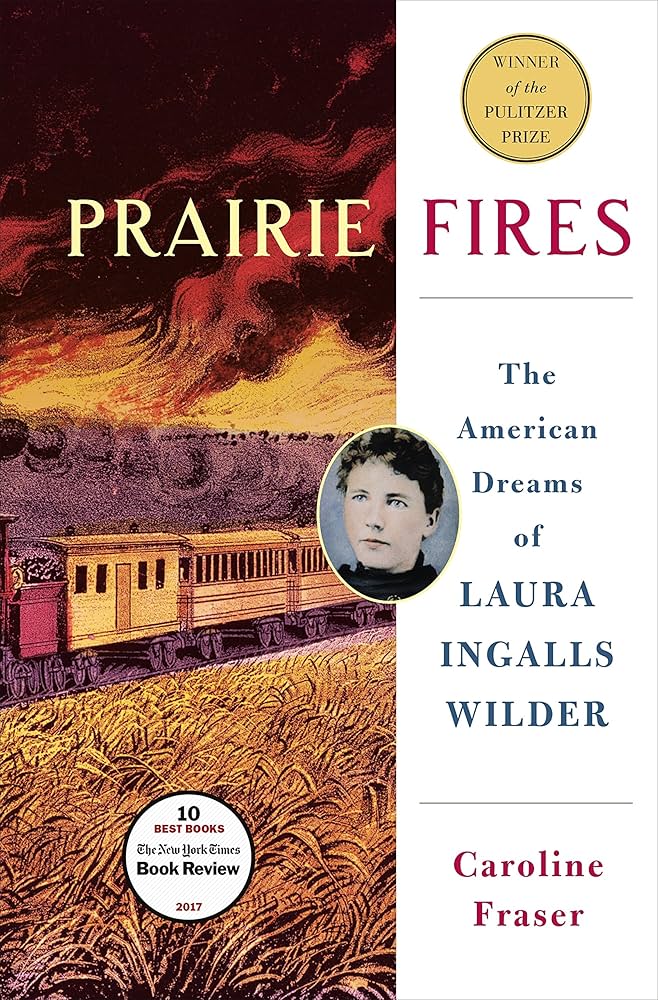
While writing, I came across Catherine Fraser’s Prairie Fires: The American Dreams of Laura Ingalls Wilder. It turns out a famous local settler to where I live, Charles Ingalls, also turned to populism as he got older. Reading about the problems Ingalls faced and thinking about those my dad faced brought me to a wider understanding of populism and especially its appeal to rural people. I could read his life on the backdrop Fraser describes and understand his move farther right.
It’s too late to talk to him about it; Dad passed away in 2020. Still, thinking deeply into the chasm between us has been helpful, maybe even healing.
To this day, I wonder about my inability to talk to him. He was unapproachable, I told myself. That’s just the way it is between parents and children, I wanted to believe.
But I come back to my own intransigence. I didn’t have the will, or the imagination, to look into the gap, to try to understand it, or to see the assumptions in my own positions and how they looked to him. Today, I think the gap that remained between us as somewhat tragic.
Tragedies like Antigone are so maddening to read because they always seem so avoidable. Just one apology, just one person who steps back and realizes things don’t have to be a certain way.
In times like these, though, I understand tragedy better. It’s not so simple as one apology. Avoiding tragedy takes a lot of mental work, a lot of reading, a lot of imagining, a lot of difficult conversations, which means creating the context in which we can have those conversations. Over and over again.
One of my sisters has taken up the gauntlet of political conversation in our family. She addresses us directly with topics of concern, seeking our input and stance. I admit, I find that old intransigence rising. I don’t want to engage. I want to dig in my heels and close my mouth.
But I also see what she’s doing. Digging us out of our silos by dragging things into the light. Not solving anything—nothing can be solved at one Thanksgiving dinner—but setting the table for better conversation. So that one day, after much talking and many forgettable or memorable meals and much struggling, we might understand each other again.
It may just be the work of avoiding tragedy.

11 Responses
Howard,
This is a helpful reflection. Thanks for offering your thoughts.
Hi again, Howard. A while back the Christian Courier suggested an “Enemy Pen Pal” program. Certainly “enemy” may be a strong term, but the idea is one I like. I have had the benefit of jumping off from that to start a “pen pal” relationship with a CC author/reader who I believe also reads here to a degree.
Actually, you and I once had a short version of this going until I kinda dropped the ball at one point on response – I’ll take the responsibility for that exchange fizzling out before it had reached maturity. Anytime you want to re-engage I’m glad to start up again with any attempt at open dialogue leading to greater understanding.
Thanks for this.
You nailed the dilemma Howard,
Let’s all work at it, steadily, opening, fighting against our own intransigence.
Thanks for this. I’ve got my work cut out for me.
Kudos to your sister!
Baby steps. The commitment is to the process, not the outcome. Jesus is rightly credited for being a great teacher. But I suspect he was first-of-all a great listener. The written word cannot adequately portray voice tone, facial expression, patience, compassion, acceptance.
Thanks for your leadership and vulnerability here. You are in the right profession!
Avoid Tragedy; Bring a Blessing. Luke 14: 13-14. HAve a T-Day Potluck. Join forces with a few families in the church. Rent the church; make sure all the lonely and struggling folks in the church are invited. Then invite any homeless or newly-transplanted folks in the vicinity to join in. Oh yes, bring your relatives. Working side-by-side in a fun project often helps mask any conflicting theological or political differences. Just a thought.
Howard, I know a little of the prejudice in Sioux Center. One of my three sons is adopted and he is half Black and half white. We brought him into Sioux Center in 1979 so he was a bit different. Our whole family was different. I and my husband were Irish and German with two sons matching that. I do believe we were accepted into our church and at Dordt but I still see signs in the larger community of Dutch prejudice. People actually think we moved here to be closer to the Dutch and it was the Reformed world view that drew us. This is strange to me growing up in New Jersey where the population of my town was very mixed as far as nations go so we did not build up a prejudice but an acceptance of others. I believe the Bible tells us to be that way.
Thank you so much for this! Very timely and relatable!
Thank you for your honesty and the sadness that’s underneath that honesty. I share that sadness and keep searching and hoping for a breakthrough in cross-communication.
Thanks, Howard. Ten of us siblings and spouses — all of us with rural roots — gathered in the Pella area recently for a plesant 48 hours. Without uttering one word about our division over what divides our nation or led four of us to leave the CRC. It saddens me, but we’ve also had enough prior email and phone exchanges to consider this discretion the way of love.