
For a while, I thought we might be unequally yoked. I had wondered about that before we married. Somewhat because of our denominational backgrounds. His was Reformed Church, mine, Christian Reformed. The pastor doing our premarital counseling told us that our Myers Briggs personality profiles indicated we were the exact opposites on all four metrics. “It’s going to take a lot of work,” he said. Best advice ever.
In this matter, the issue was competitiveness. I’m not out to kill, win, or destroy when I play a game. I think playing games is something people can do to spend time together, playfully. Playing games is what families and friends do to enjoy each other’s company. It can be a diversion from the household task list and other work. Playing games is supposed to be fun.
We have different ideas of what “fun” means, apparently.
Certainly, the play is accompanied by guttural sounds: “OH!” “RATS” and “argggh!”
The first four years we were married, we lived in a parsonage next door to the church that my spouse was serving. Both the church and the parsonage had good lawns, with a nice three-foot hedge between us. It was perfect for Sunday evening, after-church croquet games. One family in particular would join us for croquet, their little kids running around, and our dog Yoda leaping the hedge with encouragement from us to show off her agility.
This was a lovely time, enjoying summer, church friends, taking measured swings at the colorful croquet balls, aiming through hoops to the satisfying “clink” of hitting the post at the end.
Then, things got serious. My dear spouse would aim not only for the hoops, but for other players’ balls. He’d knock them out of position. He would take his turn lining up his ball to send theirs to kingdom come and score extra strikes to do even more damage. He’d strategize how to knock out other players so that he would maintain a good lead. He’d call for negotiation to end the game when the second and third players came in, because playing to the end for the rest of the group was pointless. He’d won already. Victoriously. Handily. Croquet mallet in hand, red ball perched aside the course well-rested as other players pondered finishing the game. Game over.
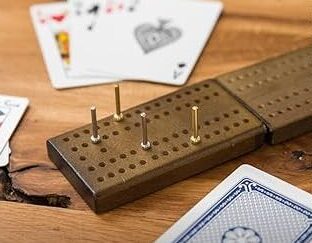
We played bumper pool, cards, RISK, Monopoly, pool, and more recently, cribbage. We took up cribbage during the COVID pandemic as a way not to watch the news all the time, and as a way to engage our brains and time together (So. Much. Time. Together.) in different ways.
If I don’t take the game seriously, if I get too distracted by many things (putting the laundry in the dryer, checking on dinner, peeking at a text message, letting the dog out), then my dear spouse thinks playing cribbage is pointless. I need to pay close attention, strategize. I need to choose my cards carefully and set aside a crib that would not knowingly give him any advantage. I can’t get sloppy, or he will not only take advantage of my lack of attention, he will use his gains to humiliate me. In the name of competition. In the name of being fit for ministry, or, rather, fit to play meaningfully, seriously. Like playing in a way “worthy of the calling to which we’d been called,” or something like that.
We were on a trip a couple of years ago and I purchased a tiny cribbage board to continue our pasttime. For some reason, I won almost every game on that particular board. My spouse thinks that board is worthless. He has a lot of faith, of course, but superstition holds the day for that particular cribbage board. He won’t play on that one anymore.
If you know cribbage, one player can make points off the other by catching what the opponent misses. That takes a lot of attention. And luck. Of course, when my pegs are ahead of my partner’s, then it’s because I got lucky. When he’s ahead, it’s due to strategy.
I do understand the sense of accomplishment when developing mastery over a game, knowing enough to have hopes I’ve chosen my cards well and played them with a sense of strategy. I can admire the bettering of one’s personal best, challenging oneself to do better—whether on a board game or a marathon.
When I married a guy whose motto was, “no cheering in the press box,” given his sports journalism days, I thought: uh-oh. This is going to be no fun. Well, there are different ways to express satisfaction and gratification in one’s team getting ahead. Or rather, by comparison to the noise he does make when his team is not doing well. And there’s satisfaction in knowing we played well, especially when I win. It’s like running the race set before us and getting the crown of victory as we re-shuffle the card deck and place the pegs in their holder for another day. All in fun, and not necessarily glory.

4 Responses
Delightful reflections, Cindi!
My father- and mother-in law “played” (bad word) Scrabble by helping each other. Sheesh. My father-in-law showed our daughters how to beat him in every game. Double sheesh. Our daughters have never forgotten that “strategy” (again, poor word choice) and regularly practice it themselves. For eight years I played squash twice a week with a gentle friend; we were equally yoked. At least once a month I’d get really angry at him, not because he was beating me, but because he just plain didn’t TRY HARD ENOUGH to lunge for my drop shot or three-wall bank returns and beat me. Triple sheesh. I don’t pay squash anymore, because age and God have made me give it up because my knees and hips don’t do what they ought to do. There are life lessons in all that somewhere, but I am very reluctant to explore them. Thank you for your wonderful and aggravating blog…
Fun story! Some much-needed humor! Thank you!
Thanks, Cindi.
It was good to be together with you this morning. Your blog further enriches my knowledge of who you, a fellow member of Hope Church, are.