I have been waiting for this book for more than twenty years. You see, when I first read Mark Gornik’s 2002 book To Live in Peace: Biblical Faith and the Changing Inner City, it wasn’t just the interdisciplinary breadth or the biblical and theological depth of the book that captured my attention; it was the names. Rooted in the Sandtown neighborhood of Baltimore, where Gornik served as a pastor, he narrated the stories of this community, telling them by name. And because I came to care about the people who populated the pages of that book, I found myself all the more drawn into the theology and cultural analysis that their lives both animated and embodied.
In this kind of street-level theology, community development is a personal endeavor. Success isn’t measured just by the number of housing units developed, but by who made homes in those houses, and how that homemaking fostered deeper friendships, community, and hope in the neighborhood. And the folks in that community have names. There is no social scientific anonymity to Gornik’s writing. He tells the story of real people in a particular place during a specific period of time in such a way that readers find themselves asking, “What happened?” Where did the story go? What happened to these people, to this community?
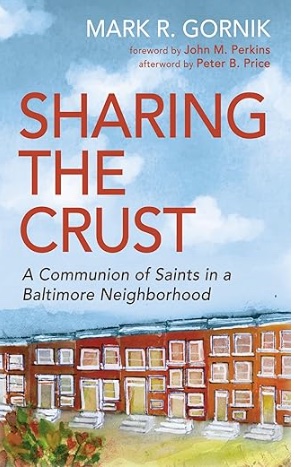
Sharing the Crust: A Communion of Saints in a Baltimore Neighborhood tells that story, and Gornik is still naming names. Indeed, in the first three pages of the book, there are no fewer than fifty-one such names, and they keep coming. But there is one name that has a special place in this story. Allan Tibbels was Gornik’s mentor, friend, and collaborator in the ministry of relocation, reconciliation, redistribution, and repentance in Sandtown. Having suffered a catastrophic neck injury in his twenties, Allan refused to let his wheelchair limit the scope of his vision or dampen the call of radical discipleship on his life. While Allan couldn’t swing a hammer, he, with his wife, Susan, was the driving force behind the rebuilding of Sandtown. As a reader of To Live in Peace, I wanted to meet Allan and Susan, and I wanted to know what happened in their story.
Gornik describes Sharing the Crust as a prayer that is offered “as a liturgy of recollection, hope, confession, gratitude, a meditation on friendship and communion.” Friendship and communion. You can’t have one without the other. The friendship between Tibbels and Gornik is forged, tested, nurtured, and proven within the context of a Baltimore neighborhood’s communion of saints. The telling of their story only makes sense, and the meditation on this particular friendship can only have depth within the context of a broader, more expansive world of friendship. That’s why you need all these names. Everyone named in this book had a place within Mark and Allan’s friendship, and every one of these people shaped that friendship; together, they created a wider community.
In a moment of particular eloquence, sharing what he learned from his spiritual director, Gornik writes,
Communion is everything–we are woven together in life, in beauty, in truth. Belonging, communion rooted in Love. Our presence, our service, our stories, alive in Love.
Communion is all we have. Communion is all we need.
This is a book of hagiography. But it is not about the canonization of Allan Tibbels. Allan died over ten years ago and has taken his place amongst the cloud of witnesses. No, this is a book about what the communion of the saints looks like when it takes on flesh in the neighborhood. Saints have a vision that can see just beyond the range of regular sight. To this end, Gornik writes, “we sought to see each person, building, corner, story, dog and cat, basketball court, water pipe, empty lot, and street the way God looks at it.” “The goal was to have the ears and the eyes, even the skin, attuned to God being experienced through the neighborhood.”
At the heart of the housing crisis, and so much else, Gornik writes, is a crisis of belonging. “What seemed then and now most profoundly missing was an imagination for the common good, a different way of seeing, thinking, and feeling about the city. What was absent was a politics of belonging in place of indifference, a commitment to biblical justice instead of abandonment and exclusion.” In Sandtown, in the life of Allan Tibbels, and in the lives of the countless saints to whom this book bears witness, such an imagination was born. “We weren’t dreaming outside the box so much as inside the kingdom of God.” That’s what saints do.
This book is a joyful, defiant, lovely, painful, liberating, and lamenting testimony to the communion of the saints as they resist the principalities and powers while seeking a better city. It is a memoir of friendships that transform the world, a memoir that refuses sentimentality in the name of telling hard truths. I waited twenty years for this book, and it was worth the wait.