
For seventeen centuries St. Nicholas, Bishop of Myra, Saint in Bari, has inspired people by his faith and generosity.
- He provided food for the hungry during famine
- He provided justice for the imprisoned
- He provided relief from inequity, petitioning for fair taxes
- He rescued the kidnapped from bondage
- He provided care for the vulnerable, especially women and children

Nicholas grew up during the late third century in Patara, a place St. Paul visited. He was Greek, as Lycia in Asia Minor, was a Greek province in the Roman Empire. The area is now Turkey, but Nicholas was not Turkish, as the Turks didn’t come until the 11th century, many centuries after Nicholas’ time.
Raised by wealthy, devout Christian parents who died in a plague while he was still young. Nicholas used his substantial inheritance to help others. As a young man he was selected to be Bishop of Myra, one of the places St. Paul stopped on his last journey. The influence of Paul in both Patara and Myra may well have still been prevalent. Jailed under Diocletian, Nicholas is believed to have participated in the first Ecumenical Council at Nicaea. He died December 6, 342 or 343 CE. His bones were taken to Bari, Italy in 1087 and it has been a place of pilgrimage ever since.
Nicholas is an unusual saint. Most saints from that time were martyrs for their faith. Nicholas is a confessor not a martyr, recognized for the quality of his life, rather than his death.
Why is St. Nicholas Important?
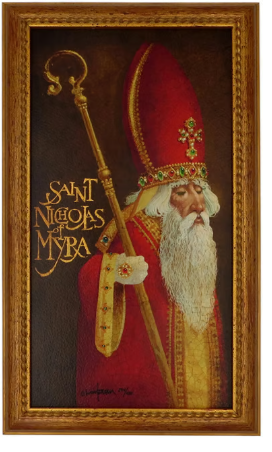
Today, December 6, is St. Nicholas’ feast day. Early in Advent and December, it helps shift the seasonal focus to giving rather than getting, need rather than greed, compassion rather than consumption. In a culture often marked by materialism and stress, Nicholas challenges us to live out Matthew 25 – to give food to the hungry, water to the thirsty, clothing to the naked, care to the sick, welcome to the stranger, and justice to the imprisoned.
The stories and legends of St. Nicholas mesh with current justice issues: hunger, mass incarceration, trafficking, inequality, the death penalty, and protection for the vulnerable. St. Nicholas provides a model for contemporary living, following Christ.
A Bright Light in Early Advent
For those who observe a true Advent – not celebrating Christmas ahead of time in mood, decor, and music, but instead immersing themselves in the Advent themes of waiting and yearning, St. Nicholas provides a bit of light.
Meanwhile, celebrating his feast day also offers some fun with small gifts and treats along with an opportunity to show love and care to others: family, neighbors, those at work, and those in need. It is a perfect time to help people understand there is a real person of faith behind Santa Claus.

St. Nicholas can visit church or home–symbolically or in person. Shoes may be put out on the evening of December 5 to be filled with simple treats before morning. These may include a bit of chocolate, a candy cane as a reminder of St. Nicholas’ bishop role caring for his people like a shepherd, a clementine or orange recalling Nicholas giving dowry money to save young women from slavery, a small toy, and, perhaps, a book.
Our boys used to get two Matchbox cars and a mesh bag of Dutch chocolate gold coins in their wooden shoes (we did live in Holland, Michigan after all!), along with some conversation about Nicholas.
At church, children may simply leave shoes in the narthex or along a corridor to discover treats after the service. A church event could include a charitable component in the spirit of Nicholas, such as collecting new toys for those in need.

The Christmas Saint
St. Nicholas, lover of the poor and patron of children, models how we are to live. His concern for those in danger or need, especially children, women, the poor, and those at sea, reveals a love for God that points to Jesus, source of caring, compassion, and justice.
Embracing St. Nicholas, who always points to Jesus, helps us recover the true meaning of Christmas
St. Nicholas Resources
Visit www.stnicholascenter.org for all the resources to learn about and celebrate this saint. There you will find liturgical resources – prayers, hymns, sermons, all the stories and legends, customs from around the world, activity and craft ideas, recipes, and much more.

14 Responses
This is a wonderful (and convicting) rehearsal of the deeper and truer meaning of the season we are in. And the next time I hear myself singing “It’s beginning to look a lot like Christmas” I hope and pray that the heart of this article pushes its way to the front row in my mind! Thank you for the wake up call!
Good stuff.
Thanks so much, Carol. Information of which I appreciate being reminded.
Thanks for this great reminder of what Christmas should be about.
….giving rather than getting, need rather than greed, compassion rather than consumption. In a culture often marked by materialism and stress, Nicholas challenges us to live out Matthew 25 – to give food to the hungry, water to the thirsty, clothing to the naked, care to the sick, welcome to the stranger, and justice to the imprisoned.
Yes, amen!
Thanks, Carol, for decades of showing and telling all who would listen and look of this salutary and oft-subverted saint!
An additional delightful practice we learned (perhaps through you or Dutch friends) is to write a playful cryptic poem on behalf of Nicholas to go with a gift, all of which invariably conclude with an Advent change, e.g. watch, work, and pray for the One who’s Day draws near +
Refreshing story in an age when getting seems to “Trump” giving
Can you expand on the reason for giving oranges? We ALWAYS got an orange in our brown bag after our Sunday School Christmas program at our RCA church. No chocolate, but lots of hard candy and mixed nuts – and an orange!🍊
I’ll gladly defer to experts, but I believe oranges are reminders of the bags of gold Nicholas tossed down the chimney of the three girls about to be sold into slavery because they could not afford a dowry. Similarly, see the three gold balls that traditionally hang outside pawn shops, as Nicholas is the patron saint of pawnbrokers. Additionally, not that long ago oranges were an exotic luxury and so they were a token of generosity and celebration.
You are exactly right, Steve. 😊
75 years of oranges and this is the first I even knew that it was symbolic of anything. I just figured that it packed easily and wouldn’t bruise like apples around rambunctious kids excited to get home to eat their candy!
Yes, as Steve says, oranges represent the dowry money Nicholas gave for the impoverished maidens. That money is also sometimes represented as apples or bags of gold. The three gold balls is one of the main symbols for St. Nicholas. It’s also the reason many got an orange in the toe of their Christmas stocking.
We were in Germany many years ago on this day. We were riding on a tour bus through many of the small towns. St. Nicholas and a companion were busy delivering small gifts to houses along the way. Thank you for this history of St. Nicholas and what this days means.
Dear Carol,
Thanks for all that you have done and continue to do to draw our attention to St. Nicholas and all that his example entails. We are happy to be members of Hope Church, where St. Nicholas visited and gave gifts to children yesterday.
Gratefully,
Jack