
I have been a bicyclist for more than forty years and cycling has never been just sport. It’s been my refuge—a place to reflect, to recharge, to process hard emotions, and to share laughter and camaraderie with friends. I’m on the cusp of amassing 100,000 lifetime miles and my bike has carried me through the remote desert Southwest, across the country on a Vision Quest, and into the Bolivian Andes on the infamous Highway of Death (a Camino of a different sort).
But on April 22, 2022, as dusk settled in and the air carried a lingering chill, my life veered sharply off course on a remote path. I lost a race I never wanted to enter—coming in second place to a tree.
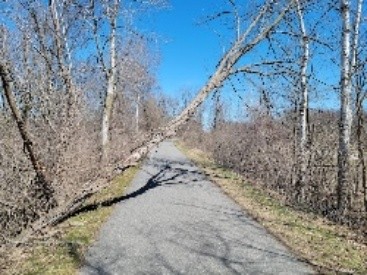
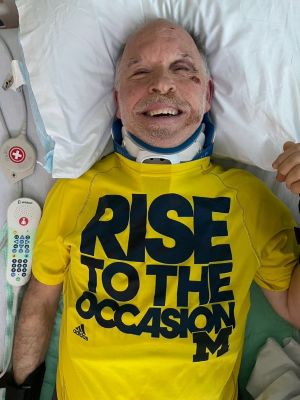
The crash was catastrophic, nearly fatal, leaving me with a severe spinal cord injury. That a Good Samaritan happened to see me fall and came to my rescue—that’s the stuff of miracles. I was paralyzed from the neck down, and no one could say if I would ever walk again.
As I was wheeled into the ER trauma bay, I had what I can only describe as an out-of-body experience—I was separated from my broken body and watching from 15 feet above as a ten-person team swarmed around me.
There was urgency amidst the chaos as each person knew their lane. There was frequent and clear communication among them, and I knew that I was well cared for, wrapped in a Calm Presence, beyond the numbing haze of shock and medication.
And then in the middle of it all, humor surfaced. I had turfed up the asphalt with a now shredded face, and a doctor tweezered out dirt, asphalt, grass, and pine needles. I cracked, “Pretty (mess)ed up, aren’t I?” I asked him to grab my phone and take a picture for posterity. (For the record: I have a face made for radio, and no, you don’t want to see it.)
OK, I’ve Survived, Now What?
That evening, a thoracic surgeon informed my spouse and me that my spine had been bruised and compressed. Surgery was needed to create space to allow room for unrestricted swelling. He was sober about the severity of my injury and spoke in grim terms about the seriousness of surgery and the prospects for recovery.
The surgery worked.
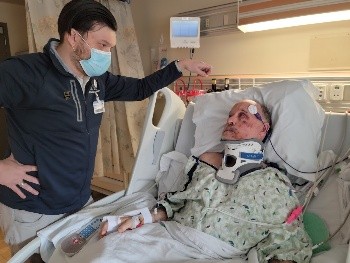
For the next 49 days, Mary Free Bed Rehabilitation Hospital became my home. I had critical foundations for optimal recovery: a healthy and active lifestyle, excellent diet, an athlete’s mindset, optimism, self-belief, a compliant attitude to follow the directions of caregivers, and a strong support network. My spouse, Fenna Diephuis, became my gatekeeper—organizing visits, managing logistics, and driving into town every day I was hospitalized. She brought nourishing food, handled practical needs, and surrounded me with love.
Calm Presence—my name for an ineffable spiritual companion—never left my side. I wasn’t emotionally wrecked. I didn’t collapse into victimhood or ask, “Why me?” Nor did I imagine this was somehow God’s will or punishment. But I did have what I call my “Job moment”—a day of pure rage when I screamed, cursed, and wept before God, raw with fear, wracked with grief, and overwhelmed by sorrow. This “Resist” day was a gift. Calm Presence did not numb me—it gifted me with spaciousness to embrace the full range of my emotions and their messages. I integrated emotional awareness into my everyday living and regularly tended what I was experiencing. Music became a valuable welcome sign to descend into my grief, and I came to cherish these moments—a sacred place where I needed to dwell. Of particular impact were songs by dobro virtuoso Jerry Douglas, bluegrass bassist Daniel Kimbro, Alison Krause, and Andy Grammar.
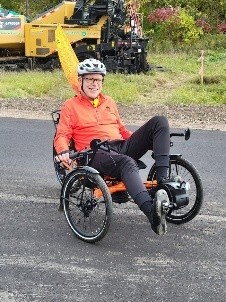
From this sacred place, an insight took shape: this catastrophic event would transform me in ways I couldn’t fathom if I would but open myself to all the possibilities My next chapter would contain purposes yet to be revealed. My only real choice was the clarifying lens of radical acceptance. I knew the road ahead would be grueling and uncertain, and I set one goal: to ride again. Not on two wheels, but on an e-trike. Most people around me thought silently, “Yeah, right…,” but that vision propelled me.
Within 4 weeks of my crash, I was riding a trike around the campus in the warm spring air.
The Gift of Daily Humiliations
Total dependence on others for my daily care stripped away ego and any sense of agency. I was immobile, unable to have a shower or bowel movement without being lifted out of bed in an electric harness and into a mobile wheelchair. Young and usually female attendants attended me in my vulnerable state. And here I’ve encountered another unexpected consolation: discovery of a deeper level of dignity by receiving their quiet compassion. The process of shedding my illusory dignity became its own spiritual path. The generosity, servant hearts, and compassion of my nurse aides was humbling.
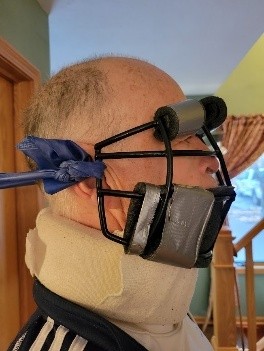
Every day for 49 days was filled with hours of rehabilitation.
The humiliations in suffering came in unexpected ways.
Excruciating nerve pain woke me up at night screaming under its assault. I could not feed myself, unable to hold utensils, or even find my mouth in those rare moments that I could hold one. I got good at slinging canned corn around my room.
Whenever I fell, I had to call for help.
I had the walking ability of a toddler And I had to learn virtually everything all over again. It took weeks of walking the halls holding onto a walker with four staff guiding my each and every move.
And then there’s the moment of my malfunctioning catheter that required a midnight trip to the operating room for its stubborn removal.
After discharge, the relentless care fell to Fenna. The burden was heavy and her caregiving stress was intense and overwhelming. But our community rallied—friends, family, and spiritual companions brought food, respite, presence, and prayers from many faith traditions. We experienced being tightly held, woven into the traditions of care and prayers from the diverse spiritual traditions of our network.
My bicycling community assisted me in raising the funds for an e-trike that was custom outfitted for a person with a disability. By September, five months after the crash, I was riding again.
Gratitude Tour
My ICU doctor told me that her team rarely learns what happens to their patients. She asked me to return in the near future. I fulfilled that promise nine months later with visits with all my caregivers, including first responders, ER, ICU, and rehab staff. Those reunions were beautiful beyond words. Their tears matched mine. The gift of being able to easily connect with others, strangers and friends alike, was a healing salve in my process, and experiencing the deep gratitude and the tears of joy from the many medical staff is a memory that will last forever.
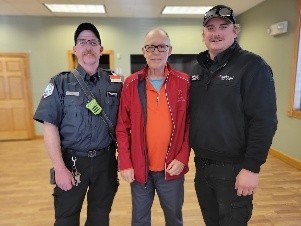
Three years later, recovery and therapy remain part of my daily rhythm—an hour of exercise, good sleep, good food, and stubborn determination. One of my physicians has called my recovery “somewhat miraculous,” crediting what he calls my intangibles.
Mary Free Bed featured my story in videos and news pieces, as did the local media. It was humbling to serve as a living testament to their world-class care—and to the mystery of healing itself.
In time, I realized what was happening was more than acceptance. It was sacred. Every moment of life—Todo—is holy—Sanctus. This crash was not only an ending, it was also an opening into mystery and the unknown. It’s as if I’d just walked into a large cathedral and I found myself standing in awe. At times, the unknown felt frightening and overwhelming: Would I always be paralyzed? To what extent would I recover? What would my retirement years look like, especially in comparison to how I had imagined them?
My Christian faith had always been grounded in trust but I’d never had to live that trust through trauma. I discovered Tara Brach’s book Radical Acceptance gave me language for what I was learning: that meeting reality without resistance opens a sacred doorway. Each moment, however painful or wearying, carries the possibility of transformation.
Here is how I metabolized transformation:
- Empathy. My suffering has attuned me more deeply to others. For example, my friend Karen lives with rheumatoid arthritis and the inevitable process of increased pain and diminished functioning. Her suffering dwarfs mine, her prognosis more grim, and I feel her anguish more acutely now than I ever could have before.
- Perspective. My late friend Kevin suffered from aphasia, a brain disease that stripped him of speech and dignity. A brilliant entrepreneur, he ended life choking and drooling, separated from friends who couldn’t bear to face his decline. His story prepared me for my own sudden losses—including the death of a retirement life I thought I’d have.
- Presence. Before my crash, urgency was my drug. Productivity, speed, and efficiency drove my bus. My traumatic brain injury led me into a new tempo. I tire more quickly, am less resilient, and have less cognitive stamina. My mantra is “Operating at the speed of turtles.” I listen more. Notice more. Speak less. I am more present in each interaction, sobered by the truth that my life may now be shorter than I once imagined.
I have learned that transformation is not a linear progression of growth. I falter. Pain returns. Despair visits. But I have come to see even this as sacred. This—whatever “this” is—can be embraced. It is the only way I know to live. There is a saying, “suffering is inevitable, misery is optional.”
Radical acceptance is my sacred path. It is teaching me to take stock, to discern what truly matters, to befriend my suffering, sadness and fear, and to metabolize grief rather than resist it. Maybe this is what it means to “pray without ceasing.”
21 Responses
Wow, Dave, thank you for letting us be part of your story.
You are an inspiration, my cousin. Always have been, even before the accident, and you continue to be so. Southern love. You know what i mean. 💕
Empathy, Perspective Presence. So right ( Just in case we were in the mood to grumble). Thanks Dave and Fenna!
Empathy, Perspective Presence. So right ( Just in case we were in the mood to grumble). Thanks Dave and Fenna!
Thank you so much for making sense of your “way through” the accident. You remind me of what’s important in life and I appreciate reading what helped you. And thanksgiving for Mary Free Bed. People I’ve loved have found healing there. Advent blessings to you and your family.
Wow. The main theme of a course I teach at Handlon Prison is this famous line by Victor Frankl, “Between stimulus and response, there is a space. In the space there is the power to choose our response. In our response lies our growth and our freedom.” I have just added this blog to that course’s reading list. Thank you.
I am beyond humbled, Duane… I would gladly meet with your students if that would ever be a blessing to be shared.
Thanks much, Daveti–and ALL of the responders, First and Many more over months. We are more than pleased you ae still with us and marvel at your and your community’s determination, humilty and gratitude. Blessings….
I am grateful for this powerful meditation on embracing stubborn determination while reposing within radical acceptance and moved by your contrasting your story with your friend Kevin’s. “Separated from friends who couldn’t bear to face his decline” is a phrase I will not soon forget.
Thank you for teaching us the right way to live and respond to what we are given in this life. I wept with sympathy and joy at the triumphant and reflective life you are now living.
I beautiful and touching story, Dave. I’ve kept up on your progress through Bob Z and know your struggle was not easy. I’m glad you wrote this down as an inspiration for others. KB
Thank you for your comment in empathy. Rheumatoid arthritis is a difficult disease at best. I’ve lived with it for 45 years. When I read your statement about your friend, I read it to my husband and said, “He gets it.” Thanks for sharing your struggles and letting us into your story as well as recognizing our own.
David, thank you for telling your story with all that you went through after a devastating injury. And thank you Fenna for being there through all that you faced together. Not easy as the one who went through the weeks of recuperation along side David. The picture of the two of you riding together is priceless. The best to both of you.
Thank you for sharing your story and your profound wisdom.
Thank you, David, for relating with such clarity your experience and profound understanding.
Dave, thank you for sharing your amazing story of resilience and grace. Inspiring and instructive in so many ways. Blessings on your continued journey. Many new adventures await!
Dave, thank you for sharing your spiritual journey that made your recovery possible. May God bless you my friend.
Thank you, Dave, for writing this moving piece about your accident and ongoing recovery. I’d heard parts of your story before and now with this article it is even more clear the ordeal and trauma of your experience. And the physical recovery is still ongoing as well as your ongoing grieving, which is never a straight path. I was moved by your description of your gratitude tour with your caregivers. It sounded beautiful. What a gift you gave to them and received from them! I’m reminded of the poem, The Well of Grief, by David Whyte whenever hearing of others grief as well as my own. May the Calm Presence continue to walk with you.
Dave,
Just read your powerful essay in RJ. Our paths haven’t crossed for a while. Given your experiences unknown to me, I feel the need to reconnect. Please email me at ricerodger@sbcglobal.com.
Dave,
Can’t explain it but the email address the appears in my first reply is not correct. Here is the corrected one: ricerodger@sbcglobal.net. The extension is “net,” not “com.”
Dave,
Can’t explain but the email address that appears in my first reply is incorrect. The correct address is ricerodger@sbcglobal.net.