
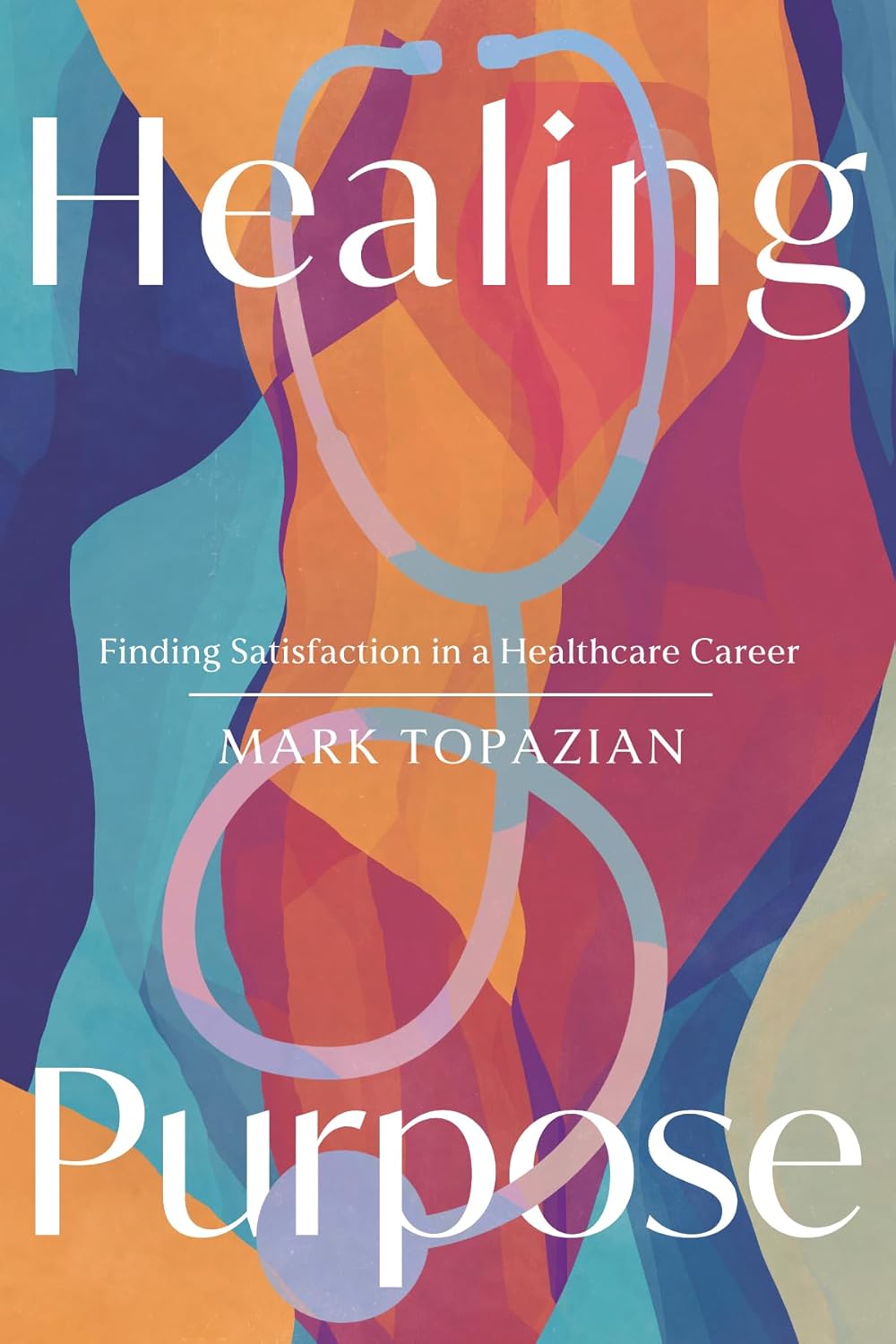
I’m grateful and honored to have been introduced to Healing Purpose by Mark Topazian. My experiences and education thus far have led me from a small Christian liberal arts college to medical school, residency training in Family Medicine, and my eventual career and calling as a Family Physician practicing in rural Midwestern America. Today my life is filled with clinic work, hospital coverage, emergency room call, and adventures with family. When I picked up Healing Purpose, I didn’t know what I was expecting to find. I was hoping to find something honest. And I did.
Dr. Topazian writes as someone who knows both the science and the soul of medicine. His background as a physician infuses every chapter, but so does a deep pastoral sensitivity. He reminds readers that “health is so much more than just not being sick,” and that good care recognizes the “mental and spiritual aspects of health and illness.” Those words resonated with me immediately. In rural practice, you don’t just see a patient’s blood pressure or lab results—you see their loneliness, their grief, their faith, and their fear. Medicine divorced from those realities becomes mechanical.
A Call to Compassionate Practice
One of the most striking through-lines in Healing Purpose is Topazian’s conviction that compassion is the heart of both medicine and faith. He writes, “Helping and compassion are different. Helping is what you do; compassion is the way you do it.” That sentence alone could be a mission statement for medicine as ministry.
Topazian argues that “compassion is key to satisfaction in a healthcare career” and that “love brings meaning to human interactions.” Reading those words, I found myself reflecting on how easily the modern healthcare system can erode both compassion and love. In rural practice, I often feel the tension between caring deeply for patients and meeting administrative or productivity demands. Topazian names this tension clearly: “If our patients are commodities, then we are too, and healthcare practice becomes primarily an economic activity.” It’s a sobering reminder of what happens when efficiency eclipses empathy.
Yet this book isn’t cynical. It’s hopeful—because it suggests that meaning and purpose can still be reclaimed. “Our compassion benefits our patients, and it also brings us fulfillment. That’s why, when we lack compassion, our work dwindles in significance and our work-related satisfaction fades.” Those words ring true. When I’m running on empty, compassion fatigue sets in fast. But when I can reconnect with the reason I do this work—serving those made in God’s image—I rediscover not just energy, but joy.
Topazian wisely observes that “if you’re suffering from compassion fatigue, this book will help you recover a healthy perspective on your work—and decide what needs to change.” That line could be the book’s own purpose statement. It doesn’t just tell you to care more—it invites you to care differently, with boundaries, humility, and renewal.
Purpose, Systems, and Spiritual Integration
While Topazian never drifts into sermonizing, his reflections are deeply theological. “To appreciate what our purpose is and how it sustains and benefits us, we need to ask why sick people are worth our time and effort.” That question stopped me cold. It’s easy to talk about purpose in abstract terms, but he grounds it in a moral reality: our patients matter because they bear the image of God.
He also addresses the systems we work in with both realism and hope: “The systems we work in should respect our God-given needs and limitations. If our workplace culture is unhealthy, we can advocate for change or find a better system to work in.” Those words challenged me personally. Rural physicians often feel captive to the systems they’re in—short-staffed, underfunded, stretched thin. Yet his reminder that even advocacy and rest can be holy acts reframed the way I view stewardship of my own energy.
Topazian’s integration of spirituality is practical rather than forced. He writes, “Take a good spiritual history because physical aspects of health are often intertwined with mental and spiritual aspects of health and illness.” I was reminded of countless visits where I sensed something spiritual behind the presenting complaint—a grief unspoken, a fear unnamed. His encouragement to approach those moments with curiosity rather than discomfort feels both compassionate and clinically wise.
Recovering Identify and Gratitude
Another powerful theme throughout the book is identity. “Recognize that we are healthiest when our identity is rooted outside our profession.” That’s a truth many physicians, myself included, need to hear again and again. So much of our worth gets tangled in what we do, in how well we perform, in how many patients we see. But Topazian reminds us that our value precedes our productivity.
He also elevates gratitude as a spiritual and clinical discipline: “The practice of gratitude is both a religious and secular window into spirituality, and encouraging gratitude is one method of influencing our patient’s outlook.” Gratitude, for him, is not denial—it’s perspective. It’s the lens through which suffering and joy can coexist.
Love as Improvisation
One of my favorite lines in the book is: “Love is improvisation because our patients are unique individuals. One size does not fit all. Compassion focuses us on our patient’s needs, not our own compulsions, and gives us freedom to act and speak in ways that best encourage each patient.” That line feels especially true in rural medicine, where every patient encounter is personal. Love, as Topazian describes it, is not scripted—it’s responsive. It’s the art within the science.
He also challenges us to stay replenished ourselves: “How do we get on the receiving end of compassion, recharging our batteries for clinical care? Equitable working conditions, sympathetic supervisors, help with stress and moral injury, and sufficient time way from work all create room for us to refill our stores of compassion.” Those words are both grace and permission—to rest, to set boundaries, to seek renewal.
Final Reflections
By the time I finished Healing Purpose, I felt both convicted and comforted. It’s not a book of easy answers but of steady wisdom, born from years of bedside experience and anchored in the Bible.
Dr. Topazian reminds us that medicine is not merely a career—it’s a calling of love, humility, and service. And for those of us who sometimes grow weary in that calling, his words point us gently back to the Source of compassion itself.
For any clinician, especially those navigating the complexities of faith and practice, Healing Purpose is more than a book—it’s a companion.

5 Responses
Thank you for this. I was struck by the idea that we are healthiest when our identity is rooted outside our profession. As a retired pastor, I’m looking back and wondering about my identity, and the struggle now that it is to not be “ordained pastor” in caring situations I still am part of. I wonder how we help one another have healthy identities, and healthy professional lives. Interesting book!
Agreed. All kinds of applications for pastors and beyond.! Thanks for sharing your personal take and particular applying.
My immediate thought too, that this is so applicable to pastors. Thank you for this review.
What a wonderful description of the impact that book had on you! After 12 years of seeing medical doctors monthly ( at times, weekly) I, as a patient, feel the difference between those just doing their job and those who truly care for me as a person and a patient! Thank you for the reminder!
Thank you Jesse for sharing this review. My decades in Pediatrics taught me that I could not practice compassionate care on my own. I was blessed with being part of a group of dedicated health care professionals who saw each patient as a child of God and worked diligently to provide them with compassionate care of the highest quality. Compassion is much more sustainable when it part of the fabric of the institution.