
I’m not a parent (unless my cat Max counts) but I recently finished listening to the audiobook of Becky Kennedy’s Good Inside. My sister (an actual parent) was reading it last month and my curiosity was piqued.
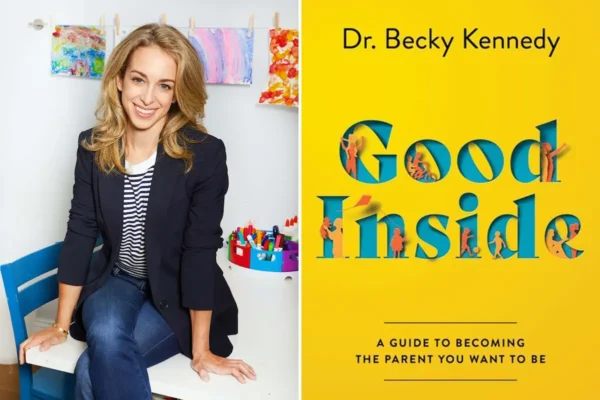
While the book is written for parents, I found that a lot of its advice and insight is something all adults could benefit from. Kennedy notes this herself — that her parenting philosophy applies to all our relationships, with our own parents and family members, our partners, our friends, and perhaps most importantly, with ourselves.
It ended up being one of those books that I now can’t stop talking about and somehow find a way to work it into almost any conversation with both my parenting and non-parenting friends.
As the title suggests, Kennedy operates from the fundamental assumption that each of us is good inside. The way this simple statement has blown my mind for the last month is unbelievable.
As someone raised in conservative evangelical Christianity, I hadn’t quite realized how deeply ingrained the idea was in me that we are bad. Original sin, our sinful nature, whatever you want to call it. I remember being raised in church and in Christian school with the idea that we can’t do anything good or be good apart from God, each of us being so deeply sinful. Bad to our core.
This belief in our inherent badness manifested in different ways. I remember always feeling like something had to be wrong with me. I had to be hyper vigilant about ways I might be sinning or messing up and prepared to confess those things in Sunday school or youth group or at summer camp or that winter retreat. I also remember being a little surprised when I finally met people who weren’t Christian and realized how good and kind they were (because that wasn’t supposed to be possible if they weren’t Christian, right?).

The reframe Kennedy offers instead: I am a good person who is having a hard time. I’m a good parent having a hard time. My kid is a good kid having a hard time.
To me, this new narrative we can tell ourselves opens a world of possibilities. It allows us room to be human, to mess up and grow, rather than rooting our identities in some sort of sinful, bad nature.
Another reframe from Kennedy’s parenting philosophy I found helpful for my own interpersonal relationships: Assume the best in ourselves and in others and get curious. Aim to connect rather than convince!
Once again, this simple reframe helps skirt the issue of making assumptions or telling a narrative about someone’s identity. Instead, you lead with curiosity and compassion to help you get to the root cause of someone’s behavior. Kennedy is adamant that you can hold firm boundaries while still allowing for room to grow rather than immediately jumping to shame, judgement, or assumptions about someone’s inherent badness.
To some of my friends, I’ve described Kennedy’s approach to parenting as helping kids figure out how to human. She embraces learning and growth as a core part of life and emphasizes that our aim for ourselves and any kids we parent should be to build resilience and figure out how to tolerate learning new things.
Though I’ve left religion behind for now, reflecting on the way Kennedy flips the narrative toward our inherent goodness brings up a big G word — grace. How we show ourselves and others grace — not because we are deeply bad and sinful and in desperate need of that grace, but because we are good people trying our best, learning and growing throughout our lives.
Honestly, I could go on, but I’ll leave you with some parting advice from Kennedy: In those tense moments we all find ourselves in, whether that be with our kids, partners, parents, friends, or ourselves, breathe deeply and remind yourself, “I am a good person having a hard time. I am good inside.”
Header photo by ketan rajput on Unsplash
Three children photo by Nathan Dumlao on Unsplash

7 Responses
So much to say . . . .
Such an important topic of discussion! Thank you so much.
Definitely an assertive corrective is needed, when the phrase original sin has come to mean inherent or default vileness. That conflation of sinfulness with badness is at the root of Christian white adult disgust for children and similar disgust for fellow adults who do not behave with our most desired signs of being aligned with white Christendom. Because the disgust is often expressed in violence, something has to change, as you say, especially in our response to children.
But I think the solution is to understand sin, the word, as a harm-oriented response to our inherent neediness and vulnerability. Sin could become again the name of that “root cause” that you are recommending we consider when responding to behavior. Badness and sinfulness are not supposed to be synonyms. Mistakes and sin are not supposed to be synonyms either.
I was listening to an educator describe his youth- and adult- oriented educational services last night at a event benefiting his domestic violence shelter. He continually used the phrase “people who choose to cause harm in relationships.” It was such a gracious phrase, and resisted the energy of placing a cloak of shame and badness on those who do so. He mentioned that the capacity to cause harm is increased wherever the relationship is low on egalitarian dynamics.
I decided about 15-20 years ago to try conceptualizing original sin as socialized interpersonal harm or inherited transmission of traumatic relational harm. This shift has held up well for my need to hold ongoing compassion for humans who cause harm in relationships, but also to hold assertive anger and boundaries for humans who refuse, even as they encounter Grace’s resources of age and experience, to recognize, grieve, and interrupt the ecosystem of interpersonal harm which they have been immersed within from birth.
Yes to this and to comments already made! “So much to say….”
Jessica, I appreciate your conceptualization of “original” sin as “socialized interpersonal harm.” I do not so much care if Adam/Eve started it all or if they just represent what we all have done and continue to do. Their story is my story. As you suggest, sin can be better understood corporately than individually. There are destructive ripple effects that tend to compound themselves and cause harm. I prefer ” universal” sin to “original” sin. God is perhaps more concerned with the corporate effect than with the individual purity violations ( the point of the adulterous woman story). That makes omission and complicity as consequential as commission.
So sanctification then looks more like loving God as God, then intentionally practicing harm reduction toward others and self, in that order. Usually it is gentle and ultra-respectful; sometimes it is violent, as in yelling, then yanking your two-year old from a hot stove. So much for self-determination! But either way, the sinner is not bad so much as in danger of harm, “socialized interpersonal harm.”
Keeping with a “socialized interpersonal harm” paradigm, I find it more helpful to think we are punished BY (all of) our sin, not just FOR our individual sin episodes. And we do not just bring punishment down on ourselves. There is that ripple effect.
I personally dislike the Heidelberg Catechism language. I do not “hate God” and I do not hate my neighbor. But I am “prone” to self-deception, to selfish gain, to temporary pleasures and entitlements, to selfish blindness, and to disgust.
Sin is usually not rebellion, as we have been taught. It is more like blindness, futility, insufficiency, self-justification.
Self-loathing is one of our tricks to convince God ( really ourselves) we are more repentant than we are.
We all sin. While some flaunt sin to the point of becoming evil (conscience-less), most of us do not. I am not saying here that sin is not that bad. I am actually saying it is worse. We do not even recognize it! And the concept of sin, ironically, is itself driving some “good” people from the church.
Allison, I appreciate your authenticity and the perspective you bring here.
Hi Allison: Thanks for telling us about a book you’ve found helpful. Even though I can testify to the sinfulness of myself and others, I like the advice to look for the best in others. One of my mottos in dealing with people is similar to what you expressed, but I added some lines: assume the best in others, but never be surprised by the worst; either way, give them God’s best. From the biographical information you give us, I get the sense that your earlier experiences negatively shaped the way you now think of the concept of sin. Experiences have a way of doing that. My own experiences were not so negative. My sense of being a sinner led me to experience the grace of Jesus. When convicted of sin, I’d confess and feel clean before the Lord. No obsessing, no ongoing shame, no sense of being worthless to God. Just grace. My parents treated me the same way when I misbehaved. I quickly moved beyond thinking of sin as “breaking the rules,” but instead looked on it as that mysterious force (mysterious to me anyway) that causes me to undermine the very relationships I want and need (whether with God, family, co-workers, neighbors, the world). And this undermining can range all the way from lazy neglect to violent hatred. We all want to get along with others , and then find that we don’t do what that takes. Grace is the response of God (and others) to us in these situations. Grace is when we undermine our relationship with them, they keep loving us anyway. If grace is only being good to people that we think are basically good, it quickly becomes just a transactional thing (sort of like the transactional analysis of “I’m OK, you’re OK”). To me, grace is the non-transactional thing of God being good to us even when we’re not ok and don’t treat him ok either. Sorry if I sound preachy—it’s an occupational hazard of retired preachers—but I want to offer my own testimony.
I echo David’s experience, Allison.
Thank you Allison and Daniel, so much to say, indeed …
I’ll limit a comment to the idea that Christians are supposed to view themselves as simultaneously sinners and saints. I think emphasis on the sinner to the neglect of the saint or ignoring the saint completely, leaves children, adults, and society in a sorry place.
I spent too much of my life with a heritage of laser focus on the sinner designation. It is a constant struggle to even consider the saint reality. Alas, what is the point of Jesus, if I can’t even acknowledge the good inside or the fact of my saintliness …
Yes! Lean into the goodness of Genesis one and not the fall in Genesis three. Acknowledge reality of sin but recognize the original goodness of everyone, albeit obscured by accumulated harm. I’ll pass this book title on.