
Carol Sturka, the lead character in Vince Gilligan’s new Apple TV show Pluribus, is not a happy person. If fact, she’s pretty miserable. She’s the successful author of fantasy / romance novels who holds her audience—and pretty much everyone else—in contempt. We don’t know exactly why she’s so unpleasant, but perhaps the root of her psychic discomfort comes from a deep sense that she doesn’t have the talent to produce works of enduring literary quality.
But that’s all backstory to the apocalypse Carol is a part of. Some sort of extraterrestrial virus infects the entire planet’s population: people freeze and convulse, and millions die. The world is engulfed in chaos . . . for about 20 minutes.

Order is quickly restored because humanity is profoundly changed. While viewers like me are predisposed to imagine the zombie apocalypse has arrived, instead a version of heaven on earth breaks out. Everyone is nice. Extraordinarily nice. There is, perhaps for the first time in human history, genuine peace on earth. Not peace through violent intimidation but peace through peace. No one kills. No one lies. Everyone cooperates. Everyone is happy. Earth might as well change its name to Utopia.
Sound good?
Not to Carol.
She is one of 13 people immune to the virus. Seven billion + others have it. She wants life as she’s known it back—full of conflict, violence, selfishness, inequality, deceit, and suffering. Although the word is not used in the show, what Carol wants is the return of good old-fashioned selfishness and sin.
She requests (from the collective consciousness of the seven billion “others,” whose greatest desire is to make her happy) a meeting with the English speakers of the uninfected 13. They meet in Spain—Carol flies on an empty jumbo jet—and she’s shocked that her fellow survivors like the new world order. They don’t want to turn back the clock. The most interesting of the group is the suave Mr. Diabate (whose West African name means “irresistible”), who shows up late because he requested a special aircraft. Soon he arrives on Air Force One. A few episodes later, he’s living in the penthouse of a Las Vegas hotel, winning millions at poker as he cosplays James Bond, and then retires to bathe with a bevy of beautiful women—who only want to make him happy. In a passing scene we see his cars, a row of different colored Ferraris with license plates spelling out the days of the week. Why should he want to go back to whatever his previous life was? Why should any of them? If Carol would simply relax and enjoy what’s being offered, everything would be fine. (Rather than pointing out the error of anyone’s ways, the “others” not only tolerate but enable Carol and Mr. Diabate as they move through the strange new world. Self-righteousness has also disappeared.)
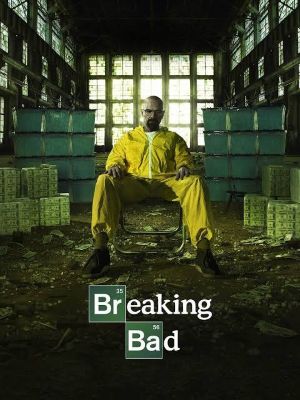
Pluribus is the most morally interesting show since Breaking Bad and its sequel Better Call Saul. What these shows have in common is Vince Gilligan, creator of all three. But Pluribus has a different vibe than those others. While Breaking Bad chronicled the downward moral journey of a high school chemistry teacher as he becomes a drug lord, Pluribus moves in a different direction. Can a miserable person rise to save the world? Should she? What would be lost if we suddenly had a morally pure society?
On Pluribus, what’s lost is individuality. I mentioned the infected billions share a collective consciousness. Everyone knows everything. They don’t understand how it works, it just does. Anyone can perform brain surgery, fly a jet, or rewire electrical circuitry. Who needs AI if you have the brain power of the entire planet? Yet just under these amazing powers something else lurks. While people are still individuals, the hive mind has destroyed their individuality.
Are peace and happiness worth the trade off?
New episodes are released each Friday, and at this point we’re about three-fourths of the way through the first season. There are disturbing realities emerging. Since the “others” cannot kill (not just people but also animals and plants), feeding seven billion people is a challenge. They’ve come up with a solution—a drink that includes HDP, human derived protein. Millions died when the apocalypse happened and another 100,000 or so die daily from natural causes. Their bodies have been harvested and frozen and then get processed. That’s right—heaven on earth includes cannibalism. It’s not like they want to do this; they simply don’t see another way forward. The HDP comes in a powder that is mixed in a drink served in school milk cartons. The explanation of what’s happening from John Cena is both chilling and hilarious.
I mentioned the virus came from space, and I initially thought an alien civilization felt so good about their life that they decided to evangelize the cosmos. Now I’m not so sure. Since the virus came from space, it’s safe to assume there are others out there. Perhaps our planet is being primed for a takeover—a planet full of people who cannot kill would be easy to conquer. I can’t tell if the show is going to head in that direction or not, but if it did, I would not be surprised. Vince Gilligan got his start as a writer on The X Files, so this is ground he’s worked before.
The tag line of Pluribus is: “The most miserable person on Earth must save the world from happiness.” Who can say if she’ll succeed? Who can say if the world should be saved from happiness? Who can say if sin will come roaring back? Can sin save humanity?

4 Responses
Intriguing…
Great questions…
Still pondering…
Whew
This sounds like that Twilight Zone episode from season 1
A Nice Place to Visit
The HDP reminds me of the 1973 dystopian film, Soylent Green, wherein human bodies were used to make the wafer that everyone depended on.