
Benoit & Father Jud
When Netflix released the third installment in director Rian Johnson’s Knives Out franchise, Wake Up, Dead Man, I had at least three different friends (who aren’t Christians) tell me excitedly, “you’re going to love this movie. So much of the God and church stuff.”
They were not wrong.
I’ve appreciated Rian Johnson’s other films, from Looper to The Last Jedi, to his prior two Knives Out movies, which have led the recent revival of “whodunit” murder-mysteries. And there was a lot I found fascinating about this film: the visual palette and the use of light and shadow, for example. The nods to John Dickson Carr and his detective-fiction classic The Three Coffins. The performances of the star-studded cast. The musical score, and its curation of Tom Waits, the Talking Heads, Roxy Music, the Catholic hymn “Lord of the Dance,” and even Larry Norman.
But my favorite moment in the film is the first interaction that Benoit Blanc (Daniel Craig) and Father Jud (Joshua O’Connor) share. As the movie begins, Father Jud Duplenticy, a young, sincere, and naive Catholic priest — “young, dumb, and full of Christ,” by his own description — has been assigned to Our Lady of Perpetual Fortitude, a small-town Catholic church in upstate New York. Almost immediately, he finds himself at odds with the rector of the parish, Monsignor Jefferson Wicks (who evokes a culture-war, MAGA-Christianity). And then, on Good Friday, Wicks is murdered.
While Father Jud kneels in prayer in the sanctuary, Benoit Blanc, genius detective, enters. Father Jud welcomes him in, and gestures into the empty expanse: “Hard to be in here and not feel his presence. . . ” Blanc, however, simply chuckles. Father Jud presses: “You’re not a Catholic?” Blanc smiles: “Very much not, no. Proud heretic. I kneel at the altar of the rational.” After inquiring about his family background, Father Jud asks again: “How does all of this make you feel?”
To which Blanc responds, “How does it make me feel? Truthfully? Well, the architecture, that interests me. I feel the grandeur of it, the mystery. And it’s like someone’s shown a story at me that I do not believe, that’s built upon the promise of a child’s fairy tale. . .” He rails on the Church’s various and sundry failings and scandals, and continues, “I want to pick it apart, and pop its befidious bubble of belief, and get to a truth I can swallow without choking.” And then, after pausing, Blanc adds, “The rafter details are very fine, though…”
Go On Being Filled With Wonder
I’ve thought about that exchange a lot through the weeks of December. On a walk through my neighborhood one night to take in the lights, I was struck that one of my neighbors had arranged a holiday scene on their front lawn that included Jesus, Mary, Joseph, and the Magi, flanked by Frosty the Snowman and an inflatable Santa whose sleigh was being pulled by a team of dolphins (I live in South Florida, for context).
This is a picture, I think, of why many thoughtful people in the 21st century, whom Daniel Craig’s character evokes, think that the Christian story is little more than “a child’s fairy tale”– and one that’s been used to violent, wicked ends, at that. Because the story of Jesus has become part of the cultural-holiday furniture, many don’t take Jesus any more seriously than Frosty or Rudolf.
This is where the testimony of our ancient parents in Christian faith is such a gift to us. The first centuries of Christians insisted that the central teaching of Christianity, which we trumpet December by December, is a mystery. The Incarnation is news: “good news, of great joy, for all the people”– an announcement about something that has happened, out in the open, on our soil, that changes everything forever. But it’s not a whodunit to be solved; it’s an endless expanse of truth, beauty, and transcendence to revere.

345-430
Over the last few weeks, I’ve been reading my way through Augustine of Hippo’s Advent and Christmas preaching. His fourth-century proclamations are a tonic for the hot-cocoa kind of sentimentality that surrounds us, and they invite us to wonder at the good news of Incarnation. So hear his reverent summons:
Our Savior, born of the Father apart from any day, and through whom every single day has been made, wished to have as his birth day on earth this particular day we are now celebrating. . . Go on being filled with wonder; the one who bore him is both mother and virgin; the One she bore is both speechless infant and Word. Rightly did the heavens speak, angels celebrate, shepherds rejoice; rightly were astrologers changed, kings troubled, little children crowned.
This is the good news of great joy for all people: Christ is born. Glory to God, and peace on earth.
Go on and be filled with wonder!
*****
In this final week of the year, we ask for your strong and generous financial support.
We come to you daily with a blog, weekly with a featured essay, plus reviews and poetry.
We hope you’ll be glad and eager to make a donation to keep the Reformed Journal going.
Simply click on the purple box below to find out all the options for giving.
Reformed Journal is funded by our readers; we welcome your support. This holiday season, we call your attention to our “But Wait…There’s More!” deal—three new books sent to you in 2026!
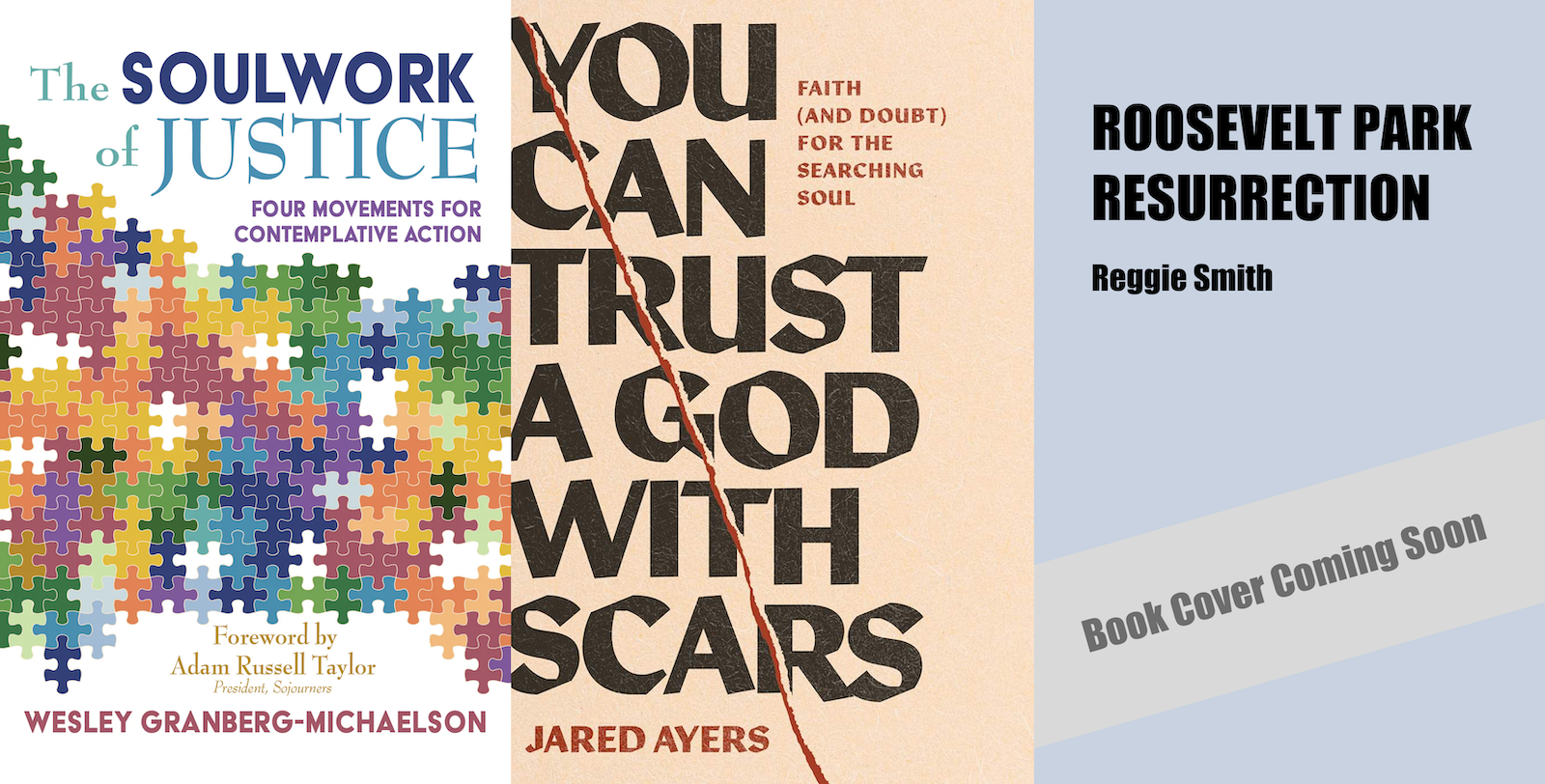
For a gift of $300 or more between now and the end of 2025, or a monthly gift of $25 or more in 2026 and you’ll receive these books. (Canadians: due to shipping costs and exchange rates, we are asking for a gift of $450 (CAD) or $38 monthly.)
Click the purple button above for more details on this year’s special “But Wait, There’s More” offer—three new books by Reformed Journal contributors in 2026! You can use the same page to give an online gift of any amount or to find info on giving by check via mail.
Checks may be mailed to:
PO Box 1282
Holland, MI 49422

8 Responses
The impulse of faith is part of the human story … I think the Western World is in a profound transition in which the forms (beliefs and “suggested” behaviors) are being deconstructed. Adherents of the faith are frightened by all of this – because things are being lost – and some of them are good. But the impulse of faith remains … there is a curious curiosity I find in many younger people (which pretty much is everyone these days, since I’m 81 – a retired PCUSA minister) … the heart hungers for connection to the divine, to the mysteries of life … I have not yet seen the latests “Knives Out,” but what you suggest here seems to be showing up a lot as of late. My thanks for this piece.
Wonderful essay. Thank you. One minor note–doesn’t the detective call it a “perfidious” bubble? I’m not sure what befidious means.
Befidious is not a real word.It makes spell check angry, and we aren’t sure what it might mean.But we seem to believe it’s the “word” that Benoit uses, perhaps as evidence of his pomposity? And we could be wrong!
Approaching 80, I get more “grinch-like” every year. While original advent continues to inspire awe and wondering I, too, wish for more mystery and less “hot-cocoa sentimentality.” Looking forward to watching the new “Knives Out.” Thanks Jared.
I too am horrified by the mixing of lies (Santa Claus and his reindeers coming to each house) and the blessedness of Jesus birth. We never mixed them in our house and Jesus was proclaimed without the presence of fabrications. I believe this is the Biblical way of celebrating our Savior’s birth.
I’m curious what Larry Norman song made it into this movie.
“Why Should the Devil Have All the Good Music?” Just googling I discovered, he was also featured in Knives Out I, with “Righteous Rocker #1.” Apparently someone associated with the Knives Out franchise has a thing for Larry!
I liked the same moment you did, Jared. And I also liked the moments in which Joshua O’Connor played the sincerity of Father Judd’s faith without satire or cynicism. I couldn’t quite tell from your post, how you saw those moments, Jared.