
In a couple weeks, I’m presenting a paper at the American Society of Church History annual meeting in Chicago about Disney World–themed devotionals. Yes, you read that right: you can pray your way around the World.
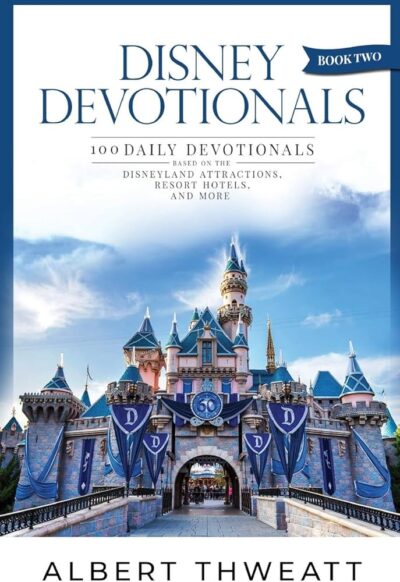
Take, for example, Albert Thweatt’s popular book Disney Devotionals, which is dedicated to “finding grace in the magic.” As the back-cover blurb states, “Disney Devotionals is a must-have for every family who wants to discover more about Walt Disney World while at the same time gaining valuable biblical lessons that will help their family grow closer together.” Inside, Thweatt connects Space Mountain to trusting God in the dark, the Enchanted Tiki Room to God’s care for the sparrows, and Dumbo the Flying Elephant to the elevating power of the Holy Spirit. It’s a comprehensive spiritual geography of the theme parks, a guide to seeing God in every bit of pixie dust.
The common wisdom right now is that American Christians have turned against Disney for being “woke.” There’s certainly some truth to that, but Thweatt’s book is part of a countervailing trend: Christians who are confident that Disney can bolster their faith. This takes conservative forms, like the new two-volume series Disney and Apologetics, which was reviewed positively in Christianity Today. But it’s also common in liberal and progressive circles: I’ve seen more than one mainline congregation incorporate Disney songs into their worship services. (In their defense, “God Help the Outcasts” is a banger.)
There’s a large group of American Christians, it turns out, who think Disney gets something right about the gospel. And here’s the thing: every once in a while, they’re right.
Each holiday season, Disney presents the Christmas-themed Candlelight Processional show at the America Gardens Theater at EPCOT. The show is, in essence, a flashy but sincere lessons and carols service, complete with choir, orchestra, and some very expensive add-on dining packages. (Yes, my dream job is to play in this orchestra.)
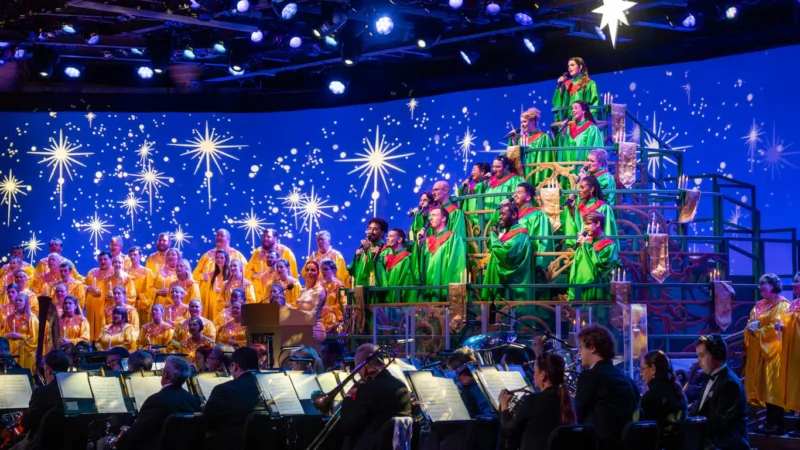
It’s also one of the few explicitly Christian offerings at Disney World. Most of its script comes straight from the gospels of Matthew and Luke, and the Christmas carols all have their traditional, orthodox lyrics left intact. To explain this out-of-character sectarianism, Disney invokes the legacy of Walt Disney, who started the show at Disneyland in 1958. Keeping the show Christian is not so much about faithfulness to a particular faith, we’re led to believe, but faithfulness to Walt.
The show runs three times a night from late November through late December: almost a hundred performances a year (plus more at on the west coast at Disneyland). A cast of celebrity narrators takes turns hosting the event and reading the Christmas story: this year’s narrators ranged from Susan Egan (the voice of Meg in Hercules) to Christian singer Lauren Daigle to Luis Fonsi of “Despacito” fame.
There are no surprises in the majority of the show’s script: we get the Annunciation, the birth of Christ, the angels appearing to the shepherds, and the visit of the Magi, all interspersed with elaborate (that is, trumpet-heavy) arrangements of well-known carols. But then, after the Magi leave, the show has to do something the gospel writers didn’t: provide a satisfying ending, a pithy summary of the reason for the season. Here’s what the narrators read:
For all the miracles of Jesus Christ, the prince of peace himself was not only the son of God, he was also a man. And he walked through this world with love. He didn’t have much, but what he did have he shared, and it became plenty: food, water, shelter, and care. He met the world around him with empathy. He saw hunger and shared the food from his plate, he saw thirst and poured for them from his own cup, he saw sickness and offered his time for their healing and soothed them with his human hands. Jesus found it in his heart to give of himself to the people who loved him and even to the people who betrayed him. To all people. Blessed are the pure in heart, for they will see God. That a baby in a manger could grow to become a man who taught a world of people what it means to love one another—that is the spirit of the season. And it lives inside each and every one of us. The greatest joy of being human is to love one another. When we share that love, that is the greatest gift of all.
I don’t know what seminarian-turned-Imagineer (another dream job!) wrote that paragraph, but somehow they nailed it. This is a Jesus who matters not because of his precise role in the mechanism of redemption, but because of his downright miraculous love of others. This is a Christmas story that ends not with a disembodied hope, but with a call to particular, embodied acts of compassion. This is an explicit endorsement of empathy at a time when some very loud and powerful Christians are calling empathy “toxic” or even “sinful.”
As a religion scholar, there’s a lot of other stuff I could say about this show: how it relies on a mythical version of Walt Disney to authorize its Christianity, how it depoliticizes the story by omitting references to Herod, how it subtly reinforces Christian nationalism by being staged in front of the American Adventure pavilion. (All to come in future conference presentations, I’m sure!)
But as someone who cares about the Christian story meaning something other than imperialist violence, this show also gives me a tiny bit of hope. Not because I think the Walt Disney Company cares much about empathy: one look at their labor practices makes that clear enough. And not because I think many guests are returning from Disney World more empathetic than when they left: that Florida humidity will boil just about any virtue out of you.
No, this show gives me hope because Disney knows a thing or two about storytelling. And they know that there’s simply no way to make the Christmas story into a story about the evils of toxic empathy or the virtues of rugged individualism. That version of Christianity, however big a platform it’s gotten in recent years, is a bad story.
But Luke’s version, Matthew’s version—and, against all odds, Disney’s version—is a good story. A son of God who was born weak and poor and who received the generous care of others before dedicating his life to the flourishing of friends, strangers, and enemies alike: that’s a good story. And good stories get told over and over again.
Even at theme parks.
*****
You’ve just read, and presumably appreciated, yet another post from the Reformed Journal. Thanks!
Now may we ask you for financial support before the close of 2025?
Click on the purple button below for all the details and ways to give.
But Wait…There’s More! gives you three outstanding books sent to you throughout 2026.
Reformed Journal is funded by our readers; we welcome your support. This holiday season, we call your attention to our “But Wait…There’s More!” deal—three new books sent to you in 2026!
For a gift of $300 or more between now and the end of 2025, or a monthly gift of $25 or more in 2026 and you’ll receive these books. (Canadians: due to shipping costs and exchange rates, we are asking for a gift of $450 (CAD) or $38 monthly.)
Click the purple button above for more details on this year’s special “But Wait, There’s More” offer—three new books by Reformed Journal contributors in 2026! You can use the same page to give an online gift of any amount or to find info on giving by check via mail.
Checks may be mailed to:
PO Box 1282
Holland, MI 49422

9 Responses
I feel like I just got another Christmas Gift in reading your article.
A beautiful, and unexpected surprise which I didn’t see coming, especially when you morphed it into a Disney production setting.
Thanks for this creative and imaginative piece of writing which reminds me how to follow Jesus amidst the political polarization that characterizes our world today…
Josh, thanks so much for this, it was uplifting and encouraging. In our culture of painting all things from “the other side” as evil you found the good, the true, and the beautiful. One need not love and excuse all things Disney, (and you did point out some weaknesses) but we can be honest and point out what they got right.
I hope you do get to play in the orchestra someday, and that you are permitted to partake in “some expensive add-on dining packages.” I also encourage you to keep adding your voice to good Christian conversations like those in the Reformed Journal, you have much to offer.
This is a Jesus who matters not because of his precise role in the mechanism of redemption, but because of his downright miraculous love of others.
For all of us trying to builld a foundation for the re-invigoration of the Reformed tradition, this sentence could be the cornerstone. The phrase, “the mechanism of redemption” is one I will hold on to. Thanks Josh.
This was a heartening read! Fair. Criticisms not spiked with sarcasm. Thank you. Years ago I was at Orlando’s Disney World and watched a presentation of the Christmas story on ice, of all things. Frankly, I, too, was surprised at how beautiful and reverent it was despite the sparkly overlay.
When I read the opening paragraph about Disney-themed devotionals, I was prepared for my eyes to roll so hard they’d fall out of my head. But this essay turned into something completely unexpected, demonstrating how grace and truth can be found in the unlikeliest of places. Thank you
“It’s a small world after all!”
We often miss the gospel messages by segregating ideas, thoughts books et cetera into Christian or non-Christian. God uses people and words and ideas (“secular”) to lead people to live better lives and to understand the gospel in surprising ways.
Thanks for this offering.
As McLuhan observed, “the medium *is* the message.” In other words–to reference another popular spectacle of days gone by–“That’s Entertainment!”
And many have “entertained” angels, unawares . . .
That’s right! I’ve even seen it myself! There was an angel on stage once when the unaware Nick Cave & the Bad Seeds were performing “From Her to Eternity” in Berlin back in the eighties; you can see it for yourself in Wim Wenders’ film, “Wings of Desire.”