
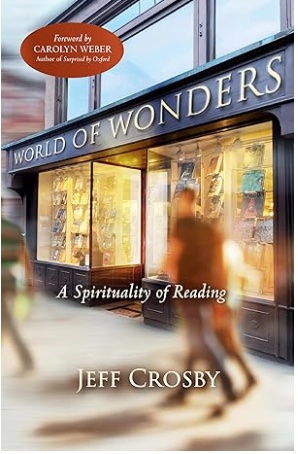
Read any good books lately?
Not only is World of Wonders: A Spirituality of Reading by Jeff Crosby a good book, it is filled with a dozen lists of other good books. Some of these books are the usual suspects: The Brothers Karamazov, the Narnia books, and The Lord of the Rings trilogy. But are you familiar with A Three Dog Life by Abigail Thomas or Surprised by Oxford by Carolyn Weber? I wasn’t, but they are on my “to be read” list now. Both these books were best-sellers, yet they didn’t get on my radar because books are primarily a word-of-mouth enterprise. (When’s the last time you saw a television commercial for a book?) Crosby’s book helps spread the word on many good books.
Jeff Crosby knows of which he writes. For many years, he and his wife operated a book store in Indiana. Then he went into publishing, first as marketing director of InterVarsity Press, and later as publisher (which is industry-speak for CEO) at IVP. These days he is president of the Evangelical Christian Publishing Association, the trade association of Christian publishers. Crosby has spent over four decades in the world of books.
Each chapter of World of Wonders addresses a different kind of reading—there are chapters on reading fiction, poetry, and memoir. There’s also an excellent chapter on reading diverse voices, a chapter on reading in seasons of grief and loss, and a chapter on reading through the liturgical year. Each chapter contains a few personal vignettes, a long quote from another author on the topic, and the aforementioned list of book suggestions. The list for reading in different seasons of family life has favorites on it like Charlie Macksey’s wonderful The Boy, the Mole, the Fox and the Horse, alongside Richard Rohr’s Falling Upwards. I knew these books, but there are also books on this list by familiar authors I’d somehow missed like Sir Gibbie by George MacDonald and The Tree of Here by Chaim Potok, along with books and authors I was unfamiliar with like God’s Beloved Community by Michelle Sanchez and The Tale of Three Trees by Angela Ewell Hunt (my “to read” list keeps growing).
An individual reader—or a book club—could keep busy for several months just by working through Crosby’s lists.
As I read, I kept thinking of magical reading moments in my life. When I was in fifth grade, my teacher took a little time every afternoon to read from The Hobbit. Unfortunately, my family moved in March of that year, and I didn’t get to hear the end of the book—we only had reached the part where Bilbo and the dwarves escaped from the elves by hiding in barrels. I never knew how the story ended, and before long, I had even forgotten the name of the book I enjoyed so much. Fast forward to my freshman year of college. One of my dorm mates asked if I’d read The Hobbit. “Never heard of it,” I said. When he told me he considered it the greatest book ever written, I picked it up. Two things happened. First, after a few pages, I knew I’d rediscovered the book I’d so enjoyed in fifth grade. I can’t explain how happy that made me. Second, I put off doing my other classwork until I devoured the book. I finished it soon, but then borrowed The Lord of the Rings books. I was supposed to be studying for finals, but was reading Tolkien instead. Somehow, my grades didn’t tank— but I clearly remember hurrying through an exam because Frodo was trapped in a giant spider web and I didn’t know how he was going to get out.
A good book suspends time. Not every book does that—actually most books don’t do that for me, but occasionally a book comes along and I get lost inside of it. There are few things I treasure more.
This helps explain why I’ve struggled to comprehend why some friends of mine exclude different genres from their reading. For example, I have a friend who won’t read novels. Why shut yourself off from great sources of beauty, inspiration, and enjoyment? (Okay, maybe I do understand this a little—I don’t like pickles, coffee, or dark chocolate.) Crosby tells his own story: once he was like my friend and saw reading fiction as frivolous. He restricted himself to reading nonfiction in an effort to gain information and build a solid knowledge base. But then he read The Brothers Karamazov and found himself weeping late one night while reading “The Grand Inquisitor” section of that masterpiece. Father Zossima and Alyosha worked their magic. Since then, Crosby’s reading of fiction has been almost insatiable as he’s gobbled up works by Kent Haruf, Flannery O’Connor, Evelyn Waugh, Ray Bradbury, Toni Morrison, and dozens of others. Crosby cites evidence that reading fiction helps develop emotional intelligence, empathy, theory of mind, and critical thinking. While I am inclined to believe the studies he cites, I can’t help but think that simply the testimony of what a difference opening himself up to reading fiction has made is all the proof of fiction’s power we need.
Above all, Crosby sees reading as a spiritual practice, a theme he returns to throughout the book. Although he doesn’t quote John Calvin, I will: we cannot know God without knowing ourselves, and there is much to discover about ourselves in the pages of a good book. By extension, then, there is much to discover about God when we read. What better reason is there to open the pages of a good book?
I found myself enjoying this book very much. I think you will too.
2 Responses
I always liked the quote of the author, cannot remember who just now, who would always ask of people, “Have you been read by any good books lately?”
Scott may have been quoting Lionel Trilling:
“A real book reads us. I have been read by Eliot’s poems and by Ulysses and by Remembrance of Things Past and by The Castle for a good many years now, since early youth. Some of these books at first rejected me; I bored them. But as I grew older and they knew me better, they came to have more sympathy with me and to understand my hidden meanings. Their nature is such that our relationship has been very intimate. No literature has ever been so shockingly personal as that of our time — it asks every question that is forbidden by polite society.”
Lionel Trilling: “On the Modern Element in Modern Literature,” Partisan Review (January/February 1961); reprinted as “On the Teaching of Modern Literature,” Beyond Culture (1965).