
The Lord Jesus is now two thousand and twenty-six years old, give or take. Our Lord is the longest-lived person we know of. I wonder how old he’ll be when he comes back.
You mean you don’t think about these things?
It’s from Our Lord’s Incarnation that we derive our global convention for counting years. This bears witness to the singular world-historic influence of the Gospel, even beyond Christendom. But using the number 2026 does not require belief that Jesus lives. He was not being celebrated in Times Square last night.

A.D. has become C.E. I’m not bemoaning it. The Anno domini of Christendom was never a biblical thing. And from a Reformed point of view it was Our Lord’s Resurrection that changed the world, not his Incarnation (sorry, Anglicans). If we reckoned time by the Resurrection then today would be 01/01/93. But the power of the Resurrection is a time-warp to begin with—the future coming into the present and all—that you wouldn’t want to reckon trips around the sun by it.
If it’s another trip around the sun, why begin the year on January 1 instead of something phenomenal, like a solstice or an equinox? Most non-Western calendars do. But we are stuck with how the Romans arranged their months. It was never ironclad. Before 1752 much of Christendom marked the New Year on March 25, early springtime, which made organic sense. It strikes me that January 1 for New Year’s Day is a sign of our general alienation from nature and its rhythms.
On New Year’s Eve our churches used to sponsor “Watch-night Services.” Our people prayed instead of partying. Some favorite hymns were Hours and Days and Years and Ages (Uren, Dagen, Maanden, Jaren) and The Sands of Time are Sinking. I miss those hymns, but I found those services tedious—though less tedious than the “wait-for-the-ball-to-drop” entertainment offered on TV.
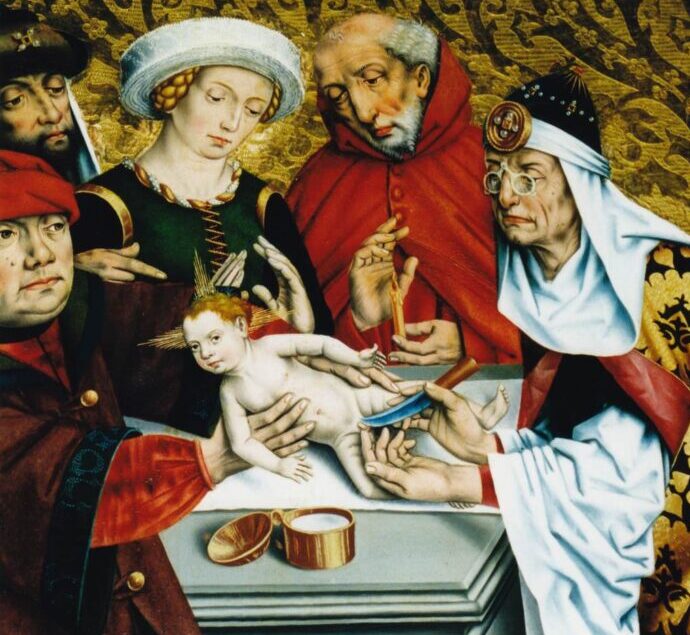
a panel on the Twelve Apostles Altar located in the Stadtkirche St. Jakob in Rothenburg ob der Tauber, Germany
In earlier times our churches had daytime services on January 1, but not for New Year’s. They were celebrating the Circumcision of Our Lord—on the eighth day after Christmas. Yes, Our Lord’s circumcision was that important that the Dutch Reformed Church Order required its observance. The observance made sense for a theological tradition so strongly covenantal. This requirement held until the early 19th Century in New York. Why don’t we celebrate it anymore? Squeamishness? Antisemitism?
I wonder if such negative motivations led to the Feast of the Circumcision being replaced by the Feast of the Holy Name, which Episcopalians and others are observing today. This marks the same event in Luke 2:21. But in that event the circumcision was primary. Jesus had already been named by Gabriel at the Annunciation, but the circumcision is what made Our Lord a covenantal Jew.
The Romans crucified Jesus not because of his name but because he was a Jew. It was a Jew whom his Father raised from the dead, and who ascended into heaven. That means — Praise God — that it is a Jew who is more or less 2026 years old today. It is one of the great ironies that the difference between Jews and Christians is that Christians worship a Jew.
He carries six marks on his glorified body: five on his hands, feet, and side, for the New Covenant, and his circumcision for the Torah. God’s covenant promises have a history in real time, with embodied people who suffered, and that real history and embodiment is taken up into God.
We are rightly admonished in prayers and liturgies to set our minds on things heavenly and eternal, but the heavenly does not exclude the earthly. And eternity apparently is complicated.
The Lord Jesus has taken up into the One God some human specificities. There is something of time and space in God: our time and our space, which should be impossible. We are not told how, and we presume there’s no combining the “two natures” nor a communicatio idiomatum (sharing of attributes). But we should not deny the wonder, and realize that we are saying something about God that we don’t understand when we say that today is 2026.
1908-1970
The Dutch theologian A. A. van Ruler argued that at the Consummation the Lord Jesus will return the Kingdom to his Father and give up his Incarnation, having finally accomplished making us all fully human. (Very Reformed!) Hendrikus Berkhof wrote that our eternal life will not be without time, because time is a good gift of God and a necessity for human life. So we, when we say that it is 2026 we may also be implying things about humanity that we do not understand.
What we can understand is that God has given to us this coming year, and, more, that God shares it with us.

11 Responses
Hi Daniel: I like your interesting observations. A good way to rouse our minds for the new year.
Deeply, thoughtfully brilliant, Daniel, in the best way possible. Thanks much.
Daniel, time to reconnect, let’s do a chat, can you send me an invite? dave@medemaconsulting.com
Enoch and Elijah may be older
Juist!
Happy New Year, Daniel. Thank you for thinking about such things. No, I don’t think about such things, but love reading your essays in RJ.
Good to be reminded of what old Dutch theologians thought. And I remember those New Years Eve church services. As well as New Years morning. Pretty sure those old Reeman CRCers were NOT celebrating Jesus’ circumcision though. That was beyond their ken. For me, that week was filled with too much church. Tedious indeed. Happy New Year, my friend.
Thank you Daniel, you always make me think about things I normally would not! Always good
Thank you, Daniel, for these “timely” thoughts on this New Year’s Day. A good reminder that we are to “number our days.”
Yes, I remember a time when our CRC congregation held services on Christmas Eve, Christmas Day, New Year’s Eve (when one of. our elders listed the numbers of births, professions of faith, marriages, and deaths that year in our congregation, and yes, sang that lovely hymn “Hours and Days and Years and Ages”), then held a church service New Year’s morning. A challenge for every pastor! Mind you, many CRC churches no longer have two services every Sunday either. I’m sure there are church members who see this as concrete evidence that we are backsliding.
Happy New Year, everyone. Come quickly, Lord Jesus.
“And eternity apparently is complicated.” Yes! A simplistic all-about-eternity gospel is so self-serving. It is so refreshing to consider a God so inclusive but not in our own image!
Thank you for this thoughtful reflection on how we count the years and on the old Watch-night and New Year services. It is a good reminder to begin a new year with gratitude rather than just celebration.Happy New Year to you and to all readers here.