
I remember having a conversation with my kids around the dinner table once about how we imagine time. Do you picture the past as pages of a calendar or hills or a spiral or tabs on a computer screen? Many of us, perhaps, think about time as a line – extending behind us and ahead of us.
Did you know that time has only been depicted as a line, relatively recently? It wasn’t until 1765 that the English chemist, Joseph Priestly, published the first timeline.
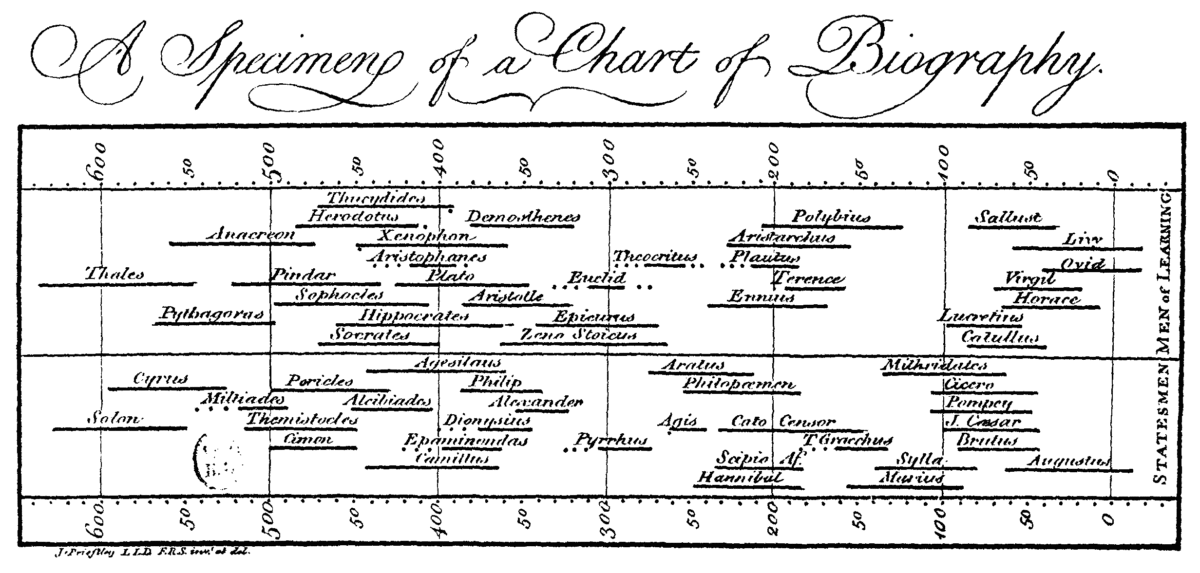
In his book, How to Inhabit Time (which I return to blog about every year around my birthday), James K.A. Smith notes the interpretive spin Priestly’s line gives to the concept of time. Depicting time as a time-line makes it look as if time inevitably brings with it progress and achievement. “The line erase[s] all the zigs and zags of contingency, the steps backward, the debts spiraling forward, as if one could map the Amazon with no bends” (p. 90).
As I facilitate grief groups with university students, they often express frustration with Elizabeth Kübler-Ross’s five stages of grief (denial, anger, bargaining, depression, acceptance). The “stages” frustrate me, too, as long as I see them as moving in order along a timeline – marching with progress and achievement. But if I see the “stages” as facets or landmarks or touchstones, they more accurately and familiarly reflect my experience of grief.
What if our varying experiences of grief are not progressive points along a line of time but places to which we travel and within which we explore?
In the spirit of traveling, I have invited students to map their grief. We pour and spread piles of rice onto watercolor paper and outline the shapes the rice makes. Then, we add and name and paint landforms and waterways to describe the world of our grief: the valleys of the shadows of death and the green pastures; the caves of isolation and the oases of holding space; the mountains of memory, the lakes of love, and the forests of fears.
This creative work helps us to let go of our tendency to chart the progress of our grief, and instead, to wonder about how we might explore and visit and inhabit our grief over the course of the rest of our lives.
Last semester, as some of my students were mapping their grief over lost relationships, I decided to make a map about the losses I am experiencing as I grow older.
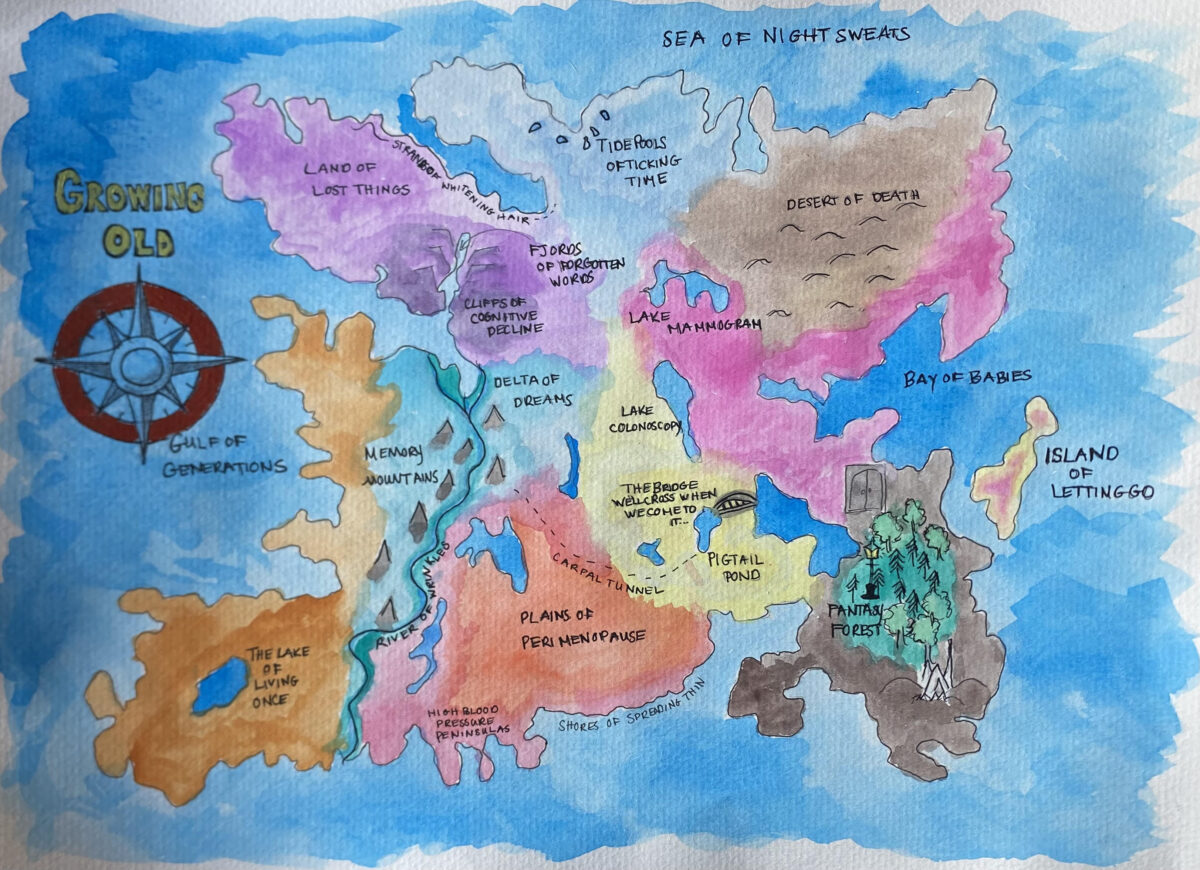
In mapping these losses, I aimed to steer clear of twin tendencies: the temptation to fight the aging process as hard as I can, on the one hand; and on the other, the attempt to embrace aging while pretending it doesn’t bother me at all. And so, I poured my rice, traced my little world, and – with equal parts humor and tenderness – named the TIDEPOOLS OF TICKING TIME, the DESERT OF DEATH, the SEA OF NIGHT SWEATS, the FJORDS OF FORGOTTEN WORDS.
I thought I’d finished my map, until last week, I quite suddenly developed tingling, numbness, and then pain in two of my left fingers. The doctor at urgent care assured me that it was nothing systemically serious – something instead to do with my median nerve. I have now added a CARPAL TUNNEL, just north of the PLAINS OF PERIMENOPAUSE, and leading away from the MEMORY MOUNTAINS and the RIVER OF WRINKLES. I find myself grateful that this map has lots of unnamed shores and inlets, as I anticipate adding to it as the years progress.**
There is a griefiness to this map, but it is not all grief. The act of mapping is an act of naming and remembering – an act of inhabiting time and dwelling with my mortality. Smith writes:
[T]o dwell mortally is to achieve a way of being in the world for which not all change is loss and not all loss is tragic — while at the same time naming and lamenting those losses that ought not to be… To be faithfully mortal is a feat of receiving and letting go, celebrating and lamenting. Being mortal is the art of living with loss, knowing when to say thank you and when to curse the darkness. (pp. 105-106)
What kind of map could you make today? What changes or pains or tragedies could you locate and name? And how, fellow cartographer of loss, might this map help you to navigate and inhabit the days that you have been given?
The NIV only finds one place to translate a Hebrew word into the English word, “map.” But Eugene Peterson finds several more opportunities to paraphrase and use this word and metaphor. I enjoy Psalm 43:3-4:
Give me your lantern and compass,
give me a map,
So I can find my way to the sacred mountain,
to the place of your presence,
To enter the place of worship,
meet my exuberant God,
Sing my thanks with a harp,
magnificent God, my God.
My map already has a lantern and a compass, but I think I will add a sacred mountain – a place where I know God will hear me, both when I sing my thanks and when I curse the darkness. Both when I lament and when I celebrate.
Header Photo by Patrick Fobian on Unsplash
**For those interested: I saw my family doctor more recently, as my pain in my arm had increased. As a fellow cyclist who has experienced the same symptoms, he thinks I may have a strained nerve in my neck from my cycling position (and my physiotherapist agrees!). I might have to add to my map STRAINED NERVE SUMMIT or CHRONIC PAIN PASS. To be continued…

13 Responses
Thank you for your words and insights here. I loved reading this piece this morning.
yes Kris, my niece. I just got to read it…..maybe I will make my map of loss and grief!
O, thank you Heidi, so interestingly written and true. My map is likely a couple of decades older than yours and has additional stages and places along the way. Keep the rice coming.
This is just perfect. Thank you.
This really resonated with me today. Thank you.
Heidi
Thanks for this posting. As always, your work is both insightful and moving. Thanks for highlighting Jamie Smith’s book. I suggest all readers of the online RJ community read that book, Both as a historian and as one of the older members of this RJ community, I assent to it’s worth and utility, both intellectually and spirtually. Thanks again.
Ron
100%! One of my very favourite books. I appreciate your historian/elder commendation.
Thoughtful, humorous and inviting……….
I’m happy to join the chorus of praise for this piece of pastoral wisdom! Thank you Heidi! Write again soon!
This idea of mapping one’s experience is most valuable and memorable. My takes are these: adding to the quote
” what if our varying experiences of _anything_ are not progressive points along a line of time and place but places to which we travel and within which we explore?”
Anything, not just grief; and I’d add the concept of ‘circling back’ to points along the line, if one needs the progressive line imagery.
Another idea is of Psalm 43, that “finding our way to the sacred mountain” also isn’t a one-and-done journey, but hopefully is continual and often.
Thanks again for this essay and especially for the visuals!
Thank you, Jeffrey! Absolutely. My very first map was a vocational one. Mapping is an excellent exercise for all kinds of reflection. And of course, the sacred mountain (and any other place on one’s map) is a place to climb again and again. Or perhaps it is the mountain that covers the whole earth (Daniel 2:35)…
Wish I had known about this creative mapping when I was facilitating “grief groups.” Thanks for sharing your thoughts and map.
P.S. Kubler-Ross meant her stages of grief to apply to the process of dying. Others have suggested that the grief that accompanies life’s losses looks more like unraveled yarn [or rice maps!]
Thank you, Heidi. Missed this completely when you first published it. This is, as others have said, helpful, wise, pastoral. I have never forgotten Mel Hugen’s Pastoral Care class at CTS when we read Elizabeth Kubler-Ross’s book. Fellow students then, as yours now, didn’t resonate with the “one and done” grief stages. But Mel wisely pointed out that the “stages” were very dynamic, repeating themselves, turning back, mixing each other up. That has helped me immensely in personal grief and in dealing with members of congregations I’ve served. I’m sure Mel’s advice still rings true.
Btw, re your carpal tunnel and other biking maladies: In 1998 I bought a custom-built Marioni road bike, mainly, I thought, b/c my 25 year old Raleigh International was 25 years old. I freely admitted that the CDN$2400 I paid for it was an extravagance. But when I got the bike and started riding, until I REALLY started getting older, my lower back pain during and after rides disappeared, never to return till about three-score and ten years of my life. Marinoni (in suburb of Montreal) still builds marvelous steel road bikes–far more comfortable than carbon fibre. Look ’em up!!