
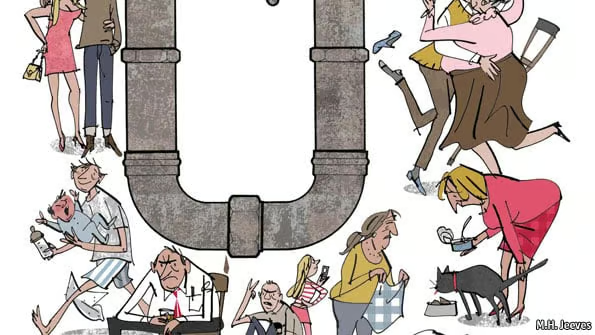
I was reading a couple weeks ago about the “U-Bend Theory of Life,” an idea initially published back in 2010 in an article in The Economist.
In a nutshell, the U-Bend Theory says that people in early adulthood tend to be happy overall, and that people in their 50s and older also tend to be happy, but that in between there’s a dip into unhappiness and discontent that reaches its lifetime low around the age-range of 46-48.
As a woman whose 46th birthday will arrive this summer, my interest was piqued.
That article asserts:
Life is not a long slow decline from sunlit uplands towards the valley of death. It is, rather, a U-bend.
When people start out on adult life, they are, on average, pretty cheerful. Things go downhill from youth to middle age until they reach a nadir commonly known as the mid-life crisis. So far, so familiar. The surprising part happens after that. Although as people move towards old age they lose things they treasure—vitality, mental sharpness and looks—they also gain what people spend their lives pursuing: happiness.
Now, anything with as expansive a title as a “Theory of Life” is bound to get some pushback. You can read about challenges to the model in the National Library of Medicine, or in a number of journal articles by psychologists. And given the staggering amount of change that has happened in the world since 2010, it could even be argued that the generational assumptions of the U-Bend Theory don’t apply as neatly as they might have 16 years ago.
At the same time, the description of the low time resonates, at least it does with this nearly-46-year-old. Kids are reaching college age, with the expenses, stress, and emotional support that this demands of us as parents. Speaking of parents, our own are getting older: health concerns, living arrangements, and worries about limited remaining time with them weigh heavily. Professionally, we reach a point in our late 40s where we come to terms with the truth that some of the career goals we may have had just aren’t going to come to fruition. And don’t even get me started on perimenopause…
I was reading about this U-Bend Theory during some of the literal darkest days of the year. December and January in Canada are an annual U-Bend of their own in so many ways. Even where I am, in the south of the country, around the Winter Solstice we only see eight hours of daylight, and the further north you go, the more briefly that winter sun appears. Seasonal Affective Disorder is a real thing.

Adding to the mental and emotional U-Bend, this past Friday, January 16, is sometimes referred to as “Quitter’s Day,” because it’s the date by which most new year’s resolutions have been abandoned. Yesterday, Monday, January 19, is called “Blue Monday,” with the dubious distinction of being labelled the single most depressing day of the year for many people.
Here we sit in the U-Bend of the year, and goodness knows the news cycle gives us absolutely no respite.
Many of the passages about hope in the Bible also include words like patience, perseverance, and waiting. These can sometimes seem like passive words, but anyone who has spent any time treading water knows how much focus and energy it takes to sustain. Hope is tiring because it is an energetic, active virtue. After a while, we find ourselves crying out, “How long? How long, O Lord?”
And yet. Slowly but surely, the days are getting longer.
There are growing pains, but the kids are gaining independence and autonomy.
The parents are getting good health care when sudden crises arise.
There are still fulfilling steps ahead in my career, and actions I can take to realize them.
Protests against injustice are getting louder.
The light persists, and the light is coming.
Maybe you had an ambitious new year’s resolution that you lost on Quitter’s Day (or before!). Or you’re feeling that Blue Monday darkness lingering. Maybe, like me, you find yourself in the U-Bend of life. Maybe you’re watching the news and honestly wondering if we’re in the U-Bend of humanity. Maybe the truest thing you can pray right now is, “How long?!?” I hear that.
When we’re able, let’s try adding on some words of hope to our lament, and see how it feels to look even just a little further ahead from the bottom of the U-Bend. This brings to mind one of the most heartrendingly relatable cries to Jesus that we have recorded in our scriptures: a desperate father, perhaps at the bottom of his own life’s U-Bend, pleading, “I believe! Help my unbelief!” (Mark 9:24)
At the very least, know that you are not sojourning through the hopelessness of the U-Bend alone. For this, we have one another. We can encourage each other with our shared experiences, and those climbing up the other side of the U-Bend can call out to us at the very bottom that it gets better ahead. A friend posted this lovely little poem yesterday by William Bronk that does just that:
A LONG TWO WAY
There is a going down into the dark
but, getting there, we turn around, come back.
The solstice comes before the winter comes.
It isn’t winter. Only slowly spring.
Also, for this, we have Jesus. As Paul said in Romans 15:13, may the God of hope fill you with all joy and peace in believing, so that you may abound in hope by the power of the Holy Spirit.
It gets brighter from here.
Header photo by Michael Pointner on Unsplash
13 Responses
I’m also 46 and feel so much of this. Thank you for your words —and hope!
We’re all in this together! <3
Oh, Kathryn. YES, YES, AND AMEN.
Ah, thanks for this encouragement! I’m so glad it resonated. <3
Thank you for this Kathryn. So well processed and a felt u turn in your ending. Loved the poem’s perspective.
I read in a Substack a while back a question from the apparent young author to the older, wiser readers out there: “ What wisdom do you have for us younger folks on our journey?” Since I was sitting with my 92 year old husband (I being a young 78), I asked him the question. He thought for a moment and then said, “this too shall pass”. Wise Wes. So I wonder if the slow u turn in life that results in happier(more content) later in life people is because there is a history of surviving —by the Grace of God—the inevitable tragedies of life and hopefully they have learned something to take with them into the next time. It seems to be perspective of what we look for and a choice. I also read recently, “there is a reason my arms are too short to carry this burden because it was meant to be carried —and is—by Someone else.” Or something to that effect.
Ah, “this too shall pass” is a great piece of wisdom – I say this often as well! A reminder both to preserve hope in the dark times, and when the bright times arrive, not to place all our hopes on the assumption that they will remain forever. I love how consistent God is through the Bible with reassurances that God will always be with us – regardless of all the things in our journey that too shall pass.
A few years ago, my wife, children and I were playing a tile game with my wife’s elderly father. There were many turns in a row in which people were unable to play a tile, so they said, “Pass.” When it got to my father-in-law’s turn, he said, “I too shall pass.” There was a sudden pause, and then we all burst out laughing. Yes, things pass and we pass, but the Lord holds us all through the passages.
A delightful story!
Thanks Kathryn It went well with our devotional this morning which was from James 1: 2-3 Consider it joy my brothers when you encounter trials of many kinds.
Because you know that the testing of your faith develops perseverance. ,,,,,,,, so that you may be mature and complete, lacking in nothing.
Wow, it definitely does! There are so many challenging exhortations to dig into in that passage, aren’t there? It’s always been interesting to me that James just launches right into this doozy of a directive at the very beginning of this letter. And I feel like there’s alignment between verse 3 and the statement in 1 Timothy that “godliness with contentment is great gain.” Maybe part of the learning as we navigate the U-Bends of life is a deeper understanding of what to hope for, and where to rest our hope.
Thanks for the article. Now in my late 60s, I can attest that the U-Bend theory is true and yes, there is a greater contentment as we age. I can also attest to the dark winter and slow spring. I grew up in Northern NY and considered attending Queens University in Kingston, Ontario. I “get” it.
Older folks need to tell young parents that the stress many of them feel will not last forever.
Beautiful, Kathryn. Such encouraging words at a time when we’re all so in need of them.