
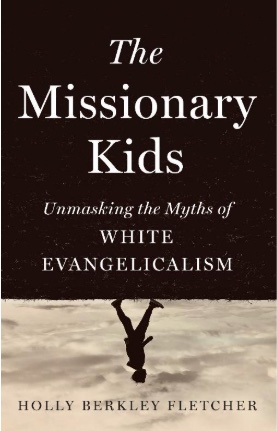
Holly Berkley Fletcher’s The Missionary Kids examines the intersection of American Christianity, culture, and missions through the experience of missionary kids (MKs). Fletcher grew up an MK in Kenya. Her book combines personal stories, interviews, research, and analysis.
I’m also an MK, born and raised in Nigeria. My parents served with a conservative interdenominational mission. At age six, I was sent to Kent Academy; for high school, I transferred to Hillcrest (where I met CRC MKs). I only saw my family a few weeks a year, and left Africa when I was seventeen.
Fletcher doesn’t bash missionaries as evil or whitewash them as exemplary. Instead, she grapples with “the complex reality of missions: the good and the bad, the beautiful and the brutal.” She explores four themes: missionary calling, mission work and multicultural attitudes, missionaries as sinners not saints, and the dispensability of American missions. She raises lots of pointed questions. I’ll highlight a few.
Fletcher describes the problem of prioritizing parental calling over children’s needs. For many MKs like me, the repeated cycles of being sent away to boarding school caused a “tsunami of pain” in childhood and a “lifelong search for home and belonging.” Child separation was a sacrifice to save souls—one we were told God richly rewards. (I still shudder at Mark 10:29.) But, Fletcher wonders, does the end justify the means? Are kids simply collateral damage for a greater good? Her conclusion is blunt: if the action to which someone feels called hurts the children involved, it isn’t of God. When my parents grasped how much my sisters and I were struggling at boarding school, they left Nigeria. They put our social and emotional needs first and never returned to Nigeria.
Second, Fletcher identifies the problem of spiritualizing pain. When that happens, distress can’t be properly named. For many MKs, a spiritual dimension complicates emotional grief. Their disorientation and loss are directly tied to God: after all, it’s God who called their parents to be missionaries. Fletcher internalized this message. She writes, “whatever you do, don’t rock the boat.” I, too, feared that if I couldn’t handle boarding school and my parents had to leave Africa, then Muslims wouldn’t hear about Jesus and would suffer eternally in hell. That’s a heavy lift for any child.
Next, Fletcher exposes the problem of theological certainty. My parents sent me to boarding school because they believed that people who didn’t hear (their very specific version of) the gospel are doomed. This assumption—that American evangelicalism is the only true Christianity—“has created a culture so convinced of its own rightness that it has little space for self-reflection.” Sacrificing children to convert strangers is just one example, Fletcher says, of how “rigid doctrine trumps the well-being of flesh-and-blood people.” Conservative churches disown LGBTQ+ individuals and won’t ordain gifted women because they are “more interested in protecting inflexible beliefs than in following an ethic of love.”
Fourth, Fletcher analyzes the problem of cultural superiority. “The popular narrative of missions as colonialism,” she says, “is an exaggeration.” And yet missionary activity is “intertwined with racial concepts of American imperialism and exceptionalism and cultural dominance.” The written history of my parents’ mission implies that bringing Christianity and bringing civilization to “heathens in darkness” were one and the same. I worry that they absorbed its paternalist attitudes about “primitive Africa” and simply passed on a North American faith uninfluenced by Hausa insights, even though they always showed respect and affection for the men and women—Christian and Muslim—they worked alongside in leprosy care and theological education.
Fletcher then calls out the problem of pervasive patriarchy. In virtually every MK boarding school worldwide, male-centered hierarchies have enabled abuse—emotional, physical, and sexual. Self-preservation and a sense of indispensability make mission agencies—including my parents’—refuse real accountability. Many “have resisted publicly acknowledging past abuses and identifying perpetrators.” Few “have earnestly taken responsibility for enabling and mishandling abuse.” Theologically liberal and egalitarian missions are better at owning up to abuse than theologically conservative and patriarchal ones. Mission boards have now adopted child protection policies. That’s an important and necessary step. But it isn’t sufficient. As Fletcher insists, until they address the underlying patriarchy that allows abuse to happen and be hidden, they haven’t solved the problem.
Next, Fletcher examines the problem of displacing racial justice work overseas. On the field, implicit bias and soft racism were—possibly still are—prevalent missionary attitudes. Meanwhile, at home, supporting foreign missions is easier than confronting the long shadow of racism born from slavery and Jim Crow. Fletcher points out that missions blossomed in the late nineteenth and early twentieth centuries, when the same Christians who were lynching former slaves in Alabama and forcing Navajos off ancestral lands were sending white missionaries to convert black Africans. She writes, “White American Christians have thrown themselves into evangelism and humanitarianism among non-white people overseas, while avoiding the less heroic task of confronting their own responsibility for and complicity in the US’ horrific racial past.” What would America look like today, Fletcher wonders, “if white Christians had devoted even a tenth of the money, effort, sacrifice and prayer” towards racial equality at home rather than to foreign missions.
Finally, Fletcher considers the problem of divorcing foreign commitments from domestic politics. A contradiction lies at the heart of many conservative churches. “The same people who are funding missionary endeavors around the world are supporting policies that cut America’s refugee program and legal immigration. Evangelicals might support medical missions to vaccinate Pakistani children while indulging in anti-vaccine conspiracy theories here. They may vote for political leaders calling for a Muslim ban while they hail missionaries befriended by Muslims in other countries.” Cross-cultural mission activity hasn’t impacted the American church’s domestic political engagement.
The Missionary Kids can be dismissed as the complaints of a disillusioned MK. Or its critique can be taken as—at least partly—right. Instead of trying to deflect Fletcher’s uncomfortable truths, missionaries, mission boards, sending churches, and denominations might acknowledge their force, pursue self-examination, and tackle purposeful change. Fletcher’s book does not offer easy solutions, but it offers something more demanding: moral clarity. If missions are to be faithful, they must be willing to relinquish certainty, confront patriarchy and racism, and place human flourishing—especially that of children—at the center of their theology and practice.

8 Responses
Thank you for tackling Fletcher’s book and sharing your own experience. I read her blogs regularly and find her story painful, but helpful in examining the moral clarity of mission work.
Thank you for this compelling analysis of this book. Because our church has always had a robust list of foreign missionaries we support, these truths about what it does to their children has been a question in my mind for a long time. Recently a daughter of our congregation and her husband were with us for a presentation and Q&A time. Still continuing their translation work from the US, she has formed a group that supports MK’s as they try to transition into college in the US either with or without their parents. She acknowledged openly what dislocation they feel. One question I have that might be a good sociological undertaking is: how many of the MK’s become missionaries themselves, given the possibility that at least one child will follow in the footsteps of a parent. I would guess the number might be shockingly low.
You raise an intriguing question at the end. Here are some anecdotal data that point toward very different answers: I was a CRC MK at Hillcrest School from 1959 to 1965, and when I returned to Nigeria as a short-term missionary twenty years later, at least six of us adult CRC missionaries on the field were former MKs in Nigeria. On the other hand, at a reunion I attended twenty-five years ago of kids who had been at Hillcrest sometime during the years 1960-1972, I was struck by how many of my former fellow students were no longer professing Christians.
Sorry Lyle. Got my replies mixed up. Here’s what I meant to send to you.
I group the many adult MKs I know into three buckets. The true believers have remained conservative, many involved in church or mission work. The skeptical have (often for good reason) left the fold entirely. The middle group (where I find myself) have ‘deconstructed and reconstructed’ their Christian faith. These three groups seem to fit the pattern of faith development for non-MKs raised in the church as well, so there’s nothing unique here. I’m always struck at the overwhelming percentage of MKs whose careers are in service (education, healthcare, social work)—very few are in business. That speaks to the influence of their parent’s calling and serving. Fletcher argues that many MKs are raised in a “bubble” that protects them from the brutal realities of poverty and sickness that are prominent in many under-developed countries. She has a point. But I also know that my lifelong sense of social justice came from living with my folks in fairly remote village settings where I was exposed to horrible material conditions that are preventable. I’ve never reconciled the contradiction that North American Christians, who claim to follow Jesus, care more about their lifestyle than the very lives of Africans. That’s part of my ongoing disillusionment with the established church and what strikes me as misplaced budget priorities.
Thanks Janice. As you might guess, MKs aren’t homogenous but react to their childhood experiences in different ways: some celebrate it as totally awesome, some condemn it as completely awful, some (like me) don’t let the bad cancel out the good (of which there is much). There’s a small cottage industry of MK writings—the recent book Sent: Reflections on Missions, Boarding School and Childhood is one compilation that reveals the diversity of responses. And there’s been some academic research on how MKs adjust as adults—it validates that unconditional parental love is critical to MK mental health (that finding isn’t rocket science, since the same is true of any child). Most mission boards now have re-entry programs that help MKs transition back to their passport country; some mission agencies are better than others at providing psycho-spiritual aftercare (even long into adulthood). My boarding schools have an alumni newsletter, social media groups and tri-annual reunions that I’m part of. I don’t know how many MKs return to the field as missionaries themselves. I know many, like me and my sisters, never considered mission service that would involve family separation. But I also know many who did become missionaries—some because they felt called, some because they were misfits in North America, some because Africa was the only world they knew, some because they were well-equipped for international ministry. I’m always struck at the overwhelming percentage of MKs I know whose careers are in service (education, healthcare, social work, church ministry)—very few are in business. That speaks to the influence of their parent’s calling and serving.
Thanks for this review … a contribution to the deconstruction of the house of cards built by American evangelicals.
I add my thanks for your reflective review. I’ve been struck by how often international college students, including MK’s, find their friends among other international students because they have such a bigger picture of the world. But I’ve also never forgotten and grieved that two different classmates become missionaries, only to leave soon after profound disappointment iin terms of seeing Western life styles maintained by their colleagues rather than an incarnational identity among those they came to serve. Two separate stories, but both of them left the church. Such complex issues still so present on so many levels.
Thank you for sharing this, and for recognizing the complexity of the issues. I taught at Hillcrest for one year and still consider that a highlight of my teaching career. The missionaries we lived with were people I greatly admire, they truly believe their calling was from God. They did their best to love their children, and yet, as you point out, we can continue to do better. We need your voice, thank you.