
A Sacred Canopy
A house stands on a street in a residential neighborhood of Darmstadt, Germany. It belongs to the Bertsch family. Soon after the Second World War, Paul and Hildegard laid its brick foundation, raised its walls, spanned the roof, and built rooms. This is where their two daughters, Enna and Hannah, grew up, and Hannah still lives there, married to Ken, who is the brother of my wife, Judy. This house was never just brick and mortar, rooms and closets and doors and windows; to them it was a sacred canopy under which they lived and moved and had their being.
The Bertsch house stands shoulder to shoulder with many others, all well-maintained and landscaped. Passersby would hardly pay it much attention. But should they pause and look more closely, they would see a vision. Should they listen more carefully, they would hear voices from the past. A house is not inert; its construction is not silent. From this house, the bricks cry out and tell a tale of the inner workings of the human heart, a tale of darkness and light.
Darkness
On the night of September 11, 1944, 226 Lancaster Bombers and 14 Mosquitoes took off from the airfields in South Lincolnshire, England, and flew under the cover of darkness to Darmstadt. On this particular mission, the British Royal Air Force was experimenting with a new strategy called a “fan attack.” The bombers approached in a spread formation in order to encompass the whole city. The Royal Air Force intended to create a firestorm by first dropping high-explosive bombs to break apart roofs and then dropping incendiary bombs to ignite the buildings. The fan attack and the firestorm were a trial run for the bombing of Dresden.
The night attack targeted largely residential areas, even though the British government claimed that its goal was to disrupt the city’s railway connections. Hildegard and Enna (Paul was in military service and Hannah had not yet been born) heard the sound of sirens and the thrum of engines and headed for the damp and moldy confines of the city’s bomb shelters along with the other residents of Darmstadt. The huddled masses were women, children, and the elderly–all the able-bodied men having been conscripted into the armed forces. It is hard for me, in my relatively secure world and intact home, to imagine the horror and helplessness of mothers clutching their children and offering what comfort they could as the ground shook from the bombs bursting above.
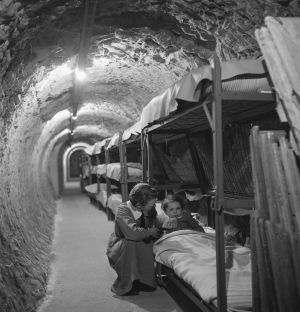
The resulting firestorm caused immense damage, destroying Darmstadt’s historic center and surrounding areas, killing an estimated 12,500 people and leaving 70,000 civilians homeless. The fire raged for hours, reaching temperatures high enough to melt metal and penetrate bomb shelters. In some shelters, the occupants were incinerated, leaving behind only unidentifiable masses of green-brown liquid and human bones.
These victims were, tragically, not alone in death. They joined the ranks of the millions who had come before them, and they foreshadowed the fate of the millions who would come after them, the dead and displaced of the German bombing of Rotterdam and London, the Japanese bombing of Shanghai, the British bombing of Dresden, and the American bombing of Tokyo, Hiroshima, and Nagasaki, to name only a few of the cities among many others mostly forgotten.
Inflicting suffering and death on civilians in order to demoralize them and weaken their resolve was and is a violation of the so-called rules of war. But, as history has taught us, war has no rules. In the heat of armed conflict, both sides justify any means, no matter how horrific, if they promise victory. Nations at war know no boundaries and know that there is no international body with sufficient authority to hold them accountable.
Light
A shaken Hildegard and Enna emerged from the bomb shelter and walked through an apocalypse–dead bodies, walls levelled, and bricks strewn through the streets. When Paul returned from the battlefield and was reunited with his wife and daughter, Darmstadt was unrecognizable. The Bertsch family had no home, no city, no security, and a very uncertainfuture.
Upon their reunion, something remarkable happened. Hatred had destroyed their home but not their hearts. Their love for one another survived, and it gave them the strength to carry on. The Bertsch family gathered themselves together, and, along with their neighbors, slowly began to clear away the rubble and rebuild their city. They picked up the bricks of the ruined buildings, chipped away the old mortar, and re-laid them to build new homes. The Bertsch family built a home from the ruins of the old, a canopy to shelter a child coming into the world, Hannah, and secure their future.
Inner-workings of the Heart
I saw the bricks in the foundation of Ken and Hannah’s house, and I heard them tell a tale of darkness and light. Their story invited me to ponder anew the inner-workings of the heart and to probe what the scriptures might have to say about its inclination to hate and love.
The scriptures tell us: “The heart is deceitful above all things, and desperately wicked; who can know it?” (Jeremiah 17:9) True enough. We need only look to Darmstadt and all the other conflagrated cities of our world. Yet, we must do more than merely acknowledge the reality of such desperate wickedness and content ourselves with a rhetorical question: Who can know the human heart? The depths of wickedness may be unfathomable, but its shallows are not.
Wickedness is a power, and its effect in the world is discernible. It aggregates over time, incorporating people in movements that disenchant the created order and thwart the good purposes of God. Wickedness can be identified, and we need to name its various avatars in order to exorcize them from our hearts and become people who do justice, love kindness, and walk humbly with our God.
We humans are contingent beings, a fragile meld of spirit and dust, a labile union of soul and body. We live from breath to breath, drink to drink, meal to meal, shelter to shelter, birth to birth. We and our communities are vulnerable and easily harmed both spiritually and physically. Our vulnerability to harm sparks fear in our hearts when we encounter those outside our intimate circles–rightly so when the outsider seeks to undo us, wrongly when the outsider is merely unknown and unfamiliar.
Our fear of the outsider stokes anger, anger ignites hatred, and hatred fuels rage. Rage seeks revenge and sets the heart ablaze, incinerating its capacity for love and empathy. A heart ablaze with rage is a fire that spreads, a holocaust that consumes everything and everyone in cities like London, Darmstadt, Hiroshima…in camps like Majdanek, Auschwitz, Si Rengorengo, Manzanar, and more.

But a heart ablaze with rage represents only one of its possible states. To play off the words of Jeremiah: The heart is trustworthy above all things, and steadfastly loving. Who can know it?
The scriptures affirm that God is love and describe how this love is the energy from which everything emerges and the force which binds everything in perfect harmony. The scriptures exclaim that the depths of this love are unsearchable and its emergence in the course of time inscrutable.
True enough. Believers marvel that the love of God is inscrutable, but they also wonder whether it is discernible enough in the unfolding of the created order to trust. The power of hate in the world is seemingly intractable and the extent of loss inestimable.
Like Job, modern believers long to say, “I have heard of you by the hearing of the ear, but now my eye sees you.” They long for the knowledge of God to move from the ear to the eye. Reading a theological tome detailing the love of God is not the same as personally experiencing that love in the dust and ashes of the world.
Love is discernible in the contingency of our existence and is made perfect in our weakness and loss (2 Corinthians 12:9). We experience loss in many forms in the course of our living, and our loss is accompanied by grief. If we allow ourselves to probe the depths of grief, we see that it is an expression of our longing and that our longing arises from love.
Grief is love with no place to go, according to a modern-day proverb. Yet this proverb is only partially true. Grief is not just love wandering aimlessly without a home. Grief is an expression of love that has within it the resolve to restore what has been lost. Love can rise from the ashes of loss and unleash the energy to rebuild our broken lives. A love like this animated the Bertsch family and countless others victims who gathered themselves and rebuilt new homes from the rubble of the old.
A Sign of the Kingdom
I have always been intrigued by Jesus’ declaration: “The Kingdom of Heaven is at hand.” In this brief declaration, he offered both a summary of the gospel and a summons to follow him. Appropriating the images of his tradition, Jesus depicted God as a king, the created order as a kingdom, and himself as the Messiah who had come to restore a fragmented and rebellious kingdom to its original goodness and integrity. Jesus initiated a middle age of the already/not yet kingdom, and summoned his followers to join him in preaching good news to the poor, captives, the blind, and the oppressed.
Experiencing the seemingly intractable evil and suffering in the world, I held on to the declaration of Jesus and looked for signs of the Kingdom that was at hand.
Throughout my life, I have partaken the sacraments hoping to realize the presence of Jesus the Christ in water, wine, and bread. I’ve walked the woods of West Michigan and the deserts of Palm Springs, looking for a world full of the glory of God. In the face of opposition and oppression, I’ve echoed the words of Rev. Dr. Martin Luther King’s beloved community: “The arc of the moral universe is long but it bends toward justice.” Less profound perhaps but equally hopeful, I’ve affirmed with Rob Bell: “Love wins.”
Yet when I probe the depths of my existence and am present to all that is happening around me, I am not sure love wins. There are many days when I feel that both society and the environment are collapsing like the twin towers of New York City. I fear that God has turned God’s face from us and is allowing the consequences of our indifference to the extinction of species and indifference (if not hatred) to our human companions to fall on our own heads.
I am not alone. I have many friends and family who were raised in a Reformed tradition and now linger on its periphery or have ventured far away. They have been waiting for a God who never seems to appear, looking for glimmerings in human affairs and seeing only darkness, seeking purpose in the evolution of the created order and finding only randomness. Their question is not: who is saved and who is not? Or who belongs at the table of the Lord? Or whether the authors of the Heidelberg Catechism intended “unchastity’ to include same-sex activity. Their interest is not in the “mechanism of redemption” as Josh Parks expressed it so memorably in a recent Reformed Journal blog. Their question is more fundamental and volatile: Is God present and active in the world at all? Is there a larger purpose in the evolution of human affairs and the created order that invites their participation?
Where can we see signs of God’s reign?
Where can we find hope?
I found hope this summer in the bricks of Darmstadt.

A Glimmering
The people of Israel and the early church affirmed that God was love. They understood this love to flow from the heart of God to the hearts of humans and from the hearts of humans to the world. They affirmed that love was the real presence of God in the world and that this love overcame evil and could not be snuffed out by darkness.
The bricks of Darmstadt invite me to probe the depths of the human heart. They tell a tale of darkness but also of light; a tale of love quickening hearts, rebuilding homes from ash and rubble, and restoring lives once lost. It is a tale about the presence of God in the unfolding of our lives and offers hope in these dark times.
The worst happened in Darmstadt. But the worst was not the end of the story.

6 Responses
Thank you Tom, for this example from your own family. Light shines in the darkness; the darkness cannot overcome it.
You’ve given me encouragement today. Let’s not lose our way. Jesus shows “The Way.” We will walk in it.
Amen Tom. Your words and thoughts well express what simmers in my heart and head. T
Tom, I have felt a little of the anger of Dutch Americans when they learn I am half German. My grandfather came to the US at a young age which was before World War II. My father who is German fought for the US in World War II and did so as any other American who loved his country. I say this when German is the largest nationality in the US and I am sure many of them came over well before WWII. My grandson lives in Germany and likes the young people there who he says are not as frivolous as the Americans he knew. We should treat Germans as any other nation of people. Some were led into ugly places but many were not.
Thank you for sharing this personal family story that I’d never heard of before—there must be so many more. As usual Tom, your heartfelt writing stirs so many feelings and tensions in me. It’s so hard not to react but “act justly, love mercy and walk humbly with my God.” In my experience, I am wondering if the author of Micah got the order wrong. Maybe if I can work on walking humbly with my God first, it will lead to loving mercy and therefore acting justly.
Thank you for your message. It resonates with someone born in an attic because Rotterdam had been destroyed by both German and Allied bombing. Family members were killed in 1943 by poorly directed Allied bombing. But you are right. The worst is not the end of the story!
As one who often feels on the periphery, my deep thanks, Tom, for sharing yet another searingly honest yet ultimately hopeful probing of our hearts in light of the ravages of human evil and glimmers of human love amidst the rubble, suggesting the presence and activity of the God revealed in our scriptures, who invites our participation in the kingdom!