
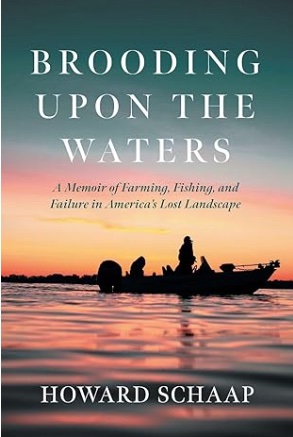
I have just finished reading Howard Schaap’s memoir, Brooding Upon the Waters, and I must say, it has been a long time since I have been so captivated by a book. For a number of reasons. The most obvious is that he writes about my home territory, which includes not just the lakes and landscapes and flora and fauna of southwest Minnesota but the austere, religious territory of the Edgerton/Leota Christian Reformed Churches beginning in the late 1940s.
More than that, I am blown away by the power of Schaap’s prose. Here, for example, is his description of some common grasses of southwest Minnesota ditches:
In the spring, the prairie is muted, even lazy, a notorious bedhead, last year’s growth all matted and tangled and grayed by winter’s attrition and needing to be pushed through by the new green and humble flowers . . . . By late September, the bluestem stands at full height, proud three-pronged heads arching above other members of its royal court: the golden spears of Indian grass, the late blooming black-eyed Susans, the receding leadplant, and the newly blooming goldenrod, its yellow fire slowly burning down from its tips (207).
The lakes and landscapes of Southwest Minnesota are an important part of this book, but the primary focus of author Schaap in this book is his father, Milton, whose fourth-grade report card at Leota Christian School, full of F’s, had been tacked up on the classroom bulletin board before parent-teacher conferences; Milton who is tormented by his Christian school classmates so that at one point he contemplates killing himself with the family car; Milton for whom the word “Leota” becomes the symbol of everything mean-spirited and repressive in the Christian Reformed Church. Milton’s God was manic, “rollicking and chaotic, joyful and unpredictable, profligate and dangerous” (25).
Somewhat like Milton.
Eventually, Milton marries, finds a farm to rent—though the soil is poor. He becomes a father and is a good dad–for the most part–warm, gregarious, loving, willing to forgo his pleasures for the sake of his kids. For a time, farming goes so well for Milton that he is voted the Minnesota Young Farmer of the Year. But gradually, that all changes: the farm crisis occurs; Milton makes some risky choices, and more and more, his behavior exhibits extreme mood swings.
The land Milton farms is close to Lake Wilson, a shallow lake known to yield bullheads, perch, and even the occasional walleye. Soon, Milton and son/author Howard become almost fanatical in their love of fishing and their pursuit of the wily walleye in Wilson and some of the other relatively shallow lakes of Southwest Minnesota—Lake Shetek in particular. More often than not, the walleye outsmart the Schaap fishermen—to the extent that at one point they go for twelve years without catching a walleye. Yet their love of fishing never wanes. As much as anything, fishing keeps them sane. Well, maybe. It also drives them crazy some of the time.
But the “brooding” in the book’s title is not primarily about catching fish but for Milton, about money, about surviving as a farmer, about wrongs suffered, about faith. And son Howard, as he gets older, broods about the erratic behavior of his dad and what can be done about it as he gets worse. Eventually, he calls on his older sisters for help, and they, along with their mother, Hattie Jean, have their dad admitted to Mayo Clinic for a short time. Other medical incarcerations follow.
Throughout the memoir, we move back and forth in time and place so that within one chapter we might move from Milton’s active life as a farmer, then to fisherman Milton out on the boat with his kids, and then to a hospital where wife and kids seek the best treatments for Milton. Woven into this narrative is Howard’s growing-up story.
Gradually, Milt’s bipolar condition becomes more pronounced. At one point, Milt simply stops praying before meals. “The loss of Dad’s prayer voice,” Howard writes, “was an absence, like losing one of your senses. Or like a three-legged table; you suddenly become aware of imbalance, that Dad’s bass had buoyed up so much of your world” (125).
After his dad hits a nurse in the hospital, Howard apologizes and then ironically tries to separate his persona from his dad’s:
“That’s not my dad,” I say. The pudding-spitting, nurse-hitting man in the room is not my dad. Nor is the racist joke-teller, the net-cutter, the wife-threatener. Nor is it any part of me, who is not his father’s son, who isn’t really even mid-western because he’s . . . now progressive in his attitudes about native Americans and everything else, who understands the trappings of whiteness and above all is not subject to the forces of history (159).
But that is only a momentary, self-deprecatory response. His deep love for his father persists. As does his love for his Dad’s OCD God.
The subtitle of this book is “A Memoir of Farming, Fishing, and Failure in America’s Lost Landscape.” It is that and so much more. It is about various farming practices and their evolution (or devolution) over the years, the treatment of the land and the lakes, the beauty of the ordinary Southwest Minnesota landscape, the joys and frustrations of walleye fishing, a family’s coping with a psychological illness, America’s treatment of Native peoples, hyper-Calvinism, and, most poignantly, the loving relationship of a son and his father.
I thought I might conclude this review by quoting the book’s last paragraph, but I have decided not to. It’s so perfect, so beautiful, but you have to get to it. It has to be read as it flows out of the last pages.
Read the book.

5 Responses
I wish my recently departed husband Wes could read this. It seems to parallel his life in many ways. He was born in South Dakota and then along with so many when the Dust Storm came, moved to the Pacific NW where he grew up with a bipolar father on a rented farm with the Nooksak River full of Salmon flowing thru the back of the property. He shared many stories with me.
I may just buy this book and read it aloud, mindful of the possibility Wes could be listening. Thank you.
Thanks for this review, David, for recommending this book, and for not ruining the ending so we can experience its perfection for ourselves.
You make me want to grab this book, David – thanks for this enticing review!
Oh, my word. Even the review has me teary- eyed. I’ll be buying this book.
Thanks, David. For the years from 1950 to 1952 I taught in Leota, the 7nth to eighth grade, and then the years form 1952 until 1954 at the first years at Southwest Minn. Christian High. So many of those names come back to me: Milton Schaap, Hattie Jean Schelhaas, (a brother was not so eager as a student but he could run really fast), Gulkers, De Kams, the Vanden Bosch daughters, John Allen – who was a very good athlete, several Van Essen boys, and a whole lot more. Ray Geerdes and Gord Vander Ark were on the staff, Arnold Christian the principal.
If you can, send me a copy of the book. I will gladly, eagerly send you a check.