
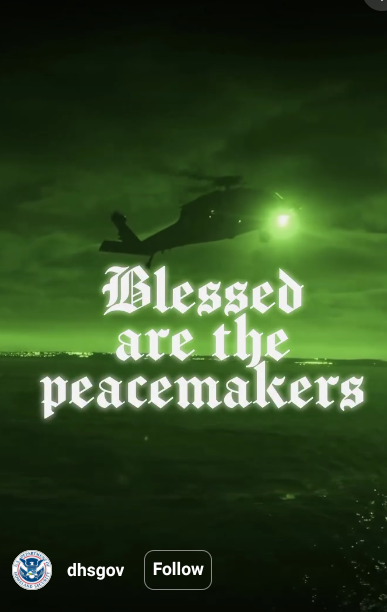
A few weeks ago, the Department of Homeland Security posted a short video on their social media pages. The text “Blessed Are the Peacemakers” appears at the beginning in a Gothic-style script, followed by just over a minute of video of DHS conducting what appear to be military operations. The video doesn’t give context for these operations, but it is captioned with the full phrase: “Blessed are the peacemakers, for they shall be called sons of God.” —Matthew 5:9
Whoever is running the DHS social media accounts certainly has a different idea of what Jesus might have meant by that than I do.
The stories out of Minneapolis have been haunting me these past weeks, a heavy lament and anger for the protesters killed and immigrants detained, for dozens who have died in ICE custody over the past few years, for state-sanctioned violence and military might wielded against the vulnerable and paraded around as a twisted form of Christianity.
Blessed are the peacemakers.
But militarized law and order is not the only way a hollow peace might be offered to us.
I have always been very conflict averse, which has its upsides and its downsides. It makes me a good listener. I am quick to offer solutions and compromises across divides. It also makes me avoid situations or conversations where I might disagree with someone, for the sake of “keeping the peace.” Sometimes, the choice not to engage, or to choose a compromise, is wisdom.
But being conflict averse is not always wise or faithful, and avoiding confrontation for the sake of our own comfort is not at all the same thing as being truly committed to peace.
When we are lulled into thinking of peace merely as the absence of visible conflict, we can lose sight of the ways that systemic structures of oppression perpetuate a supposedly “peaceful” status quo, if we are on the privileged side of those structures.
The Bible and the prophets and our own history warn us again and again of the dangers of accepting a false peace, in which the surface of the water looks smooth but underneath are swirling violent currents of systemic oppression and injustice.
Several times in the Hebrew Bible, the prophets Jeremiah and Ezekiel condemn those who cry “peace, peace,” when there is no peace.
In his “Letter from a Birmingham Jail,” Dr. Martin Luther King Jr. calls out white moderates who are “more devoted to ‘order’ than to justice; who prefer a negative peace which is the absence of tension to a positive peace which is the presence of justice.”
Dietrich Bonhoeffer, a German pastor and leader in the resistance against the Nazis, wrote, “There is no way to peace along the way of safety. For peace must be dared.”
So true peace, positive peace, is neither the absence of visible conflict nor the false peace of militarized law and order won through violence and brutality. Peace must begin with truth-telling about who we are and what we value, about the world as it is and as it might be, with a commitment to justice, with the courage to leave the paths that are wholly safe for the ones that are right. We’re not all called to risk the same things, but we are all called to risk something.
Blessed are the peacemakers.
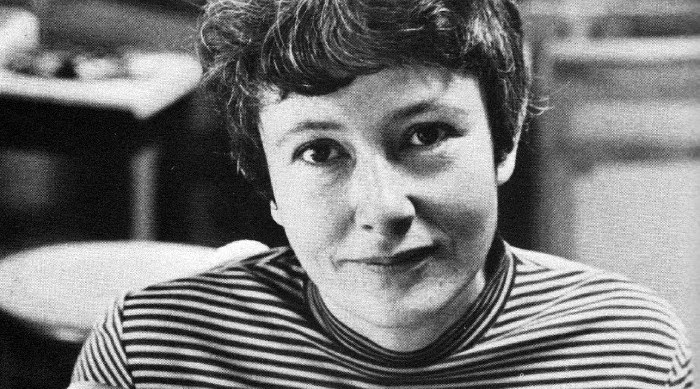
In her beautiful poem “Making Peace,” Denise Levertov writes:
A voice from the dark called out,
‘The poets must give us
imagination of peace…’
But peace, like a poem,
is not there ahead of itself,
can’t be imagined before it is made,
can’t be known except
in the words of its making.
Peace can’t be known except in the words of its making.
Some of those words are words we already know: I’m sorry. I love you. You are welcome here. Here’s some dinner. I’m here for you.
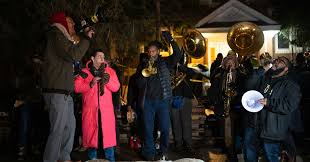
Many of the words we need to make a broader peace, though, feel impossibly far away. But we let us resist despair. Let us refuse to believe God is not still working here. The stories emerging from Minneapolis over these past weeks are cause for deep lament and anger, but they are stories too of deep conviction, hope, and love. There are networks of neighbors supporting one another, buying groceries, providing childcare, keeping their communities safe. In the face of fear, there is work to be done, and it is work we can only do together.
If peace is only known in the words of its making, what a gift it is that in every generation again, we find poets and prophets who dare us to hope for and believe in and work for peace, around dinner tables and in sanctuaries and out on the streets.
Blessed are those who refuse to meet violence with violence, who protect their neighbors with their own bodies, who in their words and actions begin to make peace known, even when it feels impossibly far away.
Blessed are the peacemakers.
8 Responses
Thank you for this beautiful post urging us all to work for true peace, positive peace, individually and communally, in the myriad ways God calls us!
“Peace must begin with truth-telling about who we are and about what we value. . . .” History really does matter. We need to look back to see where we’ve been and to help us navigate where we’re going.
Excellent article, thank you.
What a wonderfully balanced explanation of Biblical peace. It supports the idea of the Biblical view of the Divine…a God of love and justice. To drop the one in favor of the other, as can often times happen, is to be not true to the Biblical balance.
I would just add to your explanation that the balance of power in Western Europe has brought peace for the last 80 years. It too needs to be sensitively maintained and at the moment is being shredded by leaders in our own country.
Well said. Thanks.
Thank you so much for that! So many want peace but a hollow one
Peace making seems to imply working towards something, not away from. What does peace making look like today in this land of great divide? Do we display a desire for peace in our words, in our actions? How do I turn towards others (friends and enemies), not away. Jesus said to love your neighbors and your enemies. How do we move toward each other in love as Jesus would? I wrestle with that every day.
Thank you, Bethany, for your beautiful words.
I also have found a home in the UCC in Irondequoit.
Keep writing.
Blessings,
Steve