
Our series on Sunday evening worship continues.
I figure I have preached some 225 Sunday evening services, mostly in Ontario.
From my youth through college I attended about 600 of them, mostly in the Eastern RCA (Reformed Church in America). In the East, the RCA churches that had evening services were those with Second Immigration (post 1847) “Hollanders” in their membership.
During my childhood in Brooklyn we worshipped only on Sunday mornings, but then my dad took a church in the Jersey suburbs that had enough Hollanders to hold evening services. These were low energy. We sang dreary hymns like Beneath the Cross of Jesus, with dreadful lyrics like, “I ask no other sunshine than the sunshine of his face.” We got “special music” instead of the senior choir. On Communion Sundays we had the awkward “Second Table” for members who had missed the morning service—two pews of them, while the rest of us watched.
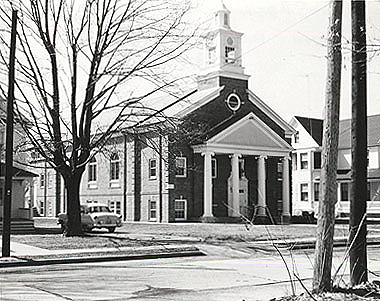
Four years later my dad took a call to a big church in West Sayville, Long Island, the only mostly-Hollander RCA in Metropolitan New York. Its evening services were more lively and sometimes enjoyable. There was a decent crowd with young people in the pews, and the senior choir sang for this service too.
West Sayville had only two churches, Reformed and Christian Reformed Church (CRC). Hollanders defined the local culture, especially the fishing and clamming, but the village was by no means exclusively Dutch. First Reformed was robust and open, and was able to integrate the Burkes, Walkers, Paglias, a MacMillan, a Fleischmann, and all the Leigh-Manuels. With the smaller, colder CRC it shared inter-marriages but no love. The two congregations put plenty of people in church on Sunday evenings.
West Sayville was peaceful on Sundays. Nobody went clamming. The fire alarm was shortened to a single blast. I could listen to the birds on my morning walks. Walter Griek would be inspecting his flowers instead of trawling for fish. I waved to Bram Wessels and said “Goede morgen” to old Arie Schaper out on his little porch. The church bell rang at 8:00 AM for the early service at 8:30.
Our congregation was big enough to need two Sunday morning services, with Sunday School in between. The RCA was not rigid: we could walk to Bill Luce’s Dugout and load up on candy for the main service. A few men at the counter would be finishing their coffee. By then Bud Van Wyen would be in his robe for the choir procession; his Gulf Station closed all day.

After Sunday dinner, people would nap, or we might walk down to the docks, and see the clammers checking their boats or reading the sky. After a light meal of bread and tea (Dutch style) the church bell rang at 7:00 PM.
The bellringer was the sexton, Case Van Hulsentop, a post-war immigrant, his hands broken by the Nazis. After the bell he’d come out and sit on the church’s wide stoop for a cigarette. As other men arrived, the line of smokers would extend across the stoop. We boys knew our place and sat at the end. At 7:15 Case would go in to ring the bell again, put a glass of water on the pulpit, adjust the windows, and come back out until the final bell at 7:30. By then we’d all be inside.
The evening service was relaxed. We kids sat together unless we were in choir. One of us might get the honor of sitting on the organ bench with Mrs. Griek. She let Kathy Van Wyen play some evening services. Kathy was talented and fun, and once for her prelude she improvised on “I Don’t Know How to Love Him” from Jesus Christ, Superstar. Every year the Bay Shore Choraliers from an AME church would sing. We had guest preachers monthly to give my dad a break. After church was Youth Group, and after that a bunch of us would gather in the parsonage, often with my dad.
So two things. First, the character of the evening service had much to do with the larger context, especially if it was enveloped in a subculture that was lively, textured, and warm. What we had in West Sayville was lacking in suburban Jersey.
Second, as Debra Rienstra noticed, the evening service effectively made the whole day a Sabbath. If you were going back to church after supper, it made a difference in how you spent your afternoon: no shopping, no homework, no NFL. A quiet afternoon made a difference in how you got ready on Sunday morning. Sundays were mildly countercultural, and you had good company.
The cliché is familiar by now: “If you’re a oncer, your kids will be noncers.” But I think it’s less about losing the second service than losing a sabbatical counterculture—which in the RCA, at least, was modulated, humane, and even pleasurable. It was churchly and not political, but countercultural nonetheless. And that, we have not suitably replaced.

16 Responses
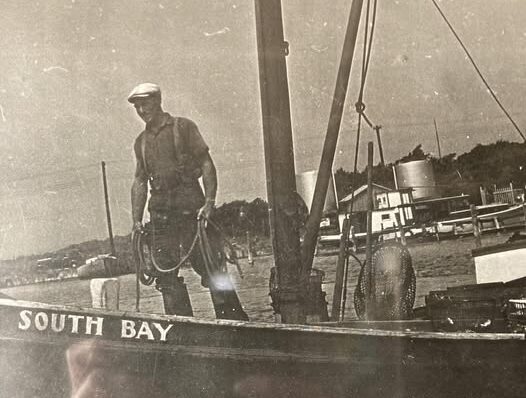
That’s Nelson Van Wyen standing on his “pound boat,” the South Bay. Much later on, I worked on that boat for four summers, assisting Joe MacMillan.
Insightful perspective. I don’t have a lot of personal experience with what has been described by this series, but I soaked in it via my family subculture. I’ve been captivated by all of the essays. It has heightened my nostalgia as I think about my parents, aunts/uncles, and grandparents. This series has allowed me to imagine the different ways in which these flawed people lived their lives on Sunday. What would they say if I could talk to them today? Thank you to all the essayists.
This brings back memories of summer trips spent in West Sayville, staying with my grand parents Lester and Leticia Van Tielen-Seerveld. They attended the CRC down the street on Rollstone Avenue. My first cousin once removed was a clammer in the Bay until that was no longer allowed and my grandfather owned a fish store in Patchogue. Visiting from Toronto, West Sayville felt like a Norman Rockwell magazine cover come to life. The feel of the church building and service was much more traditional than the urban university and suburban worship services I was used to, but it helped me understand something about how my dad grew up, helping in the fish store and learning to play music in church. No doubt there was plenty going on beneath the surface, but my memories are quite rosy.
I remember Lester and Letitia.
Luke, that little CRC produced three philosophers: Dewey Hoitenga, Cal Seerveld, and Paul Sluiter, all three remaining Christian, but otherwise very different in their philosophical orientations.
Dan, my father, Harold Bossenbroek was the minister of the CRC church during the 50s. Reverend Joldersma was the minister of the RCA church.
Bill Luce was also the traffic cop who helped us cross the main street as we walked to the Christian school on Rolling Stone Ave.
The Seervelds were very welcoming to our family. I remember playing at their house with Joyce and Wesley.
The Picture of the boat in the caption of your article is very similar to a boat, which was given to Reverend Joldersma and our family. We refurbished the boat and had good times boating and fishing for a blowfish.
Picking up on your idea of no love lost between a congregations. My mother tells a story that when I was about 10 years old, I asked her, so if the CRC‘s are in first place And the RCA is in second place, who is in third place?
A very interesting place to live, a lot of good activities.
Daniel,
Oh the memories this article brought back. I shared it with my six sisters. We all lived this life in West Sayville. We were slightly “ more Christian “ than you Reformed people because we went to Christian school and never went to Bill Luce’s on Sunday! My dad, Bram Wessels, would often note that more snd more people were watching sports on TV on Sunday.
“Mark my words,” he would say to my sisters snd I, “ sports is going to ruin the church.” Now we all watch our grandkids rushing out of church early to get to a game or skipping church for travel teams, and his words come back to haunt me.
My dad would certainly agree with you that we have lost a “ sabbatical counterculture.”
Sue Wessels Van Engen.
Thanks for this. I knew your sister Betty pretty well, and I would always go see your dad on trips home from Calvin. I believe I met you once at John and Mary Witte’s, at their house near the Franklin campus. Rupert of Deutsch, etc etc.
I’m trying to dredge up from memory what the connection was between wearing white socks all day Sunday between services and therefore not being allowed to ride my bike on Sundays to keep chain grease off the socks. Was the white socks rule to prevent the bike riding? Or was it white socks for PKs and not my friends who were farm kids (FKs) in Agassiz, British Columbia.
Dan
Wow. Great article. You said it all. Growing on Cherry Ave and living in West Sayville was the best
Blessings
Bud Zegel
Hey Bud.
I grew up in Wst Sayvlle CRC. My parents,Jim and Adriana Conkle along with Fred and Martha Stye; Jim and Alice Slootmaker left to help start the church in East Islip. Church was in a rented store front for years then East Islip CRC was built. Our first pastor was Fred Bultman then Alan Arkema.
Thank you for your article lots of memories
Dan, Thanks for the memories!
Lou and Carolyn Verspoor
Did my father ever go to Church? I only remember my Mom and Grandma Van, along with other relatives from Mom’s side of the family. The innocence of childhood was a wonderful experience but as I got older I lost my way. I can truly see the importance of the Christ umbrella now. I suppose with age comes some wisdom, but too often with many regrets. “It is good for me that I was afflicted, that I may learn Your statutes.”
My early memories in the Wallkill church was Dick Hine leaving and a young whippersnapper named Walt Van Popering coming directly from NBTS to be the new minister. My grandfather let me write “Yes” on the paper ballot on the Sunday Van candidates. It was 1953. My family became great friends with him and a couple times of year, we’d go with him to West Sayville to visit his parents and go clamming. Van was the minister in Wallkill for 19 years. His last service there was my ordination in June of ‘72.
Bob, were you ever on his dad’s boat, the “At Last”? Mrs Van Popering had a little cooking stove in it.