
Last month I went with a friend to see The Testament of Ann Lee, a new film starring Amanda Seyfried that tells the life story of Mother Ann Lee, one of the founding leaders of the Shaker movement. I’m not much of a movie person, but when one of my colleagues in the Chaplaincy passed along the trailer to the film last year, I knew I had to see it.
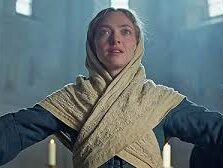
The film was fascinating. I’m a historian of religion and am probably a bit biased toward a film like this. It was so deeply layered, a rich text delving into an array of themes and questions about Ann Lee and the Shaker movement, as well as religious practice more broadly. The more I’ve thought about it over the last few weeks, the more layers I’ve uncovered.
When the movie ended, I turned to my friend and immediately exclaimed, “Ok, I need the bibliography!” — meaning, I wanted to know the ins and outs of the sources they relied on to create the film. How did the producers, writers, and director work with and interpret primary and secondary sources? How did they choose what to include and highlight? The historian in me wanted to know more about the inner workings of how the film came to be, the primary sources they relied on, and how all the pieces together to tell the story of Ann Lee’s life.
At first glance, the narrative of the film seems simple, relaying the story of a singular woman from her childhood to her death. At the same time, it tells the story about a nascent religious movement, and as viewers we bear witness to the Shaker movement’s growth, evolution, and survival during Ann Lee’s life (and its ongoing growth and then precipitous decline after her death and to present day).
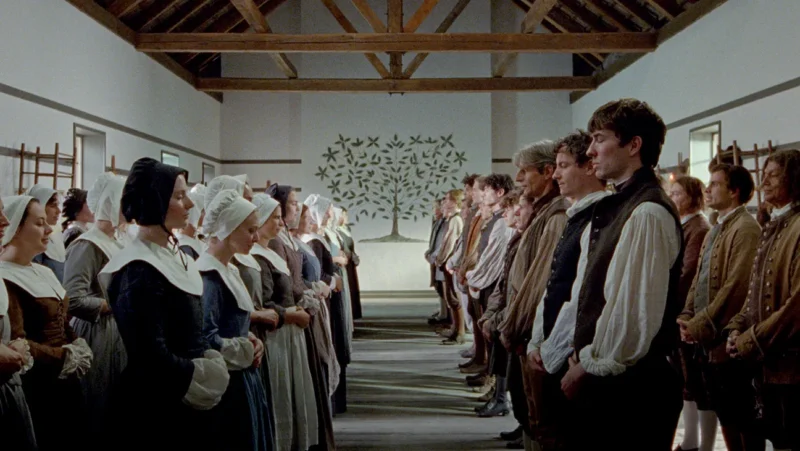
But the film is richer than that. On a deeper level, it tries to recreate the experience of the Shaker faith for viewers. Aided by stark and sometimes eerie visuals and score, these elements of the film allowed the viewer to consider what it would have been like to worship as a Shaker.
We, the audience, are invited into the practice — into the shaking, into the songs, into the religious euphoria of their worship. Music and dancing are interwoven throughout the film. It caused me to think about religion as embodied, a very physical manifestation of faith. For the Shakers, it wasn’t merely something they believed. It was a practice they embodied in the world. It also made me once again think of the sources, how the writers and directors of the movie were using the primary source material to imagine what the early Shaker faith looked and sounded like. What was it like to be part of their religious services and experience their worship firsthand?
(If you’re curious to get a sense of the vibe of the film, I recommend listening to the soundtrack, which reworks and reimagines Shaker hymns, and watching this video posted about how they created the music and choreography used in the film.)
Given its focus on Ann Lee, the film also provided a window into the experience of women in religion. A big question the film tried to answer was how Ann Lee’s experience as a woman shaped her religious calling and her spirituality. It looked at her growing up as a girl in a poor working family, as a woman expected to fully submit to a husband in marriage, and as a mother who lost multiple children. It also painted a picture of what it looked like for Ann Lee and other Shaker women to speak with religious authority and the price they often paid for it.
There’s probably so much more I missed on first viewing of the film, much more to ponder and reflect on — for example, the intersection of the Shaker faith and the material world through the many handiworks they became famous for, and also what does it mean for a religious movement to dwindle and decline?
It’s a film and rich text on religion worth viewing and certainly one I plan to revisit.

5 Responses
Alison, check out this NY Times article from last year.
https://www.nytimes.com/2024/09/05/magazine/shakers-utopia.html
Excellent article!! Thank you for sharing.
Looking forward to watching this movie hopefully it will be streaming soon. Thank you for your gift of looking deeper. It inspires me to do the same; the stretching of my knowledge of the world outside my small window.
I highly recommend the NYT article Gloria McCanna lists.
Thanks for having me add this movie to my “watch list.”
Thank you for this! I saw the movie tonight and was really impressed by the storyline, choreography and music– what a beautiful and compelling film.
The glimpse into how they put it all together in the link you shared is fascinating, as is the link Gloria shared to the NYT article about the community that is left today.