
With Valentine’s Day looming on the weekend, who can blame the marketers of the newest Wuthering Heights film for deciding to release the film to coincide with it, while hyping it in all the advertising as “the greatest love story ever told.”
But crass commercialism aside, I must protest. I’m a Bronte girlie from way back: I’ve been reading the Brontes since I was a teenager; the paper I submitted as my grad school writing sample was on Emily Bronte’s poetry; my master’s thesis was on Charlotte Bronte as was a substantial chapter in my PhD dissertation. I’ve taught the work of all three Bronte sisters–Charlotte, Emily, and Anne–in multiple classes, including a stand-alone seminar, across over thirty years. So let’s just say: I have thoughts.
Since it’s not out here in Grand Rapids, I haven’t yet seen director Emerald Fennell’s new take on Emily Bronte’s only novel, but I’ve certainly been reading lots of the “discourse” on the interwebs. TL;DR: there appears to be a number of substantial critiques and out-right pans of the film. In some ways, no one is ever happy with adaptations of classic novels. Hardcore Janeites, for example, complain if there’s even a hint of kissing (Austen didn’t have it in the novels, so no kissing in the movies). Please. Since I think filmed adaptations are best thought of as works of interpretation, I’m willing to give some latitude if a work captures something of the original spirit. Or in the case of the 2005 Pride and Prejudice beloved of my students, when it helps emphasize things like the class concerns that Austen definitely was exploring by how the film depicts the material lives of the characters.
The problem with the Brontes is that I’m not convinced there’s ever been a good adaptation of a Bronte novel (and I’ve watched them all). In the case of Wuthering Heights, specifically, one of my biggest beefs is that overall almost every adaptation only tells the story of half the novel. In what other novel do filmmakers get away with simply ignoring where the novel actually goes?
Because Emily Bronte is telling a complete tale–this isn’t just an ill-begotten romance between Heathcliff and the original Cathy, who dies halfway through the novel, after all. Wuthering Heights remains astonishing both for the formal elements Bronte experiments with–unreliable narrators, anyone? embedded narratives? –but also, like many other women novelists in the 19th century, for the way this novel is about the toxic effects of patriarchy and primogeniture, of class and gender constraints, of destructive masculinities and femininities. Wuthering Heights is ultimately about cycles of generational trauma and the way that the legal and economic system of Victorian England perpetuates all manner of inequalities and powerlessnesses.
In interviews, Fennell (whose sort of cheeky good humor I’ve always rather liked) has drawn attention to her particular vision of Wuthering Heights by calling it “Wuthering Heights” in large air quotes–and claiming that it is based in her reading of the novel when she was 14 years old.
That makes sense because if Cathy and Heathcliff are to be seen as “romantic,” it’s in an adolescent, overly dramatic way. Cathy and Heathcliff are sexy only if you’re rather young and very bookish but have also had no actual experience in relationship with another human being. Because really Cathy and Heathcliff and their behavior are pretty awful: selfish and cruel, indulgent and careless, capricious and violent in all sorts of ways. The novelist Anne Tyler humorously observed, “I found out that several of my women friends considered Heathcliff their all-time favorite romantic hero. So I read about three-quarters of [WH] as a grown-up, and immediately developed some serious concerns about the mental health of my friends.” Indeed. The last time I taught the text it made sense to almost think of Cathy and Heathcliff less as developed characters and more as elements or archetypes. But even if they are like the weather–it’s not very pleasant out. So the notion that this is the “greatest love story ever told”–I certainly hope not.
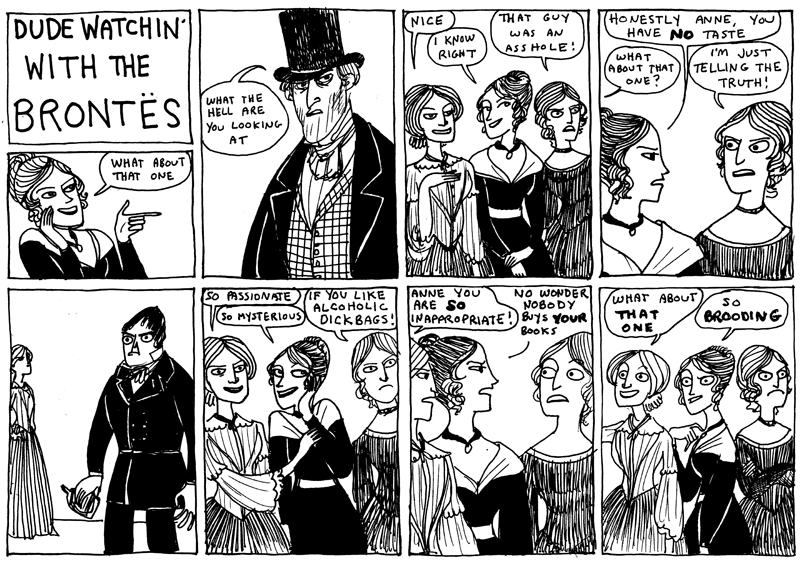
Of course, the Brontes grew up with a LARGE dose of Lord Byron and the Gothic. With destructive loves and big, big feelings; death and loss and very, very dramatic situations. Their juvenilia is replete with the characters and themes taken from that literature. Some of their major adult novels, too–Jane Eyre, Wuthering Heights, The Tenant of Wildfell Hall–feature each sister’s take on the Byronic hero. I still get a kick out of this cartoon from Canadian Kate Beaton (apologies for the language) that imagines the sisters’ conversation about their fascination with/attraction to this figure.
But actually, Wuthering Heights doesn’t suggest the triumph of Heathcliff, either. Charlotte may explicitly domesticate and Christianize Rochester, and Anne might make Huntingdon realize the error of his ways before he dies, but, even as Heathcliff remains a powerful presence in the novel, Emily crafts an ending that suggests new possibilities, or at least, breaking of old patterns.
This is why it’s crucial to read to the end of the book. Without summarizing too much of the ending, it’s at least important to note that a) Heathcliff dies increasingly unhinged and unable to finish his revenge, while starving himself to death. Sure, maybe he’s reunited with Cathy #1, and they get to roam the moors, but good riddance to them both, if you ask me. Take that messy drama outside already!
But b) in the second generation, the widowed Cathy #2 (the daughter of Cathy #1 and Edgar Linton), after finally confronting Heathcliff, has now triumphed by regaining property and finding love and forgiveness with Hareton. Hareton, also dispossessed in the novel, has been kept uneducated and wild, but he is, at heart, kind and shy. Though he is initially torn by his loyalty to Heathcliff, he protects Cathy #2 against Heathcliff’s rages and eventually also reclaims his property. But even more importantly, Cathy #2 apologizes for her earlier judgmental mocking and dismissal of Hareton’s lack of learning and roughness, and instead, she lovingly teaches him to read. She sees her own errors and makes amends–something her mother never did in her high-handed interactions with the similarly “rough” Heathcliff. And, thus, learning and literacy become the keys to restoration of both of their houses.
So if there’s a romance to be had, it ain’t Heathcliff and the first Cathy. Instead, shy, but hot Hareton who is willing to forgive and willing to be taught is a more winsome man than raging, violent Heathcliff ever will be (even as we may understand how he became angry and consumed by revenge). The first Cathy’s lack of humility (not to mention lack of communication) is contrasted by her doppelgänger daughter’s willingness to ask for forgiveness and see Hareton’s value, even as someone very different from her in affect and upbringing. And at least a few of the inequities of property and class and gender are also addressed.
Maybe the next movie version of Wuthering Heights will decide to tell that story. That’d be a blockbuster.
This new film may have depths I don’t know about. It certainly looks like the aesthetic could be interesting (though one of my students said to me today that she was somewhat worried about watching an “extended Charli XCX video”).
But I wonder if we can start more actively resisting stories that try to convince us that what gets called “passion”–something that is violent, angry, exploitative, selfish–is something laudable, is somehow “the greatest love story ever told.”
It’s just not. There are better love stories to tell. Emily Bronte even gave us one.
Photo by Joanna Kosinska on Unsplash

5 Responses
As always, Jennifer writes an informed review of wit and wisdom. Love this!
Interestingly, WH was my least favorite or of the Bronte novels. I wearied of Cathy #1 and Heathcliff and have not read it in years since I didn’t enjoy it the first time – probably should try again after reading your essay.
Of them all, Jane Eyre was by far the best and I’ve read that numerous times.
Agreed, Helen! But I couldn’t even make it through WH. Jane Eyre, however, I’ve read at least 25 times. While I bemoan the many JE cinema failures and missteps (too many spunky Janes and hunky Rochesters), I’m glad filmmakers keep trying. It makes me love the novel even more.
And Jennifer, I thought of you yesterday when I saw the WH display at the new Knapp’s Corner Barnes & Noble. I was hoping (i.e., I was pretty sure) we’d get this Valentine’s treat from you!
Hey Jennifer – I should’ve taken a course in the Brontës from you, but, alas, you weren’t around at the time of my course-taking. 😢
Love a good rant, especially one informed by actual literary knowledge. I’ve always hated WH, even as a teen. Yuck.