
How are you coping these days? Of course you’re doing all the appropriate things: prayer, scripture, community, napping, whatever positive citizenry actions you can muster. So am I. But how are you coping—by which I mean, what numbing mechanisms give your mind a rest for a while so you can face reality better? Me, I’m watching British murder mysteries.
Does it help? Sure. I watch while I’m working out on the treadmill (double points: exercise and mind-numbing!) as well as late at night when my brain is fried. Foyle’s War got me through the fall. Now I’m working on Grantchester. I’ve also watched the silly and wonderful Shakespeare & Hathaway and the charming Madame Blanc Mysteries. I even made it through one season—or “series” as the Brits say—of Broadchurch.
It’s all very educational. I have learned a lot about British life. For instance, the murder rate in small towns in England is disturbingly high. Every single week someone gets bumped off: a professor falls to his death off a Cambridge tower, a black-market dealer gets car bombed in Hastings, a rich husband keels over from poisoned tea in Stratford-upon-Avon. It’s never an accident, by the way; it’s always murder. Fortunately, in good British-upper-lip style, the citizens of these towns seem to take it all in stride. Evidently, this is normal for them. I suppose they understand that the women over in East London are busy having babies on Call the Midwife, repopulating a country plagued with weekly murder mysteries.
I’ve also learned that one addresses members of the British constabulary by their full title. Detective Chief Superintendent Foyle. Detective Inspector Keating. Don’t take shortcuts—spit out all those syllables. Also, as per tradition, English murder investigations work on the buddy system. The detective inspectors pretend they don’t want a sidekick, but they do. Usually the sidekick is somehow inappropriate for the job: disgraced police officer, random cab driver, entirely too young. Or quite likely a member of the clergy. Anyone who can produce witty banter will do. The buddy system, even when outside the lines of the protocol, tends to get results fast. Rarely does a murder require more than one episode to solve satisfactorily.
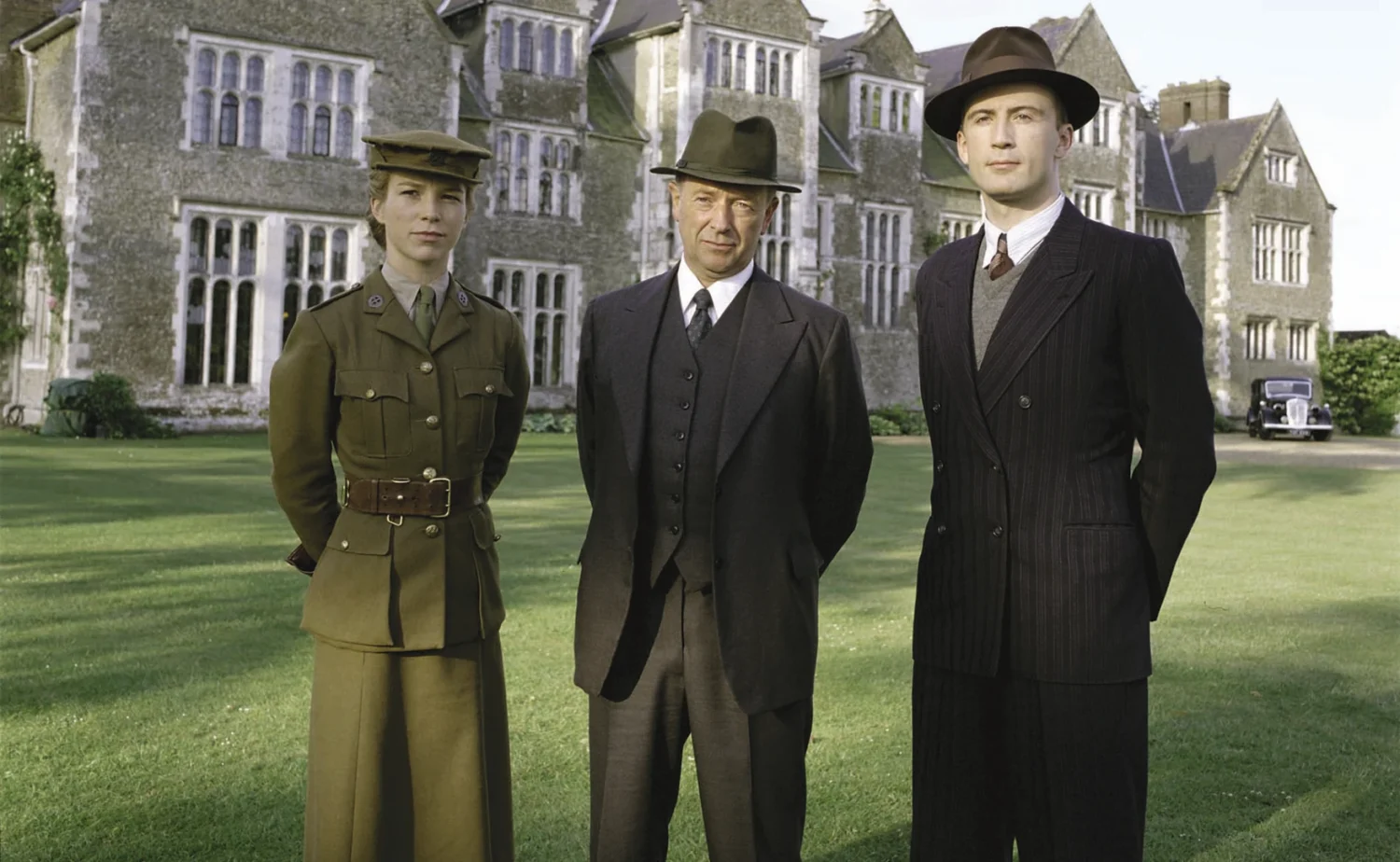
Solving crimes, apparently, also requires drinking a lot of booze. All day, every day: booze. Some murder investigators also drink tea, but some don’t even bother. Foyle—excuse me, Detective Chief Superintendent Foyle—turns down tea every time, but even he, Mr. Taciturn and Self-Controlled, will accept a whiskey. Madame Blanc and her English pals spend a lot of time before, during, and after solving a murder sitting at the local bistro, drinking white wine. In Grantchester, the Detective Inspector and his current vicar sidekick drink and smoke constantly. I guess this helps solve crimes? It never seems to interfere with their crime-solving skills, but it sure wreaks havoc with their personal lives (and heart health, one would imagine).
Speaking of Grantchester, this little town outside Cambridge is evidently where the English church sends all their dishiest vicars. I mean, wow. We’ve been through two vicars in seven seasons, and while both Sidney and Will may be pretty to look at, they are terrible vicars. Falling into bed with various damsels, drinking like fish, and spending virtually all their time solving crimes with only the occasional vicarring. Thank goodness for the Book of Common Prayer. When the hour for evensong comes, they can run back to the church, whip on their vestments, turn to the right page, and go. Better yet, they can ask Leonard, the long-suffering curate, to take the service for them (at least until poor Leonard is booted out of the curacy—long story). In their favor, these lousy vicars do tend to be good listeners and have sudden epiphanies about who committed the murder—usually while moodily smoking/drinking—but their preaching: terrible. Quasi-pious, theologically saggy word salad. Thankfully their sermons only last 1.5 minutes.
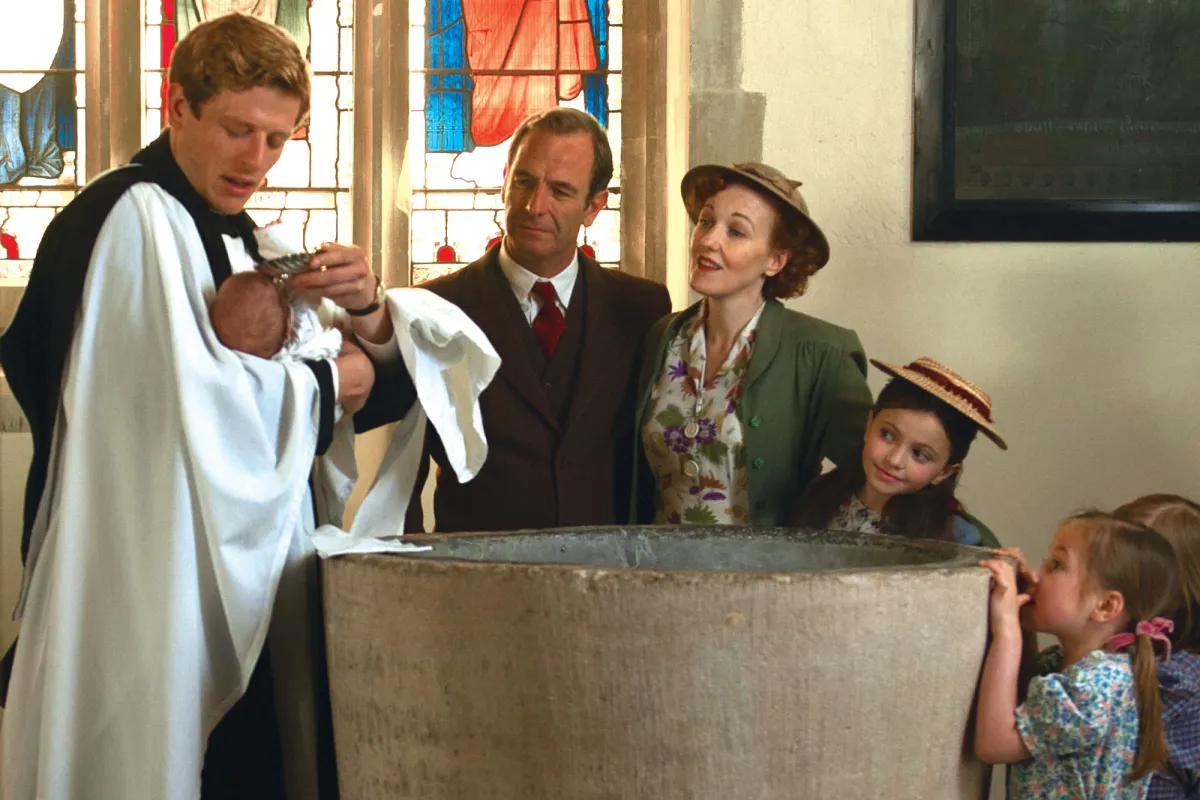
As for the citizens of small English towns, they do get around. I’ve noticed they move from town to town and take on new identities and roles—sometimes victim, sometimes perpetrator. Perhaps we can attribute this to the mighty British training system for actors. The same thirty actors—all of them excellent—seem to play all the character roles on British TV. Where have I seen that lady before? Ah, she had birth complications on Call the Midwife, then apparently moved to Grantchester, changed her identity, and murdered her brother with hemlock to secure his estate.
Everyone, of course, has something to hide. They’re having an affair, they’re embezzling, they had a love child, they’re in love with someone forbidden, they did something brutal during the war (which war? what do you mean which war? obviously World War II—or maybe the Great War). Also, everyone has good teeth and period-appropriate fashion, hair, and makeup. Well, except the unhoused, who have ragged clothes, fetchingly mussed hair, and good teeth.
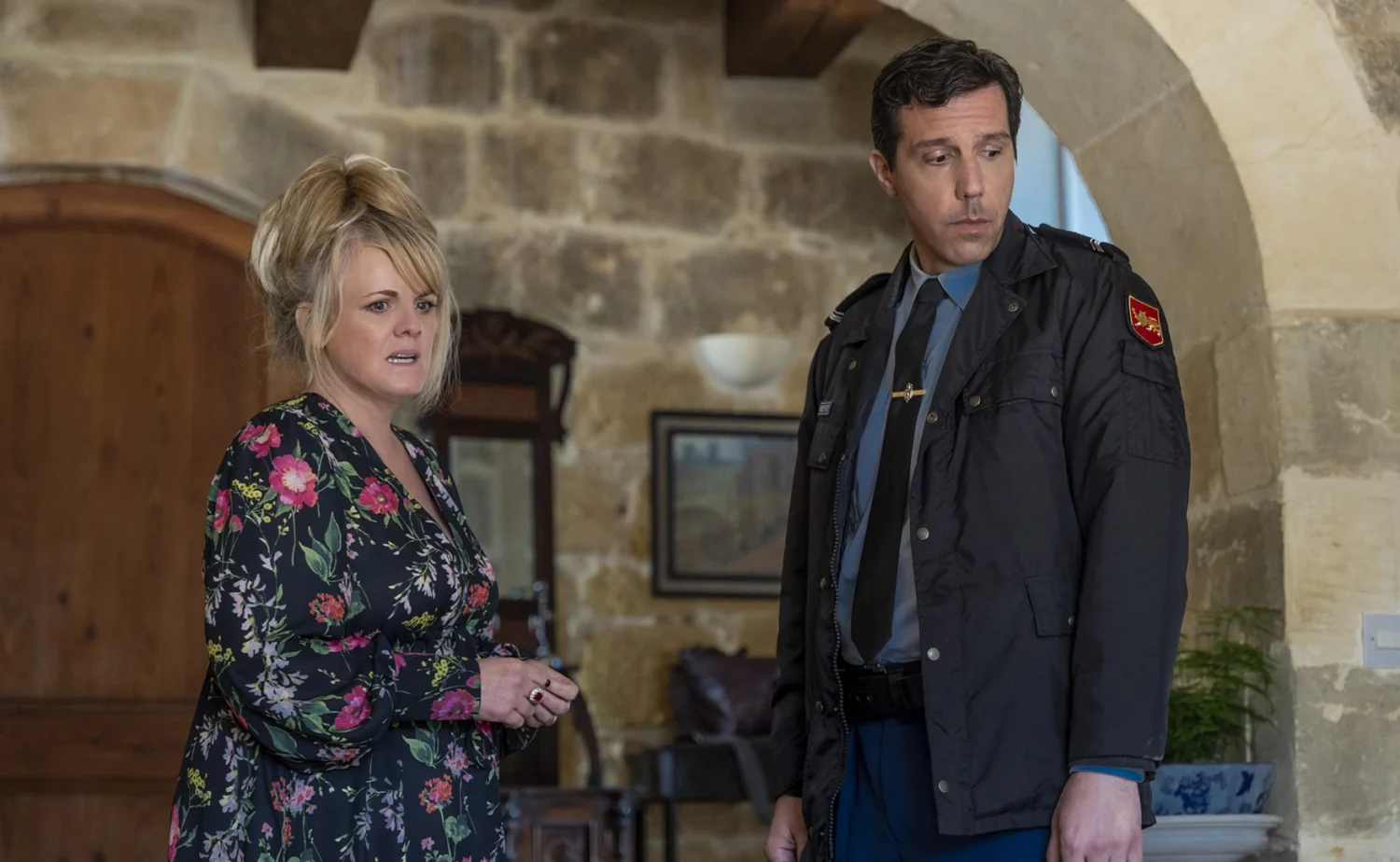
Moreover, the small-town populace suffers from—or benefits from—partial amnesia. The main characters recall their own compelling personal dramas from previous episodes, but they hardly ever reminisce about the previous murders they’ve solved. I suppose this helps them keep going without getting mired in existential angst over their crime-ridden society. The townspeople, as noted, seem to wipe their murder-memories clean from week to week. The French, too! When a cluster of English ex-pats wind up in a French town on Madame Blanc, the good people of Sainte Victoire fail to correlate the sudden uptick in the murder rate with the amateur-sleuth Brits who have moved in. On either side of the channel, the townspeople go right on gardening and shopkeeping and hiding their nefarious or tender secrets. No one gets therapy.
Well, it’s all very silly, isn’t it? Silly and satisfying in the way that formulaic fictional genres often are. The murder mysteries I watch could be classified as historical whodunit cozies—the tone remains light, we enjoy charming small-town scenes and moments of humor, the killers are rarely hardened criminals. In fact, the perpetrators are often ordinary people under some kind of desperate duress. So as viewers, we can enjoy the puzzle-solving dimensions of the story, knowing that whatever the complications, People Who Care About What’s Right—imperfect though they may be—manage to tamp down the wrong, over and over, in fifty to ninety minutes. I suppose it makes sense that these shows would appeal to me right now.
Yes, it’s a form of escapism. Unlike the hapless amnesiac English (and French) townspeople, however, I do remember week to week what’s going on out here in the real world. In the midst of snarling cruelty, ignorance, and pain, it doesn’t hurt to enjoy a little fictional encouragement that somewhere in the human spirit, we still want People Who Care About What’s Right to uncover the truth, catch the bad guys/gals, and hold them accountable. Also, watching Grantchester has prompted me to donate to my local PBS station.
Fortunately, of the making of British murder mysteries there is no end. I still have three-and-a-half seasons to go with Grantchester, and the show remains in production. Evidently, in season 9 we will move on to our third dishy vicar. I wonder if he can preach? (Doubt it.)
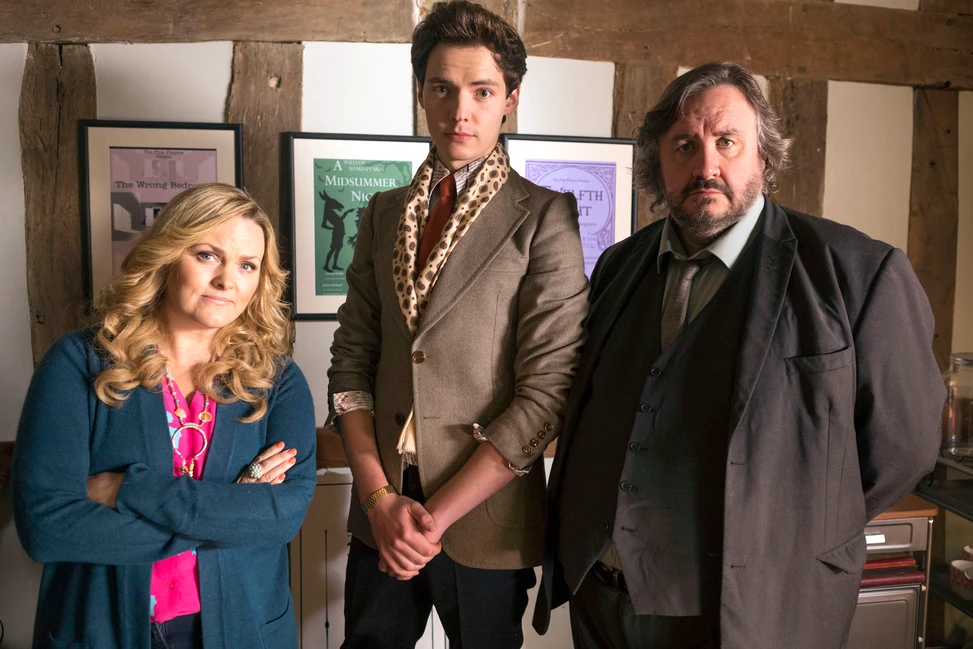
A short, annotated list of cozy-ish British murder mysteries mentioned in this post.
Please add your recommendations in the comments.
Shakespeare & Hathaway: The coziest of the cozies, with plenty of silly humor. Luella Shakespeare and Frank Hathaway, with their aspiring-actor assistant Sebastian, solve murders in Stratford-upon-Avon. Lots of delightful Shakespeare-related Easter eggs and references. Setting: close to modern day. 5 seasons. BritBox or Hallmark through Amazon Prime, neither of which I have, so I watched seasons 1-4 through the library.
Madame Blanc Mysteries. Also light and cozy in tone. Amateur sleuth Jean White solves crimes with her friend Dom, a taxi driver, and their other British ex-pat friends in a town in Southern France. Jean’s antiques expertise comes into play every time. Setting: close to modern day. 4 seasons. AcornTV.
Grantchester. Slightly darker in tone and a wee bit racy. Detective Inspector Keating and one or another vicar sidekick solve murders in the Cambridge area. Good puzzles and historical fun, although I spend a lot of time muttering What are you doing, you dummy! whenever the main characters make ill-advised decisions in their personal lives, which is often. Setting: 1950s and 60s. 10 seasons. PBS Passport.
Foyle’s War. More serious, but fascinating in its attention to the reality of living in England during and after World War II. The taciturn and principled Detective Chief Superintendent Christopher Foyle solves murders in the southern coastal town of Hastings (and later in London), assisted by the young Samantha Stewart and (sometimes) Detective Sargeant Paul Milner. Excellent acting and complex stories. I actually learned a lot I didn’t know about World War II from this show. Setting: 1940-47. 8 seasons, but only a few long episodes per season. AcornTV.
Broadchurch. I’ve only watched one season of this show, as I found it too dark (and I don’t have the right streaming service for the other seasons). Detective Inspector Alec Hardy and Detective Sergeant Ellie Miller solve crimes—slowly—in Dorset. Fantastic acting (David Tennant! Olivia Coleman!) but they do one murder per season (I think?). Setting: close to modern day. 3 seasons. Season 1 on PBS Passport.
Note: No guarantee my notes about streaming platforms are correct. These platforms change their offerings all the time, just to drive us crazy with frustration, and it’s very difficult to figure out what is streaming where.
Thanks to friend Lisa DeBoer for recommending Foyle’s War and friend Leanne Van Dyke for the word “dishy.”

45 Responses
You might like Shetland. Especially Jimmy Perez.
Shetland is a great series. I would add Agatha Raisin, Magpie Murders, Annika and Whitstable Pearl.
Thanks. I also turn to British murder mysteries as well as watching West Wing again. Takes my mind off all of the things going on around me, while also watching the news and other podcasts.
I like Sister Bonaface, available on Hoopla (the free library app)
At one point Ann and I were hooked on the British series Murdock Mysteries. Eventually we watched all 318 episodes. I’m not sure it’s even available any more but it was a delight.
Murdoch Mysteries is Canadian, unless there is also a British version 😀.🇨🇦
Midsomer Murders
25 seasons of quirkiness! I think this show established the formula.
Father Brown
Vera
We really enjoy our subscriptions to Britbox and Acorn, where you can watch all of them!
I watch all that you watch and I enjoy the British language and scenery. I record or watch them when they are on public TV so that is another way of seeing all and more of what you have seen. It is good watching in my world that blocks some of the violence in our real USA world.
You[ve touched a delightful nerve this morning. Having watched PBS Sunday evenings for 50+ years and still watching even more on Britbox and Netflix, all of these and more, are a delightful form of escapism that usually solves the crime without the grime of American crime shows. You know, stiff upper lip and on we go, never much blood and guts, either. Currently into season 6 of The Crown and I’m feeling quite sure that all the royals and most of British society must die from lung cancer and cirrhosis of the liver; never without a neat drink or cigarette in hand. Marvelous fun.
Quite right. I have noticed that people in these shows remain relatively tidy even when they’re murdered. One little knock on the head, and they’re done. Just a little pool of blood to mop up.
Father Brown,( he’s not ” dishy,” though.
No, but he IS adorable. And a better priest!
Delightful! Thank you!
Spoiler alert: the next vicar who comes to Grantchester is dishy also and he can’t preach.
Sigh. No surprise there. Glad I didn’t get my hopes up about the preaching. 🙂
Not British, but you might like Astrid, a French crime drama available for streaming with PBS Passport.
Sorry, West Wing for me.
I can’t wait to read your post to my husband. The past several months (during football season) I have been hooked on British murder mysteries. I’m just now watching Broadchurch but, in the past, have watch Mis Scarlet, Miss Fisher (she’s a little racy but so entertaining), Bookish, and Annika. But the one that got my husband hooked was “Astrid”. It’s a French murder mystery with subtitles, but so fascinating. There is a British version of Astrid called Patience that is also very good. What you said about “being my form of escapism is oh, so true.” Loved your post!!
Out of desperation for mind numbing content I subscribed to BritBox. My husband says it’s the one streaming service we’ve gotten our money’s worth, by a lot.
Good to know. We could probably do with a streaming inventory. Thanks.
Midsomer Murders; Inspector Morse, set in 60s and 70s, played for 20 years or so; Endeavour (set in 60s, prequel to Endeavour, with Endeavour (yes…) Morse in his younger years; Sherlock (with Benedict Cumberbatch, PBS Passport); Murdoch Mysteries, Canadian actually, but we’re still kinda in the Commonwealth and King Charles is on our coins, set in Toronto in the late 19th & early 20th centuries, besides catching all variety of killers, Murdoch also invents prototypes of gadgets now well-known to us, like telephone, radar, cell phone and more. in 18th season now Netflix for first 15 or so years–no commercials–and on CBC Gem from there on (CBC Gem).
Thanks for all the great suggestions, everyone!
We also love Britbox. Check out Vera, Grace or Lewis.
We like Brokenwood, set in a small New Zealand town, with gorgeous scenery, lots of Lord of the Rings references, and those fascinating Kiwi vowels (“The cause of dith has yit to be ditermined”); Miss Scarlet, with its smoky 19th century London setting and Kate Phillips; Unforgotten, which is a bit dark but has redemptive plotlines; Annika, set in Glasgow and featuring Nicola Walker’s snarky asides; and Astrid, featuring a persuasive portrayal of a neurodivergent main character. If you want to see James Norton (the first dishy vicar from Grantchester) as a terrifying sociopath, try Happy Valley (but dark, dark, dark!).
VanderKolk on PBS. British crime drama set in the Netherlands. Every now and then an actual Dutch accent is heard.
Check the original VanderKolk too
I think you mean Van der Valk. Bookish is a new British detective series this year. Also, I’ve watched Ice Cold Murders, Ridley, Guilt, Miss Fischer’s Murder Mysteries, Vienna Blood, Maigret and Before We Die, all on PBS Passport.
Yes, Van Der Valk
I hate to admit it but Judy and I are watching some of these for the second time.
My favorites are any in settings that predate smartphones.
I love both Brit Box and Acorn. Also check out Death in Paradise and Return to Paradise.
Have you seen the Belgian original of Professor T? Brilliant, brilliant, brilliant. PBS. The British imitation just doesn’t have it.
What I hate about Grantchester is what they do with gay priest. Constantly humiliating.
The comments are a conversation among our friends with similar viewing addictions. By all means watch Astrid for a remarkably insightful main character who is on the autism spectrum (though the plots in season 5 get a bit contrived) and Unforgotten for moving and thoughtful engagement with challenging current issues (especially the lifelong wounds of childhood abuse in — I think –season 2, and for Nicola Walker, terrific in Annika, though her replacement in the last seasons is excellent too). But Foyle’s War! It’s on a class by itself, for superb acting and insight into a nation at war. Susan and I have watched it only twice, but we have a friend who watches the entire run every year or so.
And then in the off-season, to the mid-shelf mysteries set in Australia or the Caribbean
I recommend that you find a way to finish Broadchurch. Its finale was very satisfying . . . reminding me of a George MacDonald novel.
Don’t miss out on “A Touch of Frost.”
I find it interesting that you found Broadchurch too dark but basically pass of the others as shallow and unrealistic given the number of murders that occur. What I liked about Broadchurch was the depth of characters and the time needed to solve one murder over 9(?) episodes. I do think the first season was the best. I think British (and other European -eg Wallander) mysteries are so much better than the shallow hero worship and melodrama of what gets turned out in the US.
It is true that the Brits seem to have a a few very good actors that appear in multiple shows. It was a bit jarring to remember Olivia Colman as Ellie Miller and then see her as Queen Elizabeth in The Crown.
I agree with Jeff. Broadchurch is my all time favorite. And I have to disagree with you about perfect teeth. One of the reasons I love British TV is because the actors don’t all have perfect teeth, and they mostly look like normal people.
I can’t find Father Brown in your review. Speaking of numerous murders in one small town!
Department Q was awesome, but only the British version.
No one has mentioned Vera, Detective Chief Inspector in Northumberland in northern England, a no-nonsense middle-aged sleuth, who exhibits in an unemotional way compassion for perpetrators and victims. Regrettably, the final episode was last year.
Ms Fisher’s Murder Mysteries. 1920s spunky flapper heroine. DEE-lightful though only a few seasons. Acorn and PBS.
Thank you for this post. I feel so seen.
I’ve been binging dystopian series but I think I need to move to British murder mystery series!
Loved this article! Husband and I have watched all the above and agree with your assessment. Another series you might enjoy is Midsomer Murders.
We enjoy British Detective shows. On one of our last trips to England we went to the real village of Grantchester and saw the church and some of the scenes commonly used for filming. Now you’ve given us more shows to add to our watch list.