
Snowy ag fields glow faintly in the dark, carrying just enough residual daylight to stand apart from the moonless night. Carol was driving us home and I woke from a drowsy shotgun-rider fugue. Half asleep, half awake, half something else, a head-full of tossing all night in the hotel and standing all day in the cold. Headlights from on-coming traffic vector over us. The trees were even darker, visible as shadows, darker still, there on the far horizon.
It’s a little perverse to say that I enjoy Lent, but I am comfortable there. It’s the spare lonesome expanse, the waiting out the gray, the quiet in your head. And I am ruminative and moody by nature – perfectly content to stand apart and let my internal monologue range feral among the things I think I understand, the things I don’t, and the longings. Content to wander the borderlands of belief, whistling (as it where) past the graveyard with wan and tepid faith in the battered compass I carry.
Yard lights glow in the fine night fog. Lights of a barn or a farmhouse or some human fixture, though at night and at distance, only the lights. Out to the horizon, in a pattern of sorts. None too close, none too sparse, a familiar geometry of distance and isolation, flickering nodes on a grid of forties. That delicious sense of loneliness to counterpoint the rushing traffic.
Lent makes the space for the sojourner. It begins in darkness and asks people of faith to search and sit with it, to sit with the uncertainty and longing — and if not to be comfortable there, to summon the grace to bear it. There’s genius in the church calendar, aligning Lent with the darkness of February in the temperate regions. We are winter people. We know the darkness and cold as familiar and we live the transition. We know all this intellectually but Lent invites us to experience it physically, pinging the long dormant dusty synapses of our animal brains. Short days, snow and ice, granular and gray. The slow return to light on the scale of long nights and harsh afternoon sunlight spending itself out during the commute home.
I know yard lights for what they are, but I also remember that knowing is only partly satisfied by things you can touch. A philosophy grad student, a friend 30 years ago, tried to explain his research into Karl Barth by having me look deeply into a steep-sided side canyon of the Bitterroot near Stevensville and then to see around the corner. I remember knowing something of the disappearing shadowy distance despite never having gone there. I was too dull to get what he was trying to tell me, but I understood something else – having been somewhere similar.
Lent is the long shadows in our familiar woodlands, the bare branches, the distant crow. It’s the world in grayscale, everywhere the interplay of darkness and light. The emergent knowledge that the binary makes no sense without the juxtaposition of its two opposite states.
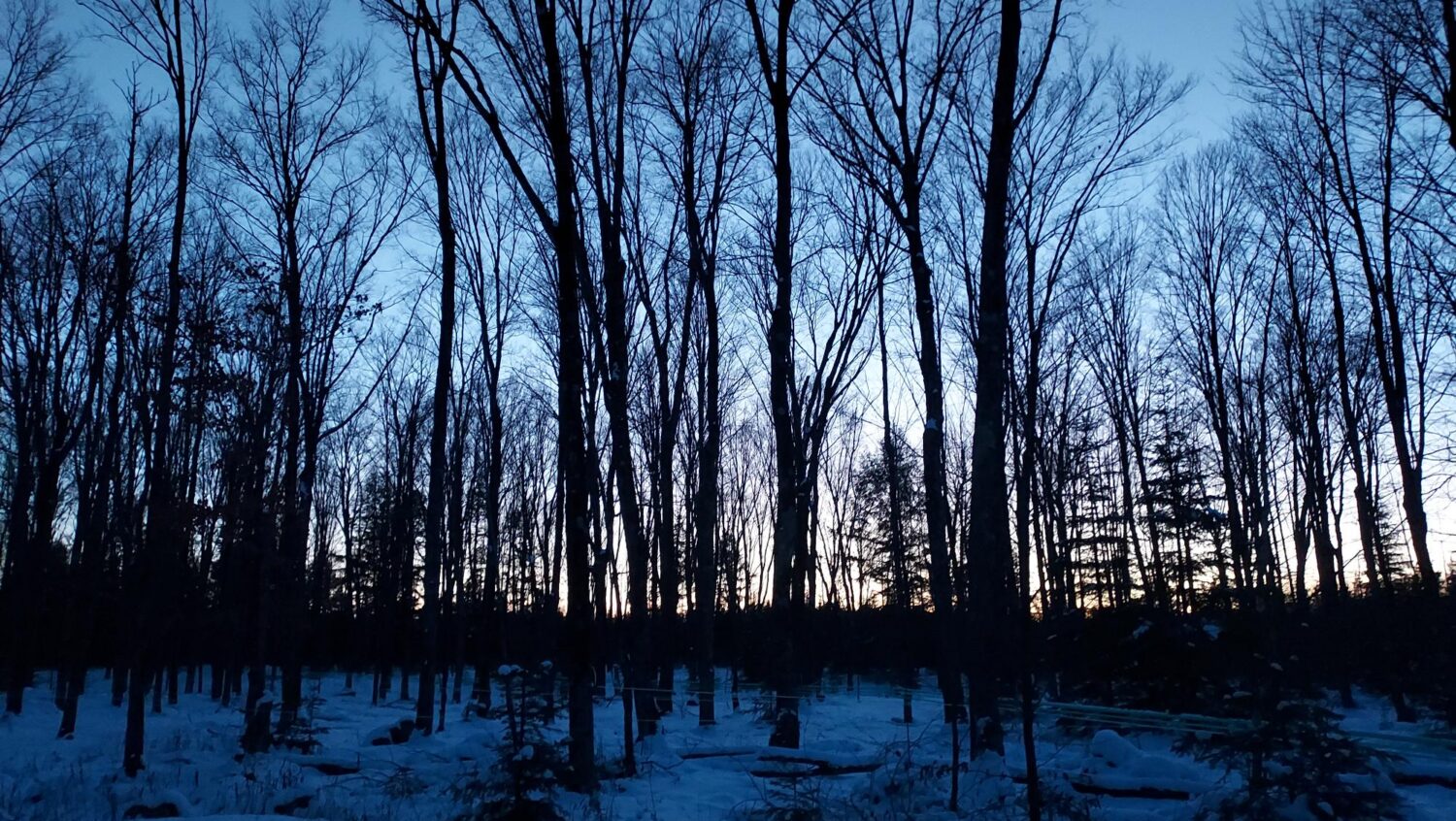
And this Midwestern ag-land nightscape. Lights calling to a welcome sense of cold distance, off and away from Route 51, like campsites in the rolling row-cropped prairie, flaring just far enough apart for a reserved Midwesterner. I let the reins slack.
I’ve told the story before, but Lent for me is forever known through an experience of one of our Lenten services. As the Pastors stripped the Table parements and dimmed the sanctuary lights and the music stopped and left, we sat silent with ourselves in the gravity of the story, heavy with the moment passed. And there, where I normally sit on the left side a few rows back, the winter sun vectored in through the dove-and-geometry-stained glass. It moved, front to back until it was full in my face, even uncomfortably so. And I could see nothing for the full glare.
I feel the refuge, and let it draw me in. Warm campfires of other sleepy travelers. Out there if I need them. If it should all go to hell.
And there, on the left side a few rows back, the darkness released was itself consumed in warmth and light. And I’ve held that experience for years. More than a metaphor. In that holy moment, ritual and story, transcendence and muddy reality wrapped themselves together to say, “hold on. . . it gets better.”

3 Responses
Once again, thank you.
Wow! Poet, teacher, prophet, theologian, friend!
” my internal monologue range feral among the things I think I understand.”
Thanks for this!
Tim, you have been blessed to be a blessing. Thank you. I’ve been blessed this morning on my Lenten journey. I especially needed to hear: I also remember that knowing is only partly satisfied by things you can touch.
I’m such a Thomas.