
Religion’s back now, hotter than ever before, I have to tell you.
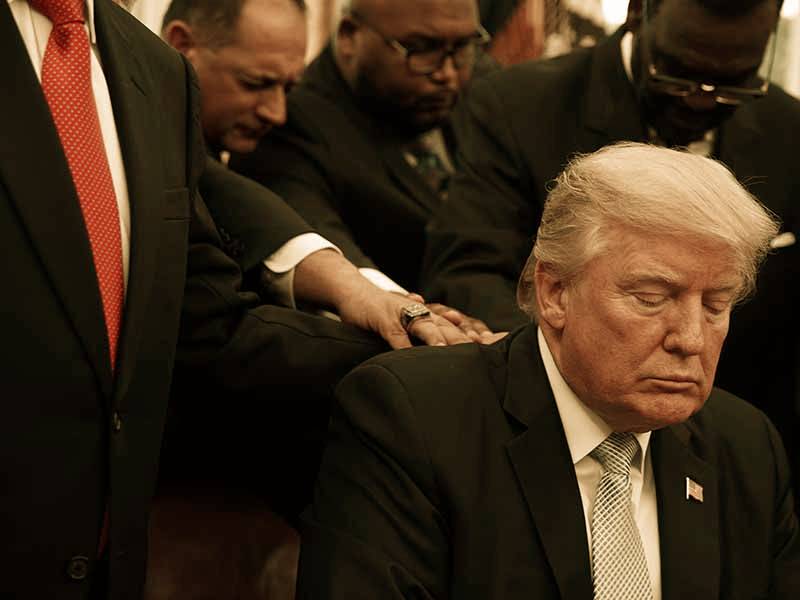
The National Prayer Breakfast was held on February 5, and since its beginning in the 1950s, it’s been customary for the President of the United States and other dignitaries to attend. The prayer breakfast is a private event, put on by an organization known as “The Fellowship.” They are low-profile, and call themselves an organization without an organization. The prayer breakfast, however puts them in the spotlight.
My primary thrust here is to write about Donald Trump’s remarks at this year’s event, but please allow me to digress first about those putting on the event. There have been books and documentaries about them, claiming they’re nefarious right-wing actors. I know some of those in leadership and once attended the prayer breakfast. Instead of being mysterious conspirators bent on world domination, they are sincere evangelical Christians who are interested in being close to those in power. That may not be your cup of tea and you may feel they are misguided, but the “shocking revelations” about them have been off-base. When I attended the prayer breakfast, President Barack Obama was there, along with future President Joe Biden and former British Prime Minister Tony Blair, the keynote speaker. I understand the attraction to being close to those with power—I felt good about myself being in that room.
The name “prayer breakfast” is a misnomer on two counts. There’s not much prayer and there’s not much breakfast. For security reasons, the doors remain shut while the President is in the room. Because of that, breakfast is a few pastries pre-set at the table. The breakfast is part of a longer event which lasts a few days, includes various seminars, and politicians from around the world attend. A decade and a half later, one of my clearest memories is of Charles Colson standing in the hotel lobby with a receiving line stretching out the door, like an evangelical pope.
The featured speaker this year was supposed to be Bill Lee, the governor of Tennessee. Donald Trump was supposed to give opening remarks, but instead hijacked the event. As one commentator put it, “Trump delivered a speech that wandered for 40 years in the desert of vanities and grievances.” By the time Trump was finished, the emcee made a joke that the breakfast was about to turn into a luncheon, and Bill Lee scrapped his keynote address.
Aides had prepared a message for the President, but Trump mostly winged it and did what he calls “the weave.” Others call it logorrhea. Reading the transcript, it’s easy to tell when he’s off script:
“I have a really big ego.”
“Half the time, we’re a minority and we still win. How do we win with a minority?”
“This moron . . . Thomas Massie. There’s something wrong with him.”
“I gave the farmers $12 billion. And they don’t even want it; they just want to be treated fairly. But we’re getting it from that. But we’re getting it, nobody’s ever in history and it’s — we’ve never done it either, like anywhere close, we’re taking out more energy out of our beautiful land, oil and gas, clean oil and gas. And I always say clean, beautiful coal. You know, I told — the only thing I told these two guys they have to do, because they’re the greatest energy people in the world, the best.”
“We have peace in the Middle East, by the way. First time in 3000 years, we have peace.”
“I stopped the mutilation of children. The mutilation, the word is mutilation. They mutilize, the mutilation of children. I stopped it.”
Trump’s remarks about religion were scattered throughout the address. In addition to “religion’s back now, hotter than ever before,” there were these statements:
“I think I probably should make it (into heaven). I mean, I’m not a perfect candidate, but I did a hell of a lot of good for perfect people. That’s for sure.”
“I’ve done more for religion than any other President.”
“I don’t know how a person of faith can vote for a Democrat. I really don’t.”
“When Christians come under attack, they know (presumably the attackers, not the Christians) they’re going to be attacked violently and viciously by President Trump. I know it’s not a nice thing to say, but that’s the way it is.” (Peter Wehner recently wrote a forceful piece about this.)
“Some major politicians refuse to say the word God.”
“I think God is watching over you. God is watching over him (Mike Johnson). I don’t know about me.”
“This will be the last year that Democrats show up for this event, I tell you. I got to say, how the hell do you vote for these people? But some churches are seeing a 30%, 50%, or even 70% increase in the number of converts and also the number of people going to church each week.”
“The word Christmas was almost gone. And we did, people use Christmas anymore. We brought back the word Christmas, they didn’t want to use it, and we’re using it again.”
“As the Bible tells us, ‘Blessed are the peacemakers.’ That’s true. The peacemakers are very important. But you can only have peace, I find, through strength.”
“Scriptures always tell us that blessed are the pure in heart. I don’t know if that applies to me necessarily. I’m not so sure.”
Donald Trump’s theology lies inside these remarks. He is works righteousness to the core, with no understanding of grace, faith, or forgiveness. At the beginning of his speech, he brought up a past statement that he didn’t think he would get into heaven. That was all a joke, Trump said, using his familiar defense for words that didn’t land well. Now he says he does think he will get into heaven because he’s done “a hell of a lot of good for perfect people.” He may have flipped on his view of whether or not he will enter heaven, but his understanding of salvation hasn’t changed. It reminds me of my youth ministry days when a teenager said to me, “Just tell me the least amount I have to do to guarantee I don’t go to hell.” One might think the evangelical Christians around Trump would be able to explain being saved by grace through faith. I’m sure they’ve tried. It doesn’t sink in.
Why?
It’s simple. To be saved by grace begins with the humble admission that one is in need of forgiveness. The President doesn’t do humility, doesn’t apologize, doesn’t make mistakes, and has said in the past he’s never asked God for forgiveness. When originally asked that question, Trump said, “I don’t think in terms like that.” He does not and cannot think in terms like that because of his narcissism. His narcissism leads him to second-guess and mangle scripture. Trump’s narcissism overwhelms everything. In the Donald Trump version of the “Footprints” poem, it’s Trump that carries Jesus through the rough spots. His narcissism disrupted the prayer breakfast.
Not that it matters to evangelicals. Trump was given a standing ovation after his 75-minute ramble. Even though that reaction frightens me (and doesn’t make me believe religion is hotter than ever), it leads me to do what the prayer breakfast is supposed to prompt us to do: pray for our nation, the world, and our leaders—especially the President.
6 Responses
Is Narcissism a choice?
“In the Donald Trump version of the ‘Footprints’ poem, it’s Trump that carries Jesus through the rough spots. His narcissism disrupted the prayer breakfast.” A spot-on, pithy observation. Well said, Jeff.
Thank you, Jeff (I think)
Your accurate, disheartening, analysis led me to this biblical study…
God’s use of human derangement to judge sinful nations…
Nebuchadnezzar : Daniel 4
King Saul: 1 Samuel
King Ahab: 1 Kings 21
Belshazzar: Daniel 5
Rehoboam: 1 Kings 12
Pharaoh : Exodus
A call to repentance?
What he says is bad and what he does is even worse. Here is a quote from the Interfaith Alliance, The most pressing threat to religious liberty in our country today is the Trump administration itself. Religious Americans don’t need their protection – we need protection from their attacks.” See their one page response to his fist year here:
https://www.interfaithalliance.org/post/one-year-of-the-trump-administrations-attacks-on-faith-communities-and-abuse-of-religion
The great irony you have articulated so well here, Jeff, is that Trump’s trumpeting of his Christian convictions has revealed the opposite both for himself and those who gave him a standing ovation: he has none. It’s the very definition of apostasy:
Apostasy, from the Greek word apostasia, means …”; in theology, “a total abandonment of the Christian faith”
I wonder how substantially different Bill Lee’s address would have been–in delivery perhaps.