
The soul of every sort of flesh is its blood. – Leviticus 17:14
During a call, my brother, Bill, told me, “The thrill is gone.” An ominous sign. For years now, ever since his kidneys had failed, Bill had put the middle of his hand over a long, wide scar on his left arm each day to check for a vibration—the thrill—that indicated blood was flowing through his arteriovenous fistula. No thrill indicated an obstruction that would make the fistula useless for dialysis.
Five years earlier a doctor had gerrymandered Bill’s circulatory system by connecting a vein to an artery. Since then, a technician had poked two long needles into the fistula over 500 times. One of those two needles connected to a tube through which his blood was pumped out and into the dialysis machine, the other to a tube that returned Bill’s filtered blood to his body. Bill’s fistular vein, having suffered the insult of being poked once too often, had collapsed.

A temporary plastic access was inserted near Bill’s clavicle so he could continue dialysis while awaiting surgery to construct a new fistula. “Not exactly a chick magnet,” Bill said, about the device protruding near his neck. The weariness in his voice undercut his attempt to make light of this setback.
I flew to Portland, where he lived, from San Deigo the day after a vascular surgeon constructed Bill’s new fistula, so I could help with wound care and provide moral support. I was coming from a Whitworth University Board of Trustees retreat. The historic Hotel del Coronado, built in the nineteenth century, was a picturesque setting for our meetings but struck my boss, Whitworth’s president, and the trustees as too threadbare for habitation. They had opted to stay in The Views, a modern building, with floor-to-ceiling windows and spacious bathrooms, that was part of the hotel’s complex. I’d seen the trustees only in meetings and at meals or near the beach at the open-air Tiki Bar with its thatched roof. I and other members of Whitworth’s staff there as support personnel for the meeting were staying in the historic hotel. The bathrooms were cramped, the windows small, and wooden floors wavy with age.
Even when descending from Spokane, where I lived, into Bill’s ramshackle life, the contrast between the ample orderliness of my everyday life and what I encountered there always made me uneasy. Coming to Bill’s from the Board retreat, where I’d eaten lavish dinners after watching the sunset over the ocean, was more disorienting. Though my room at the Hotel del Coronado had been deemed too shabby to house a trustee, it had been larger and considerably cleaner than my brother’s whole apartment. Though I was in Portland for Bill’s sake, there was no place for me to sleep at Bill’s. I was sleeping elsewhere.
As I stood in Bill’s small kitchen, I could easily talk to him across the breakfast bar as he sat watching TV in his recliner only a few feet away. Occasionally, Bill would move to the small desk and ask his cat, Willy, if he wanted to be brushed. Willy would jump up onto the desk and the two of them would lock their eyes. Bill, a relaxed smile lighting his face, slowly stroked the cat’s swaying body. It pleased me to watch this ritual as I peeled potatoes, carrots, and onions to cook with the pot roast Bill requested. Our mother had made pot roast for most Sunday midday dinners, browning the meat, then cooking it and the vegetables on low in an electric frypan while we were at church. For several hours Bill’s apartment smelled like our childhood.
Bill and I ate our dinner off plates balanced on our laps—he had no space for a dining room table. Afterwards, I’d put the rest of the roast and vegetables into dinner-portioned containers, to freeze along with the chicken breasts and pork loin I’d cooked.
Before I left, I changed the dressing on Bill’s arm. The raw tenderness of Bill’s new fistula moved me. How could its strangeness have come to seem mundane? Are there practices more grotesque than creating a wound, letting it heal into a scar, and then stabbing it with needles to pump a person’s lifeblood through a machine? Yet this grotesquery had kept Bill alive for over five years.
By my third day in Portland, I’d filled Bill’s freezer, so I asked him if there was any place he wanted to go on my remaining day in Portland. Bill’s answer was Cannon Beach, on the Oregon Coast. He had not been out of Portland since he’d been able to ride his Harley-Davidson down Highway 101.
If we were going to spend time on the coast, I wanted to get Bill near the surf. Searching online, I found a place that rented wheelchairs with large tires for beach use. Bill said thanks, but no.
Part of me understood why Bill did not want to subject himself to conspicuous decrepitude, though I hope I will always be willing to suffer humiliation to be near waves crashing on the shore. A picture I keep on my bedside table of our mother shows her left arm resting on a cane strapped to her forearm with Velcro. Her other cane is resting against the wooden deck rail behind her. Beyond the deck is a long stretch of beach and Pacific Ocean waves battering two large rocky outcroppings characteristic of the northern Oregon Coast. At the time of the picture, Mom’s eyesight was dimmed with macular degeneration, but she could hear the ocean’s rhythms and inhale its pungency. The picture shows our mother’s hard-earned serenity. She looks like she is gazing into eternity, a hint of a smile on her face.
As I drove toward the coast on Highway 26, Bill sat beside me with his left arm propped on a pillow and said little until we passed the section of mountains that in our childhood memories were denuded by the Tillamook Burn. He commented on how tall and dense the firs and hemlocks had become. I asked, “Do you remember that old restaurant we used to stop at when we were kids? The one called Pixie Kitchen?” Bill nodded but lapsed back into silence.
On the outskirts of Cannon Beach, I turned off Highway 101 into Ecola State Park. The road narrowed as switchbacks took us higher at each turn. The road ended at a parking lot where, several yards down a path, the Ecola Point overlook promised a panorama. There was only one other car in the lot on this chilly January morning. The path was paved. I offered to get the walker out of the trunk, but Bill said he’d stay in the car. Only in hindsight do I realize that he’d likely been advised not to do anything that would stress his healing fistula.
I walked past shrubs still dripping from an earlier drizzle. The sky held a high overcast but the air below the viewpoint was clear enough to see Haystack Rock rising above low fog three miles away. The ocean churning around nearby basalt outcroppings produced a beat that sent “…Vast, unmeasured, boundless, free…” looping through my mind. I stayed for only a few minutes, not wanting Bill to be sitting alone in the car too long.
As we made our way through the town of Cannon Beach, I kept looking for a place where I’d be able to get Bill a direct outdoor view of the ocean, where he could hear the surf and smell the brine. I turned down a side street that dead-ended at a railing on the top of a retaining wall, with the beach many feet below. Bill took his time getting out of the car, but soon both of us were standing at the railing with the breeze in our faces. A stiff breeze had blown away the fog. We could see breakers a long way out.
As we stood there, I asked him if he remembered the time that Mom had driven onto the beach’s shingle—which in Oregon is legal—and the car got stuck. My mother had Bill, Diana and me get out and stand at a safe distance while she reversed, then went forward, reversed, then went forward, again and again, rocking the car gently until it made a path for itself and regained traction. She’d mastered this technique, which requires patience and persistence, in Michigan snow.
Bill’s reaction was unreadable. I could not tell whether being here mattered to him. Perhaps he was just indulging me.
We got back in the car and drove on to Mo’s, a restaurant whose big windows provide a beach-level view of the ocean and Haystack. As Bill ate fried oysters and I ate a shrimp salad, we watched people walking, hooded heads down. Near Haystack’s base, some people stooped to peer into tidepools as I remembered doing many times over the years. I handed Bill my phone and he scrolled through the pictures I’d taken from the Ecola Park overlook. Though he ate with a surprising appetite in a dialysis patient, he gave no signs of pleasure at the view.
After lunch, we stopped at the candy store Bill remembered. The place was busy. As Bill took his time deciding what he wanted, I admired the friendly artistry of the women in dark blue aprons scooping candy into small white paper bags. Bill chose three different kinds of chocolates.
As Bill and I stepped out of the store, I saw large bronze sculptures of animals in the window of an art gallery next door and asked Bill if he’d like to go in. He shrugged. “If you want.” After only a few minutes, Bill sat down on a leather couch, saying, “Don’t rush on my account.” I looked at a few more paintings and sculptures without being able to take them in. Bill’s impatience seemed to waft toward me from behind.
As we got back into the car, I asked Bill if there was anything else he wanted to do. “That’s enough,” he said, “let’s head home.”
It was a stunted and misshapen day—for me, as it must have been for Bill. Yet my memory of it contains an element of beauty, like that of the wind-sculpted coastal pines that cling to coastal cliffs. I hope in the mix of all that Bill was feeling and not saying, there was something akin to that for him as well.
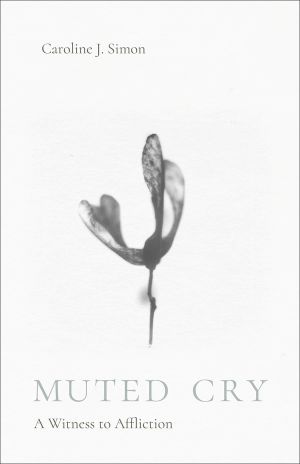
Muted Cry by Caroline J. Simon. Published by Augsburg Fortress, 2026. Excerpt taken and modified from chapter 13. Reproduced by Permission of the publisher. No part of this excerpt may be reproduced or distributed without permission of the publisher.

4 Responses
Beautiful, sad, and a call to pause and wonder as I follow you down a similar road.
Thank you.
I also look after an afflicted brother. This beautiful writing speaks to my heart. I’ll be buying this book …
Your title says so much of the journey. While dealing with my first husband’s Alzheimer’s disease I came across the book “Creating Moments of Joy”. It sounds like you were trying to do that for your brother. God bless you.
I am the afflicted one, some weeks or months more than others . The fatigue is super over laying, and sometimes, even to react to a soothing beautiful memory is to much to show outwardly. You gave him more memories and a placard on his heart that he saw it, he saw all he could take in…. A true gift❣️