
Who among us hasn’t stood at the glass in a zoo’s great ape exhibit and felt the disorienting recognition? The hands. The eyes. We watch them watching us. The line between “them” and “us” begins to blur.
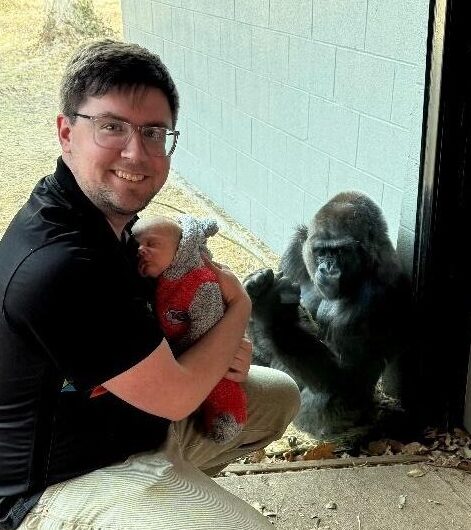
And yet it seems that we work hard to quickly redraw that line thick and dark.
Humans have searched long and hard for a trait that secures our uniqueness. Tool use, we said. Then scientists observed chimpanzees fashioning sticks to fish for termites. Play. Language. Creativity. Imagination. Empathy. One by one, these candidates have wobbled under scrutiny. The thick, dark line refuses to hold.
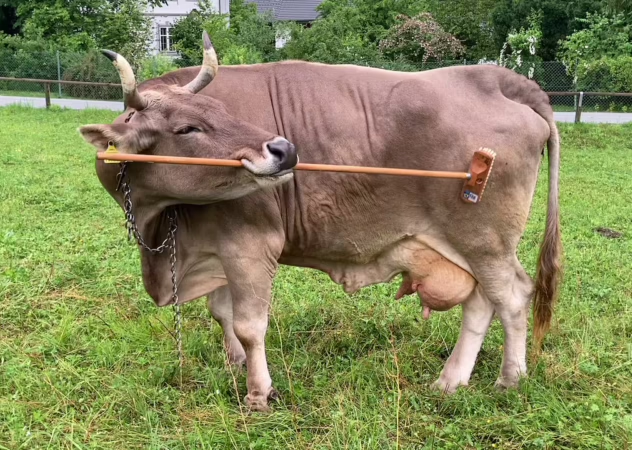
A recent report described Veronika who demonstrated what researchers classify as genuine tool use by a cow. To meet the standard for tool use, a tool must become an extension of the body, allow the animal to accomplish something otherwise difficult, and be intentionally reoriented for different purposes. Across seventy trials, Veronika used a heavy deck brush to scratch herself, flipping it, shortening it, adjusting angles, even switching to the handle for sensitive areas.
Scientists believe they observe empathy in a variety of animals including chimpanzees, dolphins, rodents, and elephants.
Language? Koko the gorilla reportedly used over 1,000 signs and understood far more spoken English. Dog lovers are probably not surprised to learn that dogs process words and tone using brain regions strikingly similar to our own.
Even octopuses, invertebrates of all things, display problem-solving capacities and perhaps even forms of consciousness that unsettle our tidy hierarchies.
Most recently, Kanzi the bonobo—long known for lexigram communication and tool use—demonstrated imaginative play. In a make-believe tea party, he carefully tracked invisible juice and imaginary grapes. We watch with delight when our children develop imagination because imagination matters. Many of our highest cognitive acts—planning, moral reasoning, hope—depend on the ability to envision what is not yet visible. Yet imagination seems to be shared with non-human animals too.
If the line between human and non-human animals grows increasingly fuzzy, where does our insistence on human exceptionalism come from?
Christians, I think, are tempted to turn to Genesis 1:27: humans created in the image of God. Or to Hebrews 2, echoing the psalmist: “You have made them for a little while lower than the angels; you have crowned them with glory and honor, subjecting all things under their feet.”
These texts have often been read as boundary markers—a divine endorsement of hierarchy. Humans at the pinnacle. The rest of Creation subject to humans.
Read in context, perhaps these texts press us in a different direction. The image of God in Genesis is paired not with privilege but vocation: to till and keep, to name and nurture, to exercise dominion that mirrors God’s own life-giving, sacrificial care. Hebrews, too, ultimately points not to human triumph but to Christ—glory revealed in suffering love, dominion expressed through self-giving.
If there is a line, perhaps it is not a line of capacity but of calling.
Maybe what distinguishes us is not empathy, language, imagination, or tool use. Maybe what distinguishes humans is responsibility.
And how are we living up to this calling?
The climate is warming. We have polluted the air and water. Topsoil is eroding. We live in a time of devastating loss of biodiversity. Microplastics circulate in our bloodstreams and lodge in our brains. We are losing forests at an alarming rate. The ice caps are melting, and sea levels are rising. Bombs crater landscapes already fragile. The whole Creation trembles under the weight of human actions.
Romans 8 offers an image of unity: “The whole Creation has been groaning together as it suffers together the pains of labor.” The whole Creation. Together. The groaning is shared.
Perhaps that is the final blur in the line. We are not outside Creation looking down. We are within it, aching alongside it.
If the imago Dei means anything in a warming world, it cannot mean domination without accountability. It must mean representing God’s character within Creation—bearing God’s patience, restraint, mercy, and love.
The glass at the zoo does not separate us as much as we imagine. The eyes looking back at us are not merely curiosities. They are reminders.
Our difference may not lie in what we can do. It may lie in what we are called to do. And that line, unlike others, is thick and dark.
Header photo by Manuel Velasquez on Unsplash

13 Responses
Thanks again. Lots of implications. So maybe one blurry line between us is that we sin, and animals do not. Another way to say what you say is that humans are the priests (prophets?) and animals (and plants, and rocks) are the congregation (the parish). In any case, thank you again for your informed and stimulating writing.
Thanks Sara! This one’s a keeper — to share with my Au Sable students.
Thank you for this, Sara.
Thank you, Sara, for what—for me—is a new perspective, perfectly summed up in your essay’s final paragraph.
Beautiful. Thanks Sara.
Your comment that “maybe what distinguishes humans is responsibility” recalls the point made by the authors of the CCCS book, Earthkeeping. In addressing the question of the uniqueness of human beings, the authors argued that it was accountability. Humans are accountable to God for all that we do, including how we care for and interact with God’s creation. The concept of responsibility also contains the notion of response to God’s will for humanity and creation.
Thank you. This is a very timely and potent reminder. Responsibility cannot be championed too strongly.
Thank you! Your mention of octopus reminds me of the documentary My Octopus Teacher, which like your essay greatly enhances our awareness of the commonality between us “them.” Which in turn makes us more creation-caring.
Like we’ve talked before, I think the imago dei in Genesis depicts God graciously sharing God’s image or status with humans as earthly representatives. We’re not made of special stuff somehow unlike other creatures, but God has gift us a role as you argue. I also think the imago dei gets a lot more play in the New than Old Testament. And the NT imago dei is largely represented through Christ. This particular human, the icon of God, bears God’s image to and into humanity. A “new creation” perhaps prepared for a new God-given role in a New Earth? Thank you again!
Thanks for a deeper look into imago dei. Perhaps we are “chosen” in the sense Israel was chosen. It is not that we are more favored or deserving, rather we are given an important mission to represent the heart(image) of God. So in the Philippians 2 sense, we do not claim equality with God something to be grasped but rather modeled and shared as a missional privilege.
I like that connection to Israel, especially the line in Deuteronomy 7:6-8. “The LORD your God has chosen you to be a people for his treasured possession, out of all the peoples who are on the face of the earth. It was not because you were more in number than any other people that the LORD set his love on you and chose you, for you were the fewest of all peoples, but it is because the Lord loves you” In this context, the Lord could have said to humanity, “I have chosen you to bear my image, not because you were more capable than the others animals, but simply because I love you.”
Sorry to come at this good discussion so late. My Dad was both a committed Christian and a biology teacher in the public school. I’d see him studying the Bible to teach adult Sunday School and I’d also see him at his desk at school with a chart of apes evolving into humans. That the two things could be compatible was always plausible to him and me. So I never had a problem with the fuzzy line between humanity’s abilities and that of other animals. If some day, an evolutionary link from apes to humans is disproved, I won’t be sad, but neither will my faith suffer if it’s proved beyond a shadow of a doubt. Like you, I didn’t see being human in terms of capabilities because I was always keen on locating the “image of God” in something that persisted in spite of the lack of abilities (as would be the case with a human fetus or someone in a vegetative state). As you state so well, being assigned responsibility seems to be a part of the mix of being an ordinary human, and is surely tied to the “servant-dominion” role in Genesis 1. But still, the idea of being responsible takes us back to abilities—the word means have the ability to respond. And that leaves out those humans who lack the abilities many of us have. So without chucking the responsible part of this, I tend to emphasize that humans are not exceptional as over against other animals, but exceptional in terms of how God relates to us, even if we are unable to relate back.
I love this! I do wonder, however, if non-human organisms relate to God in their own ways…at least I don’t exclude that possibility.