
As the pastor of a mid-sized congregation in middle America, I serve people who are red-blooded conservatives and those who are true-blue progressives. Some believe that we must “support our President” while others march in resistance. Some think we’re hurtling toward fascism. Others are convinced that liberals and lesbians are destroying faith, family, and future.

And every week, as I study and write a sermon, I’m mindful of trying to thread a needle that’s faithful to the text, applicable for the living of these days, and not overtly partisan.
Lately, I think I’m failing.
I assuage my guilt by noting that pew-sitters can get political hot takes everywhere. When everyone has a podcast, a Substack, or a social media presence, do they need my voice in the scrum? When the round-the-clock-outrage-industry goes full blast, does the church really need their pastor to weigh-in on the day’s controversy?
Worship offers something markedly different. I try to protect our worship space. Liturgy, confession, congregational singing, the reading of Scripture, and the celebration of the sacraments can easily be sullied by attempts to be “prophetic.” Corporate worship is a setting for the clear proclamation of the Gospel of grace in Christ Jesus. It’s a setting to listen for the voice of God and the kindling of a Kingdom imagination. An hour on Sunday morning with no screen demanding our attention feels like a fitting respite from the political noise. We engage both a sacred text and the Living Spirit. And we do so in community.
And so I do not quickly or easily speak into every political moment. I’m nuanced. Maybe muted.
Or maybe just cowardly.
Because then the headlines come.
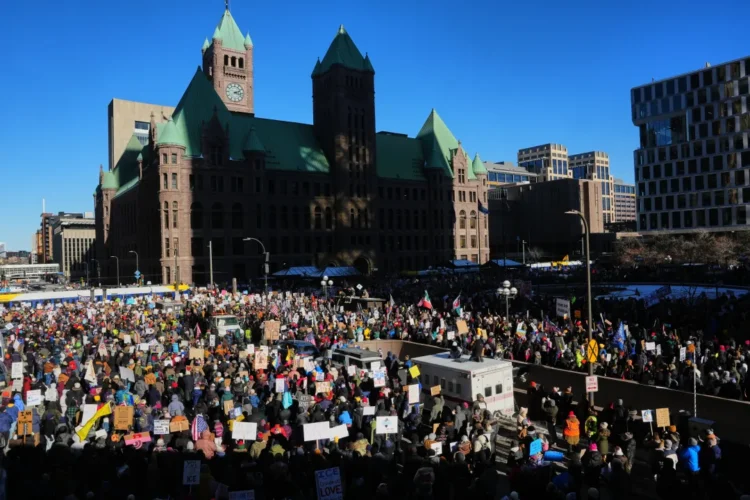
The President calls people “garbage.” Citizens are gunned down in the streets while exercising their constitutional rights. We blow-up “drug-runners” without due process. We invade and “run” a country to control their oil. Masked militias roam our streets. The world order in place since World War II creaks and cracks. 71,000 Palestinians are killed in Gaza. The President and his ilk lie with impunity. All of the January 6 insurrectionists are pardoned. We enter into a war of presidential choice with a dozen different rationales. We’re siloed and splintered from friend and family. And on and on. You get the point.
There’s literally something every week that invites reflection and response if we are to love God and love neighbor faithfully. The Gospel calls for nothing less. Being nuanced or muted seems lukewarm, rightly spewed out.
Some churches address injustice every week. They hoist flags, post signs, and bear witness to a progressive American vision. There are also churches that avidly promote a MAGA version of Christian Nationalism. Still others avoid politics like a plague. And there are churches that are just trying to thread a needle.
I can attest that it was easier twenty years ago. You could listen to the teachings of Jesus or consider the implications of the image of God, and then from a position of privilege, recognize that competing political philosophies were, in their own ways, seeking similar ends. There were differences of opinion about public policy, taxation, national debt, immigration, and constitutional interpretation. Christ-followers were found across a wide political spectrum.
The last ten years, however, have been increasingly troubling and toxic. There is less trust, less conversation, and less common ground. Dearly loved church members, on both ends of the spectrum, have picked up their marbles and gone home.
As W.B. Yeats wrote, “Things fall apart; the centre cannot hold.”

Friends tell me that threading a needle today is weak and not sufficiently woke to the degradation of democracy. This is no time to keep silent. Congregational unity be damned. Holding the middle is naïve, complicit, or cowardly. And they’re not wrong. I don’t want to be silent when they come for the ICU nurses.
My guess is that I’m not alone. My guess is that there are other pastors who are trying to find their voice in this historical moment. If a congregation is politically pure, then raise a fist, fly a banner, speak up! But when your pews hold a tenuous mix? Should politically conservative congregants expect their more progressive pastor to opine on the current administration? Is that bringing the Gospel to bear on this scourge?
I don’t want to be sidelined by cowardice. I want to stand with the marginalized, the oppressed, and the brokenhearted. In the face of evil, I want to bear witness to the power of love. I want to act consistently for the sake of Creation.
So, is this a moment when consequences and community are secondary? Is this the hour to speak clearly about human rights, civil rights, constitutional rights, and biblical righteousness? No matter the cost?
After the disruptions of Covid and denominational disaffiliation, how do I help a fragile church community hold together? In the age of Trump, what is my role? If we continue to fracture, how will we mend the body when this political moment passes?
Is there even a needle still left to thread?

20 Responses
Central to our Reformation tradition has been the ( preaching of) The Word. While this was strategically somewhat effective in the past, I am not sure it is fair to place this burden on pastors today. Scripture has always been misapplied and manipulated, but in the “information age” we currently live in, any parishoner is an “expert” theologian and analyst of world affairs. Many of us appreciate you for naming the issue . We live in a time and place where defiance of such Christian norms as honesty, gentleness, and love-of-neighbor are defied proudly. Uncle Screwtape would be proud. Thank you for being honest and persistent.
Absolutely right on. Gotta feel it, gotta name it. It’s not enough just to say, “The long game,” but we might take comfort from, and be inspired by, Bonhoeffer’s strategies in Life Together and Miskotte’s strategies in his Bible preaching and teaching in Nazi-occupied Amsterdam.
We face this as members listening to each sermon with ears honed to hear the words of God that propel us to resist the deranged use of ‘returning our nation to God’ as an excuse to revel in the power of military might, ignoring those we should care for, and making immense profit for a few. The may seem like a cop-out, but we do not need our pastor to be political, which he wisely does not do, because the words that he speaks as we sit in the truth of the beatitudes during Lent, tell us exactly what our faith requires. We know there are others who may not hear what we do, but we know what God is laying on our hearts. Continue to be faithful to the Word and let it do the political part.
Well stated — “be faithful to the Word and let it do the political part.”
Thanks for sharing the weekly challenges of preaching God’s word in a difficult world. I am so grateful for pastors who preach the Word every week because I go to church in the midst of all the clamor and chaos to hear what God says, not what other people think or say. I need that weekly encouragement that the “world belongs to God and not to the people in power” One of the things I cherish is the congregational prayer in which the pastor directs us in prayer for the people affected by war and for those in power who make decisions, for the maimed and the grieving. That prayer reminds me that I am weak and powerless, but God is not. May the Holy Spirit continue to empower you to speak the words that God’s children need to hear.
It is easier for a camel to squeeze through the Needle’s Eye gate, than for a rich white US suburban Dutch Protestant follower of Jesus to thread the pastor-job needle: how to repeat the provocative words Jesus said to the rich and righteous influencers of his own synagogues and temple and also keep the paid position?
If you have not yet been fired or thrown off the edge of Sagawau Canyon by your own faith community’s most privileged members, your public rhetoric has been either more successful or less laser-focused on taxes, tithes, coins, storehouses, wages, wealth than Immanuel’s sermons and speeches and stories were.
Hoarding money is a deadly illness, and existing while impoverished is a slow death, and we, rich and poor as we are, need our vocational preachers to dig in on the theme that will get you fired and rejected by your actual patrons. Please preach boldly on the scandalous and upsetting and comforting future: a major reallocation of wealth and favor and resources is coming.
Hi Jessica: Thanks for your passionate dedication to the revolutionary preaching of Jesus. I interpret the political implications of Jesus’ teaching in a way that’s very similar to you (and I have a hunch Roger does too). I want to be a Jeremiah who lays it on the line, in spite of opposition. But since Jesus has come, I also want to be a Jeremiah who takes seriously the now and not yet of the new covenant in which we don’t have to tell each other to know the Lord, but rather can trust the faith commitments of the others (Jeremiah 31:34). When I look on the gamut of people in my church (from the MAGA folks to the progressive ones), I don’t want to see one side as the evil “them.” Like me, they too know Jesus—though imperfectly. We are all the family members of Jesus—even in all our wrong political opinions—with perhaps a few false brothers and sisters who slipped in (Jude 4). Jesus doesn’t want pastors to burn the whole house down in order to get rid of the rats. The issue that most needs addressing in the congregation is not whether we have the correct opinion about the sins of our political leaders (either right or left), but about how the Lord wants to keep transforming our own sins into beautiful holiness. Yes, we need to talk about the evils of hoarding wealth and the goodness of generosity. And the evils of resorting to violence to get your way and the goodness of making peace. But we also need talk about the evils of hating those on the other end of the political spectrum, and the evils of jumping to conclusions about others based on who they vote for, and the evils of thinking we’ve fulfilled the will of God simply by having what you consider the best theologically-informed political opinion. God has better for us. As a retired pastor myself, my prayers go out to Roger and you and others who are preaching in a world on fire.
It sounds like you hear my request to preachers as a request for preaching that delivers straightforward talking points on financial morality, and that you want to place my request within a balanced morality menu of sermons. It seems to me that Jesus foretold of an imminent political future he was establishing and that he was inviting his listeners to enter alongside and after him.
I think that a foretelling sermon is different from a stewardship sermon that inspires churchgoers to increase their pledges or their general liberality, or to moderate their self images or their vice meters. You made it to retirement, and are still energetically offering proof texts to assuage the sharp hunger and thirst of others, so you may be one of the ones able to make Jesus’s words more palatable to religious people than he could.
I was not allowed to aspire to our group’s esteemed vocation of preacher due to my gender, sorry to mislead you in to thinking I preach. I am a layperson who is thirsty for USian preachers willing to take the visible social and economic risks which help sheep gain trust that Jesus’s Way has as many courageous and comforting shepherds as it has perils.
Hi again, Jessica: Perhaps you are not a preacher ordained in some denomination, but you are a preacher nonetheless. I’m not sure what I said that made it sound as if I were advocating for namby-pamby please-help-the-church stewardship sermons, but I understand how it’s always hard to discern a person’s heart through text messages like these. I’m trying to discern your heart as you are trying to discern mine, with only a few sentences to go on. I do think those who hunger and thirst for God do need a message that’s palatable, even if the sweetness of the gospel will also cause stomachaches (Rev. 10:9-10). (Sorry, proof-texting is an occupational hazard.) I wish you well in finding ways to live out the message of the living Jesus in our hurting world.
Thanks for engaging in a side convo, David, it is an important topic, and I can tell you also care a lot about the welfare and the courage of preachers.
A couple days ago I landed this comment under another person’s reply which was confusing and cumbersome, thanks to the blog moderator for fixing it!
Yes, we’re all prophets, priests, and kings announcing and living the message of Jesus, but in Roger’s essay context here, a professional clergyperson wrestles with unique benefits and risks that come with the freedom of deciding how double-edged to get on their pulpit platform with a mighty sermon pen. The privileges and penalties are greater when your weekday work is to compose a rhetorical artwork that will be unveiled in a public place at morning coffee time on each Day of Rest to the very same listeners who have willingly set up ACH payments to fund your salary, housing, and health insurance. It is super complicated to be employed in the church’s CEO position, which comes with both a corner office desk and a scalding hotseat. Many of RJ community are familiar with being in an actual employment position like that, but many aren’t.
It is possible to discern another person’s spirit through the word combinations they broadcast or send directly to us, so we make meaning of digital communication with some confidence. So, you have several sentences about preaching on various kinds of goods and those evils. I read those several sentences as a push toward using the pulpit as a moderating and civilizing platform to improve virture and discourage vice. Sunday pewsters, rich and poor, are panting for the Living Water and Tree of Life as they use Sunday mornings as a quick breather before drowning a little more deeply into a new week of labor and bills. Even when we ask or thank you for a Honeycrisp of Sortingoutgoodandevil, that is not what we are in need of. No denying that a gentle moral and attitude adjustment lesson on break day is to greatly be desired for its palatable sweetness and its overall support of the national GDP, but weekly virtue/vice lessons can be soporific as warm milk to the rich and as repellant as lukewarm liquid to the poor. Repellant lukewarm liquid is the beverage of Roger’s theme, and the John who was exiled to Patmos for preaching Jesus’s message keeps on reminding preachers and their patrons to cut it out of the diet.
Full time caregivers of babies and young ones are in place to provide palatable lukewarm beverages as we use words and lullabys and bedtime stories to regulate their nervous systems and provide them gentle shaping nurture into healthy social mores. Vocational preachers are not in place to provide their adult patrons warm milk and letscalmdownandgetalong energy from the pulpit. Roger’s energy shared in the essay is his increasing unsettledness with the pressure to use the pulpit to hold it all together, to forestall congregational eruptions of conflict, or to tap the brakes on any enthusiasm for alarming revolutions of the wheel of fortune in the larger community.
This publication is largely serving as a mutual reassurance caucus for retired or nearly retired CRC and RCA ministers who have been moderately progressive, but also generally comfortable in careers laboring in Reformed institutions that have traditionally esteemed and ennobled its straight white male leaders. It has been a good run in North American Reformed Christendom, with these leaders being aided by generations of volunteerism and secretarial service from the culture’s womenfolk. There has been a reduction of vocational distress for these leaders, thanks to the buffer zone of membership restrictions which maintain the cultural homogeneity of the group. Roger says he has experienced higher vocational discomfort in the last 20 years. The stress inherent to a white church preaching role is only going to increase, unless white supremacy succeeds at gaining back the ground it’s been losing since the cool 60s and groovy 70s.
What is coming down the canal is going to be less palatable for us, but is going to save our ships. Jesus’s wonderfully valuable yoke-unlockers in the pulpits get the privilege and pain of creatively announcing the imminent unraveling of this tangle we’re all trapped in, and we pewsters who hunger and thirst for Righteousness (who is on the way and already here) will say it again: Dear Preachers, please stop laboring to contain us all during pulpit time with cautious virtue-patching and anxious vice-darning needlework. You don’t need to thread those needles. Let those old stitches rip!
God promised Moses that the gold of the future worship furniture used by his redeemed-from-slavery beloveds would come from the wealth donated or plundered from the assets of their enslavers, and he told Moses to announce that same news to everyone who wouldn’t care to listen, the enslaved discouraged laborers, the elders in middle management or retirement, and Pharaoh the cruel head honcho himself. (Exodus 4:11-22, 5:22-23, 6:9-12 for those who desire the ethos gained by prooftexting). That “dramatic reallocation of wealth and favor is coming!” N.E.W.S bulletin is a non-partisan, non-violent, non-judgmental fresh good spell each Restday morning throughout time. It’s also relevant, regardless of which corner of the map is wiring breaking updates from the frontlines about the renewed war bombings and renewed peace efforts.
I always imagine that Isaiah, Micah, Amos,… struggled in similar fashion, and I wonder if their wives and friends told them to be careful lest they offend someone. It is so easy to look at German pastors at the time of Hitler and ask how they could be complicit or silent, it is more difficult to ask, with N Wolterstorff, why American pastors do the same about atrocities against Palestinians and South Africans. Thank you for sharing this struggle, we need wisdom on this.
Roger,
Thanks so much for stating this question so well. Much as I want my own political perspective reflected in the sermon each Sunday, that’s only empowering to me and my point of view: it doesn’t empower the mission of the church to bring shalom to the world. Peter Wehner says it well in the current Atlantic article, where he talks about bringing shalom to the world: “If Christians are going to help heal our broken world, they will need to rediscover that sense of enchantment, of faith enlarging and enriching our lives and the lives of others, and of trying, even imperfectly, to pattern our life after the life of Jesus.”
Necessary as it is for me to keep up with it, the news these days doesn’t bring me much enchantment of any kind, and it certainly doesn’t enrich my life and encourage me to do so for others. I go to church for that. I go to church to learn how to pattern my life after Jesus.
Thanks for what you and our preachers are doing so well every Sunday. It can’t be easy.
I’ve preached for 50 years—and am still at it. I’ve come to believe there are times when the Word speaks for itself (attribute it to the Holy Spirit) without human intervention. For me, the reading of whatever happens to be the lesson for a given Sunday—especially if it’s not of the preacher’s own chosing, but from the Lectionary—is the single most dramatic and important moment in worship. There are times when I don’t explain the text so much as hide behind it.
Each week as I sit in the pew I struggle with this issue just as you do. Our church, too, is a mix of MAGA, liberal and everything in between. How do we reconcile when I believe those in the other side of the political aisle do not reflect Jesus’ teachings while they probably think the same of me?
Yet each Sunday here we are, worshiping the same God, professing the same Christ and listening to the same scripture.
Keep the faith. Continue to minister. In the end Christ will prevail.
Love God and neighbor, said Jesus, reinforcing the teaching of the OT. Obviously, the command is rife with implications for how we live our life, how our life reflects love in all our relationships, and that necessarily includes our politics. If the MAGA members of a congregation cannot infer that from the sermon message preached, is something missing?
Thank you for these reflections. When I read scripture, I note that Jesus isn’t always driving the money changers out of the temple, but he definitely does it. I suppose that reflects the wisdom and discernment of Jesus, which I might aspire to, but fall woefully short of. And that might be the point, I’m never going to get it right, because I can’t, so I try with the best of intentions, and I pray that my congregation and I have built enough of a relationship together that they will listen with that in mind, and listen with the same humility that I’m trying to bring to each sermon. When I fail, I pray they will forgive, while pushing back on me.
The trouble I find is when I preached about the troubles Jesus might find with the war in Iraq, my flock listened, agreed or disagreed, and talked to me about it. The same could be true when I spoke of the unbiblical practice of deporting millions, as President Obama did or the counterproductive, unbiblical practice of killing thousands from a distance with a drone, again, as President Obama did, and every President after him. In each case, some agreed, others disagreed, but they never questioned my intentions (at least not as much as I tried to discern my own intentions). We loved each other, and moved forward to feed the hungry, pray for the oppressed and dying, worship God and follow Jesus to the best of our ability together. Now, if I mention in passing that crosses being carried at the January 6 incursion into the capital building or signs that read “Jesus 2020” at the same event are not reflective of a gospel message or Christ like behavior or more recently that the war in Iran is troublesome for any number of Christian ethical principles, which we find all over the Word, I get rousing applause from some, and others leave, maybe to never come back, without a word or conversation. There is something broken that has slipped into the church where political ideology has infected the life of the church. Am I part of the problem? Have I been preaching the same gospel over the last 25 years only to find significant changes all around me? I could go on, but that’s the troublesome point I’m wrestling with, and simply saying, I’ll preach what the Word says doesn’t work anymore, at least not in simple ways, but maybe that’s what we’re supposed to do, and then trust God. Of course, I know full well that’s exactly with the White Christian Nationalist preachers are saying too. I don’t know what to do. Maybe that’s the world we live in. Maybe we’ve always lived in it, and I’m just waking up to the reality.
I read this just now and said, “Wow.” As an “in-awe” type of “wow.” Thank you for this profound reflection, for being present (living with) the questions. I’ll be rereading this again and again. And then writing more in an attempt to answer these questions. And probably going around and around in my mind and heart regarding any “satisfactory” answers. As the King of Siam said, “Tis a puzzlement.”
Thanks for your reflections the current dilemma facing congregations today. My heart was broken by the closure of Trinity Christian College last year. My alma mater. Even though I can’t even be called a “oncer” in terms of church attendance, I appreciate the Christian “world & life view” that I have in my heart. Trinity tried to make sense of how to look at all of creation with a tolerant but firm foundation.
i yearn for our pastors to Stand up and preach as Jesus would. Many of our churches are luke warm and our pastors try to keep their jobs and their retirement. Fortunately Jesus didn’t care about this and was a Radical. We are not a Christian Nationalist movement!!!
You raise so many important and difficult questions. Thank you!