
In an opinion piece published in The Hill after yet another mass shooting, a former governor, Ed Rendell, writes, “It is the height of hypocrisy for any politician to offer ‘thoughts and prayers’ to victims’ families when they know they will not support any changes to stop gun violence.” For some the phrase “thoughts and prayers” has come to signify a kind of ineffectual hand-wringing or a convenient, safe, socially acceptable way of deflecting responsibility. I have some sympathy with those critics. I also know how easy it is to say “I’ll pray for you” in a moment when adequate words are hard to find.
I want my own promises to pray for others—so many others these days—to be authentic commitments and do my inadequate best to honor those commitments. Still, I find myself musing, as I have for years, over what intercession—praying for—actually entails. I imagine many of us first practiced intercessory prayer as children, kneeling by our beds asking God to bless Mommy and Daddy and a list of others that sometimes included dogs or dolls or a pet rat. It’s a fine enough way to start learning to pray—knowing we are participants in the flow of blessing, receiving it and giving it with words partly our own, partly inherited from a long lineage of saints. My small rambling roll call of intentions concluded with words I spoke at my mother’s prompting—words I knew by heart well before they were fully understood: “Let the words of my mouth and the meditations of my heart be acceptable in thy sight, O Lord, my strength and my redeemer.” They’ve served me well. She is with me still, a companion in prayer, when I say them.

But there came a time when prayers for others felt a little like a laundry list—or more accurately, a grocery list (I never had occasion to list laundry. I just dumped it in the machine and turned it on). Reading about how Jesus prayed forty days in the desert, or through the night at Gethsemane, how Paul urged the Thessalonians to “pray without ceasing,” and hearing how faithful people at bedsides kept prayer vigils for hours at a time, made me wonder exactly how they extended prayer—at its best a kairos moment of encounter, into long stretches of chronos time. Specifically, I wondered how they sustained intercession for more than the time it took to name the person or the need.
Other dimensions of prayer—adoration, confession, thanksgiving, and even supplication for my own needs seemed somehow less mysterious. But praying for, on behalf of another person felt different: was I pleading her case? Offering a character reference? Pointing out her needs? Reminding God to remember her? Or perhaps merely soothing my own anxieties? The questions seem a bit juvenile, if not theologically offensive, but they represent with some accuracy the real confusion I felt about intercessory prayer.
Then I had a little breakthrough. One day, praying for a dying friend I knew neither prayed nor believed, it occurred to me not only to pray on his behalf, but, curiously, in his stead. The notion seemed presumptuous, but somehow hopeful and energizing. If he wasn’t going to come to God on his own behalf, perhaps I could take his place. I found myself acknowledging to God that my friend wasn’t likely to show up, and asking if God would hear my prayers as though they were Bob’s. Whatever its theological merit, the thought lifted my heart, and I was able to stay longer than usual, intently and contentedly in prayer for—and as—my dying friend. When I finally rose, I felt the kind of satisfaction one feels at having brought groceries to a bedridden friend or having removed some of the weight from their pack and put it in your own. This thought may have come from reading of Charles Williams’ novels with their strange theory of mystical substitution—that we can, more than metaphorically, stand in for one another. That little shift from on his behalf to in his stead didn’t answer all my curiosities about intercession, but it gave me a way of imagining it that helped me pray. And it helped me realize that imagination has a place in prayer.
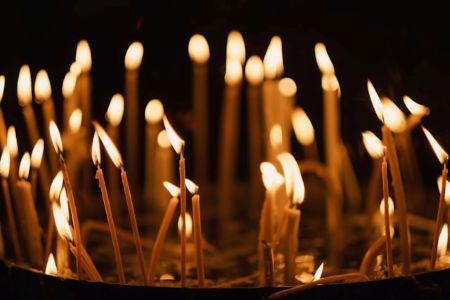
About the same time, I began to investigate forms of intercessory prayer that lay well outside the scope of the more or less spontaneous, biblically allusive mix of colloquial and Jacobean address I learned in Sunday school. Some of these involved candles lit on significant days, burning through hours of someone’s surgery or stressful exam. I must have been at least twenty before I looked at a litany, stretching across several pages of an unfamiliar prayer book. My deeply devout Protestant parents had kept us carefully shielded from all things “papist.” But something induced me to read the whole Litany of the Saints, slowly, name by name, petition by petition. It was deliberate, decorous, unhurried–a procession, a long, patient staying with. The unabashed leisure of litany opened new doors for me into welcoming, hospitable, prayer space where I could dwell content for a while and set down the burdens and concerns I carried for myself and others. Making my way through it, words dissolved into a kind of hum, a field of energy in which I could be held and moved, soothed and rocked by the rhythm, into an altered state, not somnolent, but relaxed and buoyant.
I was similarly moved by a kind of humming prayer in African American churches where quiet surges of assent bore up the preacher’s spoken words like waves under a boat. Audible “Mmm hmms” or “Uh huhs” or a descant of affirmation, “Yes, Lord,” or “Yes, Jesus” lifted even this hesitant white visitor into a state in which words ushered me into an awareness of divine presence words themselves couldn’t quite reach, where they dissolved into breath.
Music and words meet in other kinds of prayer. Some days I rely on hymns to be my vehicles of intercession. Some days I play chants or evensong. Every prayer tradition has forms in which words meet music, repetitious as litany, soothing as lullaby, lifting us into what one dear friend calls “prayer space.” Sacred song is its own form of energy and has its own kind of efficacy. Jewish scholar Avivah Gottlieb Zornberg writes about Israelites who sang their prayers in the very midst of fear and anxiety even as walls of water rose around them. We pray now, as they prayed then, held together in the thick of things.
“Holding” is one of the verbs that comes most readily to mind these days when I think or speak of intercessory prayer. And “carrying.” I will hold you in prayer. I will carry you in my heart. Like a child lifted from a cradle, like a beloved drawn close into strong encircling arms, like a comrade reaching a hand to help someone up and over a wall. When Quakers offer to pray for you, they promise to “hold you in the light.” When I pray, I imagine that—the one or ones for whom I pray encircled by light, bathed in it, held safe in it from encroaching darkness.

A friend of mine, when she offers to pray for me, assures me, “I’ll walk with you through this.” Another promises to “lift up” my intentions or simply to remember them. Another keeps me on her prayer list. She has an actual written prayer list, her own version of litany. Some “include” me in beautiful daily or nightly prayers where I know I’m gathered with others into the shelter of these words, descended from St. Augustine and Thomas Cranmer and generations since: “Keep watch, dear Lord, with those who work, or watch, or weep this night, and give your angels charge over those who sleep. Tend the sick, Lord Christ; give rest to the weary, bless the dying, soothe the suffering, pity the afflicted, shield the joyous; and all for your love’s sake.”
It’s a prayer wide enough to embrace not only our dearest beloveds but also those in war zones and prisons and hospitals far from home and sleeping in doorways. I do what small things I can for them, as we all do. And then, as I can, with words I gratefully borrow and gradually grow into, intercede for them.
I have more to learn about intercession. But I know we’re commanded and allowed to intercede for one another by a grace that includes us in God’s own work, bearing one another’s burdens, holding one another’s hands, and sometimes standing in and standing for those who may, for all we know, be standing in for us.

5 Responses
Lots of wisdom here, tightly packed. And yes, that Charles Williams novel.
Beautiful and wise, thank you.
This is so good! I really liked “That little shift from on his behalf to in his stead”. Stand before God in their place. There are so many people in my life I can apply this to as I pray for them. It does presume I know what to pray for— even for myself —my will or Gods. Thankfully, that verse in Romans; “when we don’t know how to pray, the Spirit intercedes with sighs too deep for words.” comes to my rescue.
I really appreciated your section on praying for some one in their stead, especially when those people don’t pray themselves
Thank you for letting us in on your pondering. I agree: certainly pray on another’s behalf.
My question about prayer is “Why?” God does not need us to remind God who needs praying for. God already knows who needs healing and comfort etc. So why do we pray? I think I know part of the answer but I’m curious about yours.