
“Who taught you how to preach?”
The cohort of pastors, seminarians, and staff members I lead were circled around a corner table in the coffee shop where we’d convened, when one young woman posed the question to me as we waited for the final few of us to turn up: “Who taught you how to preach?”
It’s a question I’ve been chewing on lately. I’m currently designing a preaching course for seminary students, and the occasion has made me wonder a bit at how both tradition, ideas, theologians, as well as our friends, experiences, and congregants shape how we preachers practice our calling.
For all of us summoned into this vocation, who seek to be “obedient to the work,” as Madeleine L’Engle put it, we discover our voice over time as we listen to, and learn from, the voices of others. In my experience, this dynamic is true across many kinds of crafts, whether preaching and teaching, or medical research, community organizing, jazz guitar.

Closer Encounters
I’ve sought to apprentice myself as a preacher to the usual suspects: those giants of the faith whose influence has stretched through centuries. And so it’s true enough that Augustine and Ambrose and Chrysostom, Calvin and Luther and Karl Barth — and, voices like Lesslie Newbigin, Tim Keller, and Fleming Rutledge — have taught me how to preach.
In some ways, however, I think we’re actually marked most deeply by the myriad others we encounter at closer range: those people, voices, and experiences that shape who we come to be and how we come to practice our craft.
In an important way, my Dad taught me how to preach. He was a college professor for most of my life, but he also pastored a church when I was young. So it was in his tone of voice that I first heard the proclamations of Exodus, Isaiah, John. It was while I watched him stand in the pulpit of Easton Union Bible Church that I had my first embryonic experiences of the mystery that when the Church gathers and opens the text of Holy Scripture, we’re standing on holy ground.
Mike taught me how to preach. He was the first pastor I interned for, and he let me teach and preach, again and again and again, no matter how poorly things went or how little I may have deserved another opportunity.
Daniel taught me how to preach. A first friend in my days as a church planter in downtown Philadelphia (I’ve introduced him in this journal, and in my book as well), it was conversations with Daniel, and many other friends and neighbors like him, that taught me to articulate Christian faith to the many and growing numbers of those who live their lives outside the decaying ruins of Christendom and aren’t party to the jargon and insider-arguments of Church life.
Tim Brown taught me how to preach. I’ll never forget being mesmerized as he, in a sermon, once recited Romans 16 from memory — a passage I’m ashamed to say that, even as a divinity student, I’d often breezed right by. Tim embodied what it means to internalize the Text into one’s mind and bones and nerve endings, and so to become the kind of person Psalm 1 envisions: “their delight is in the teaching of the LORD, and on his teaching they meditate day and night.”
Jeff Munroe taught me how to preach. In my last year as a divinity student at Western Theological Seminary, I enrolled in a course that Jeff offered entitled “Reading and Writing for the Pastoral Life.” It was easily one of the best courses I took. Jeff showed me how much we preachers have to learn from poets, memoirists, novelists, and writers of all sorts. We both, after all, work with the same raw materials: language, and all the love and boredom and transcendence and violence and futility that comprise the human experience.
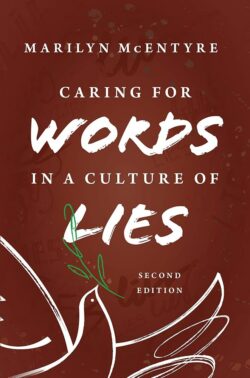
Marilyn Chandler McEntyre taught me how to preach. Our principal text in the afore-mentioned class was McEntyre’s Caring For Words in a Culture of Lies. In her writing, and then as a doctoral advisor, Marilyn modeled what it is to love words, tell the truth, share stories, cherish long sentences, listen deeply to poetry, attend to translation. She illumined for me the holiness of language.
All these voices, and so many more, have shaped what my voice sounds like. They’re all how I’ve come to say, “by the grace of God, I am what I am.” I’d guess you have a cloud of your own witness for which to thank God, too — mothers and fathers and friends and teachers and advisors who’ve shaped how you serve God’s kingdom, whether you’re preaching sermons, or designing software, painting landscapes, caring for sick bodies or minds.
So, who taught you?

2 Responses
Good question. Meditating on your question, with a little embarrassment, I think I might have surreptitiously rebelled against everyone who ever tried to teach me. I will say that for a few years early on I listened early every Sunday morning, on the radio, to William A. Jones, from Bedford-Stuyvesant.
Jared, Thanks for stimulating us to thinking. I will admit when I read the first paragraph I cringed, but you quickly turned my cringing into amens. I cringed because I have witnessed too many “cookie cutter” methods for preaching, I said amen because you drew from a wealth of knowledge, experience, and examples and through it all remained you. When I taught a course in prophets I found delight in challenging students to see the multitude of teaching methods used by the prophets: poet, actor, story teller, historian, … One place I learned to teach was from Scripture, it taught me there are a variety of good teaching methods. Not all preachers need to memorize the text, they do not all need to start with a quote from someone we’ve never heard of, they do not all need to “find trouble in the world and trouble in the text,” but perhaps some should. And yet, there are jewels we can learn and apply, but only when we are humble enough to learn from others. You gave me something to ponder today, and that is a gift.