
In this season of retirement, I have become interested in reading family histories and viewing family albums. I’m particularly drawn to family histories and albums of those with whom I am acquainted. Histories elicit memories of my own, and photographs frequently cause me to recall occasions and interactions with the individual(s) pictured.
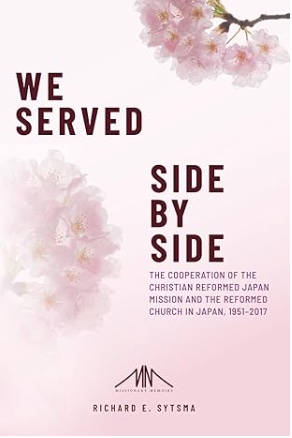
Richard E. Sytsma has given a wonderful gift to the greater Church, and more specifically to the Christian Reformed Church in North America (CRCNA) and the Reformed Church in Japan (RCJ), in We Served Side by Side: The Cooperation of the Christian Reformed Japan Mission and the Reformed Church in Japan, 1951-2017. The author’s insights as a missionary kid (MK) and later as a missionary with the Christian Reformed Japan Mission (CRJM) bring a unique perspective to the cooperative and mutual ministry of the two denominations. This book reads like a “family history,” and the abundant photographs, many from the Sytsma family collection, bring it to life.
In the opening chapter, Sytsma provides a succinct historical context of Christianity in Japan. Without this context, an understanding of the mutual ministry of the CRJM and the RCJ, as well as other Christian missionary ventures and the situation of the church in Japan, would be diminished.
Protestant Christian missionaries began ministry in Japan in the late 19th century, not long after Commodore Matthew Perry and his black ships ended Japan’s centuries of isolation in 1853. In 1877, through the efforts of Reformed and Presbyterian missionaries, the Nippon Kirisuto Itchi Kyokai (later the Nihon Kirisuto Kyokai) was founded, adopting the Westminster Shorter Catechism, the Westminster Confession of Faith, the Heidelberg Catechism, and the Canons of Dort as doctrinal standards. The formation of the Nihon Kirisuto Kyodan (United Church of Japan) in 1941 is significant in understanding the history and development of the RCJ. With Japan’s entry into World War II, the Japanese government began to exercise greater control over the church, forcing the Kyodan to compromise its faith by expressing Shinto expansionist ideology in Christian terms.
On September 2, 1945, Japan signed the unconditional surrender to the Allied Forces. General Douglas MacArthur, Supreme Commander for the Allied Powers, closed his speech by remarking, “The problem is basically theological.” Shortly thereafter, MacArthur challenged the churches in the United States to send missionaries to Japan, and the CRCNA, the RCA, and many other denominations responded.
Henry and Eunice Bruinooge, Edward and Frances Van Baak, and Magdalena Koets arrived in Japan in 1951, having been ejected from China following the Communist revolution. These missionaries laid the foundation for the launch of the new mission work in Japan, which would soon be designated as the Christian Reformed Japan Mission (CRJM). They would be followed in 1952 by Rev. Richard D. and Dorothy Sytsma; in 1955 by Rev. Leonard and Clara Sweetman, and Rev. Maas and Eloise Vanderbilt; and in 1959 by Rev. John and Hazel Timmer, Rev. Harvey Smit, and Martin and Barbara Essenburg. Their children accompanied them and, joined by siblings born in the years following, they became part of the first generation of post-WWII MKs in Japan. Several others followed as missionaries, associate missionaries, and volunteers with Christian Reformed World Mission (now Resonate) in the years that followed.
Unlike the RCA missionaries and other mainline denominations, the CRJM chose not to partner with the Kyodan but with the RCJ, as the RCJ’s Eastern Presbytery requested that the CRCNA send missionaries to help them spread the gospel in Japan, a request accepted by the CRCNA’s Synod in June 1950. The RJM believed that the Kyodan had made too many compromises with Shinto, and the CRJM concurred. That began eight decades of mutual ministry between the CRJM and RCJ, which continues to this day.
The substantial portion of We Served Side by Side is Sytsma’s thorough chronicling of this ministry’s history, organized by decade. He begins with the initial years of formulating cooperative policy and evangelism during the 1950’s (side-by-side ministry between CRJM missionaries and RCJ pastors, self-government, self-support, and self-propagation as outlined in the Japan Mandate of 1950), continues with the rapid church planting expansion of the 1960’s, the diversification in ministry and missionary personnel during the 1970’s, the resetting of the direction of CRJM during the 1980’s, the continued reorganization and retrenchment experienced in the 1990’s, which finally led to the shift from church planting to leadership training at the dawn of the 21st century, then to the present. Sytsma is very honest about the occasional tension and difficulty through which CRJM missionaries and RCJ pastors worked. Each chapter offers significant insights and is supplemented with tables and photographs that document the growth of the CRJM/RCJ ministry and its missionary personnel.
My parents (missionaries of the RCA) and I arrived in Japan in September 1953, so, in many respects, the history that the author recounts is my history. While only modestly aware of the challenges confronting missionaries in a Japanese culture that resists the Christian message, I was very much aware of the complexities of missionary family life. For that reason, Sytsma’s chapter, in which he identifies and elaborates on those complexities, was particularly meaningful and insightful. Many CRCNA missionaries served as administrators and faculty at the Christian Academy in Japan (CAJ). Nearly all CRCNA MK’s attended CAJ while other MKs attended the American School in Japan, Canadian Academy, International Schools, or, in my case, schools operated by the United States Department of Defense.
While CAJ was my high school basketball team’s intense rival, we put those sentiments aside when CRCNA, RCA, and MK’s from other denominations spent at least a month each summer at a missionary community on one of the hillsides of Lake Nojiri in Nagano prefecture. Each year, RCA and CRCNA adult missionaries gathered for an evening of food and fellowship. The RCA MKs attended the Saturday evening dances in the Nojiri boat house while the CRC MKs stood on the dock outside of the boat house looking on in disapproval, but maybe also with a little jealousy. Still, it was at Lake Nojiri that friendships were formed, and I continue to stay in touch with some of my CRCNA MK contemporaries thanks to social media. Also, the photos in this chapter and in Appendix 8: the CRJM Family Album not only bring back memories but are quite touching because of my friendships with several of those pictured. The author’s transparency and vulnerability in recounting the details of his sister Kathy’s death at age 17 is extremely moving.
I was delighted to read the glossary of Japanese words and phrases, and found that knowing most of them was quite comforting. Sytsma’s myriad appendices are very helpful, comprising the many CRCNA missionaries, volunteers, and associates who served in the CRJM, a timeline of the missionary work, biographical sketches of RCJM pastors, and CRJM supporting ministries, among other information and data.
I found Richard E. Sytsma’s concluding words in his chapter “Reflections” particularly apropos, summarizing the experience of most missionaries in Japan:
“Carrying out the command of Jesus to make disciples of all nations has been difficult. But along with that command, Jesus gives a wonderful promise: ‘And surely I am with you always, to the very end of the age’ (Matt. 28:20). The history of the CRJM as it served with the RCJ illustrates the truth of this promise. Disciples are being made, baptized, and taught, and Jesus is keeping his promise. He is always with us, and he is building his church.”

4 Responses
Abuna, thanks for this. As you know, I know a little bit of this story from my friendship with Phil and Ginger. When was the RJC founded, before or after the War? Also, I suspect the CRJM would not have worked with the United Church even if it hadn’t kowtowed.
Abuna, thanks for your kind words. The RCJ was founded in 1946, the fruit of the work of Reformed and Presbyterian missionaries that began in the late 19th/early 20th centuries. And, yes, I agree that the CRJM would not have worked with the Kyodan.
Yes, your story is my story, too. From one Japan MK to another, ありがとう! (thank you!)
Thanks, Rich. It was so interesting and a delightful read. Very natsukashii!