
On a snowy evening in mid-January, I stood in a packed café, leaning against an empty glass case ready to hold the following morning’s fresh baked cookies and brownies. Every chair around the tables was filled, and the perimeter of the space was lined with people perched on stools or benches or standing wherever they could find a spot.
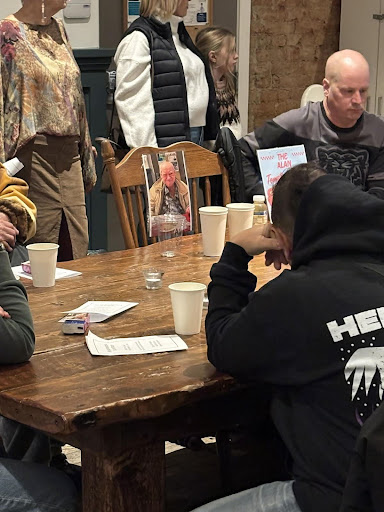
We were all there for Alan, whose regular chair at the Harvest Table was empty, save for a picture of his weathered face that was taped to the top.
Alan had been a daily customer at 541 Eatery & Exchange, a non-profit pay-it-forward café where my husband, Justin, served as Executive Director until this summer. As ED, Justin became Alan’s medical emergency contact, bringing him to the hospital when necessary, advocating for his care, and taking him out for an A&W burger when Alan could return home.
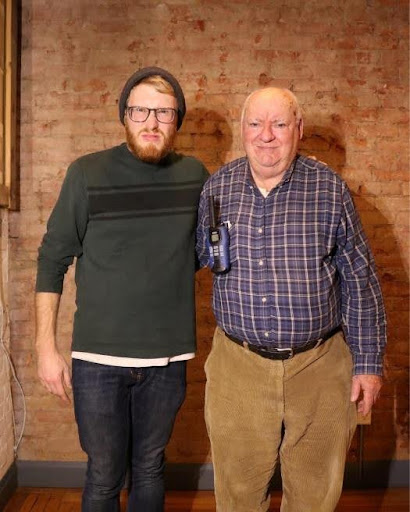
As such, it was Justin who received the call from the police, a few days after Christmas, after they had discovered Alan’s lifeless body in his apartment during a wellness check. Alan had attended the Christmas dinner at 541, and sometime in the next few days, had slipped, unnoticed, from this life into the next.
This quiet passing seemed somewhat fitting for a man who revealed little about his life. Friends knew only the bare facts — he had been born in Montreal, been married and divorced, never learned to read in full, and worked a series of odd jobs, always skirting the edge of poverty. He had Type 2 diabetes and struggled with his health during the last few years.
But this lack of knowledge about Alan didn’t stop Alan from being known, attested to by the dozens of people who came out on a Wednesday night to pay tribute to his life. Person after person talked about the man who held court from his chair at the Harvest Table, next to his best friend Donny, rambling about his day, complaining about the bus, discussing the news.
They talked about the tomato sandwich Alan ordered every day – fresh tomatoes on whole wheat bread, never toasted – a sandwich that wasn’t on the menu until it was added in Alan’s honour after his death.
They talked about the small gifts Alan would give to people, trinkets he picked up at the dollar store or thrift store (I myself was gifted a knock-off Coach wallet). Alan’s most frequent gift was a packet of tissues – people would end up with whole drawers full of Kleenex packs because Alan insisted you take one from him, whether you needed it or not.
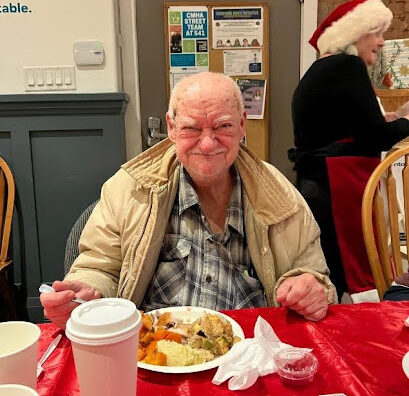
They talked about Alan’s curmudgeonly side, and his slightly abrasive way of communicating what he wanted or expected, which would drive people to exasperation only to be disarmed moments later by Alan’s mischievous grin and a package of Kleenex.
Alan had no family, but he had a home among the friends, staff, and volunteers of 541 Eatery & Exchange and its sibling non-profit, Helping Hands Street Mission. In these places people come together from all different walks of life. Some, like Alan, are just barely making ends meet. Others grapple with addiction. They sit at tables next to customers having a business meeting over lunch. Some volunteers once relied on these places for food and clothing. Other volunteers give their time and resources in acknowledgement of a comfortable life. The presence of all these people at Alan’s memorial service – including a paramedic who regularly treated Alan – was a testament to the power of relationship and community in the face of life’s hardest challenges.
Indeed, as Justin and I reflected on the evening as we drove home, we both felt moved by hopefulness. In the dark of winter, in a world of ICE raids and protestors being shot, of wars and war crimes, of economic uncertainty, of bitterly cold days, an unlikely community of people had come together to honour the life of a man who, by all accounts, the world had left behind.
In general, I’m a bit skeptical of the trend away from funerals toward “celebrations of life.” I think we lose something, theologically and emotionally, when we shift away from a service pre-burial, marking the transition from one reality to the next, to a memorial held later, often with an emphasis on remembering the life of the deceased with joy and gladness.
But my own curmudgeonly feelings about this fell away on that January night in the café. This community was indeed celebrating a life. Each of us had shown up to bear testament to the fact that Alan’s life mattered, that Alan – a man with no government IDs – was a person with a life and a story and a community and a home.
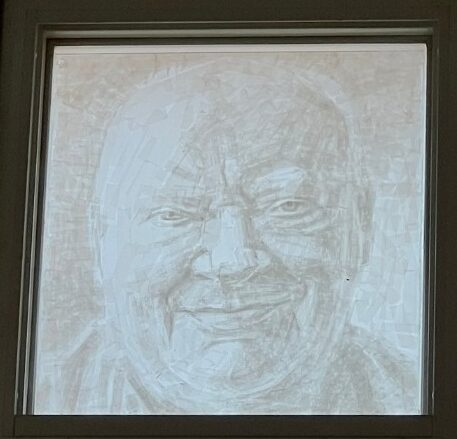
To celebrate Alan’s life was to kick at the darkness that so easily obscures those who live on the margins. Indeed, six years ago, a translucent portrait of Alan, along with a number of other regulars, had been commissioned to adorn the high windows at 541 Eatery & Exchange. Now one need only look up, on a bright sunny day, to see the light illuminate Alan’s weathered features, still present in the place he called home.

13 Responses
Thanks for this beautiful story, Laura. At a time where a human life is valued so little by so many in power, it’s a kindness to know about Alan and those who valued him.
Right on.
Laura, thank you for sharing this tender story that includes so many layers hope in our world today.
While the news speaks of not only millionaires but billionaires making more, you speak of Eatery & Exchange, a non-profit pay-it-forward café giving space for on-the-margin people like Alan to be welcomed as he is.
In a heightened world of masked ICE police? you tell of police doing a wellness visit. Stories of hope that don’t make the news.
But the kicker for me: Alan’s life mattered, that Alan – a man with no government IDs – was a person with a life and a story and a community and a home.
Read that again: no government ID. I know it’s complicated. But surely a person like Alan ought to have a voice beyond a tomato sandwich not on the menu.
I’m moved by your description of Alan. I’m also moved by the existence of the 541 Eatery and Exchange. Sounds like a beautiful place.
Beautiful! I wish I could have known him.
A worthy tribute. Thank you.
Thanks for sharing sone of Alan’s story with us and giving us hope for all who are precious in his sight.
An eloquent reminder that there is that of God in every person, as the Quakers put it.
Every Monday and Friday 150-200 unhoused people sit down for a meal at my Tucson church. What a gift to us all it would be if each could be known as Alan was known. (We have a long way to go — but quite a few have become regular helpers with the meal and attenders on sunday,)
So deeply Christian. So beautifully written. Thank you.
Beautiful story, beautifully written, Laura. Thank you.
Tears in my eyes as I finish this beautiful tribute to the love of Christ, practiced by everyday people to an everyday person who, though on the fringes of society, was cared for by many. Thank you for telling us his story.
Thank you for a moving, beautiful story. At the church where I worship (Presbyterian) we call those celebration-of-life services “Witness to the Resurrection.”
Thanks much, Laura. Lovely–Alan found a home for sure.