
“And not only the creation, but we ourselves, who have the first fruits of the Spirit…” (Romans 8:23)
Last fall, my wife, Joyce, and I joined an RCA global mission trip to South Africa, to study the history of apartheid and its continuing legacy in that country. The pilgrimage was sobering, reminding me of the experience I had decades earlier visiting Hiroshima and Nagasaki, Japan. Yet like when I visited Japan, the visit to South Africa also was not without its joys and pleasures. There were a couple of safaris, sightseeing, and opportunities to experience the various cultures that make up the nation. Even though I enjoyed those things immensely, it was the serious work of our trip that sticks with me. It was my first visit to South Africa, and I’m quick to admit that a couple of weeks there does not make me any sort of expert—in fact, I’m still processing the trip, and there are things I saw and experienced that I want to share.
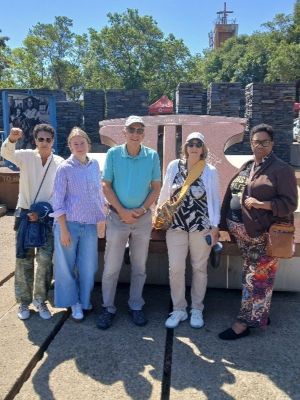
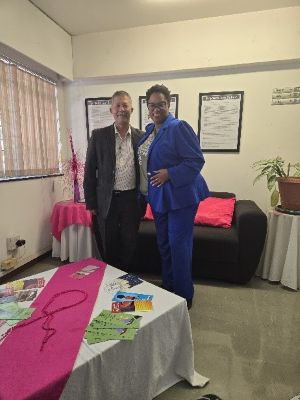
We spent a week with our RCA partners at the Setshabelo Family and Child Service ministry in Botshabelo, south of Johannesburg, outside Bloemfontein. “Setshabelo” means “the place of refuge.” The family and child ministry is the only Black-owned Christian social service agency in the country. I consider it a biblical example of “first fruits.” Under the leadership of Executive Director Keabetsoe Sekoboto, this agency provides family preservation, adoption and foster care, and victim empowerment against gender-based violence.
During the apartheid era, Black African men working in the diamond mines were only permitted to come home during an extended Christmas holiday, breaking down the structure of tribal families. One consequence that grew out of those long periods separation was the spread of AIDS, which led to another consequence: many children became orphans. In the United States, we think of AIDS as something in the past. But it’s a present reality in South Africa, and Setshabelo Family and Child Services is strategically placed at the center of the ongoing AIDS crisis. One of the joys of the trip was seeing a six-month-old orphan adopted by a university professor. The professor’s mother was also part of the adoption, pledging to help nurture the child. As the professor and his mother beamed with joy, I thought of the African proverb, “It takes a village to raise a child.”
In addition to Setshabelo Family and Child Services, another first fruit came through visiting a Sunday morning worship service in a congregation of the Uniting Reformed Church, one of the RCA’s denominational partners through the World Communion of Reformed Churches. The sermon, in English, was about Moses leading Israel into the promised land and echoed the preaching tradition of the Black church in the United States during the Jim Crow and Civil Rights era. I will not soon forget the congregational singing: no organ, no praise team, no screen—the only instrument was hand drums. A soloist began, then the congregation joined with dance and voice, and the music swelled to a crescendo of praise. One of the songs translated for us rang out: “Our God is so great!”
An additional meaningful first fruit came when we visited the site where the Belhar Confession was adopted. We talked with leaders of the Uniting Reformed Church— “uniting” because they still hope for denominational unity with other Reformed churches. However, the General Secretary expressed little hope of meaningful reconciliation with the white Reformed churches of South Africa, citing experiences of condescension and an unwillingness to engage as equals.
Most sobering for me as a Reformed Christian was learning more fully how Reformed theology provided the ideological underpinnings for apartheid. Although the apartheid regime came to power in 1947, the roots of apartheid go back to the Dutch East Indies Company of the 1600s. South Africa was used as a “filling station” for sailors on the way to Dutch colonies in Asia. Over time, Dutch settlers in South Africa established fruit farms whose crops protected sailors from the ravages of scurvy. Of course, those settlers, the “Afrikaners,” brought their Reformed faith with them from the Netherlands. Dutch immigrants used a twisted doctrine of election to legitimize their subjugation of the majority Black population, and drew heavily from Israel’s conquest of the promised land found in the book of Joshua as a paradigm for their own experience. A racial hierarchy was created with whites on top, “colored” (Asians imported to do tasks that were beneath the dignity of white people) below, and Blacks at the bottom.
Apartheid advocates drew upon several biblical passages as divine mandates for racial separation. They cited Genesis 9:18-27 (the so-called curse of Ham), claiming the Black race descended from Ham and therefore was divinely sentenced to servitude—the same argument used to sanction slavery in the antebellum American South. Proponents of apartheid also pointed to the Tower of Babel story in Genesis 11, arguing that God’s confusion of language and scattering of peoples showed that God desired the separation of races and ethnic groups. On this basis they argued that racial integration defied God’s intention for humanity.
Apartheid’s theologians also drew up on the New Testament. For example, Acts 17:26, which says “From one man he made all the nations…and he marked out their appointed times in history and the boundaries of the land,” was cited as justification for the creation of tribal homelands. Not surprisingly, the land designated for tribal homelands was undesirable, not unlike the reservations given to American Indians. And, like many other authoritarian and oppressive regimes, they cited Romans 13:1, “Everyone must obey the governing authorities,” to squelch any sort of protest or opposition.
While we must be aware of the white Dutch church’s manipulation of scripture to provide a theology of apartheid, we should also note many Christians were instrumental in the movement that led to the dismantling of apartheid in 1989. The undying spirit of common and ordinary people, Black, white, and colored, made a difference, as they held on strongly to the belief that all people are created in the image of God.
I was particularly struck by the example of Beyers Naude, a white Afrikaner clergyman who had been a member of the Broederbond, the secret society which helped shape the apartheid regime. Ordained in the Dutch Reformed Church, Naude began to question apartheid. At first, he lacked the courage to speak out, but eventually he broke with the Broederbond, and gathered other white clergy members around a more inclusive way of reading scripture. He was placed under house arrest, and later became a member of Dutch Reformed Missionary Church–the black Reformed Church.
Naude and other white clergy emphasized verses such as Galatians 3:28, “There is neither Jew nor Greek, slave nor free, male nor female, for you are all one in Christ.” This verse challenged racial, ethnic, and social distinctions, and reinforced unity among believers and universal equality for all people.
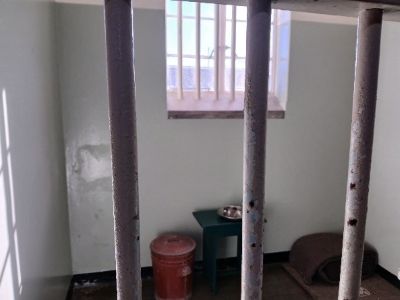
I recall being a young pastor serving on the General Program Council of the RCA in the mid-1980s when General Secretary Ed Mulder reported on his travels to South Africa and his growing friendship with Beyers Naude. At the time, Mulder faced significant opposition within the RCA for his anti-apartheid stance. After all, the Afrikaners had much in common with white RCA members. Some RCA members had even labeled the African National Congress a violent terrorist organization. Mulder faced a “profile in courage” moment, and Naude told him, “You cannot straddle the fence. You must make a clear decision to side with the oppressed, the Blacks and colored who have suffered under the apartheid regime.” Ed Mulder took Naude’s advice and led the RCA to take a stand against apartheid.
Because Reformed theology provided the ideological underpinnings of apartheid, I believe it is important for the Reformed Church in America to continue its commitment to South Africa and to partner with Setshabelo Family and Child Services. I have seen firsthand how they are harvesting the first fruits of the kingdom of God. This ministry has helped countless women, men, and children affirm their dignity as people created in the image of God.
Those of us in the United States look around today and wonder, in the midst of our national struggles, what can we do? One thing we can do is look at how oppressive and authoritarian systems in other countries have been dismantled in the past. The story of how South Africa overcame apartheid (while still struggling with apartheid’s legacy) teaches that social change requires a corporate movement that takes time. Yet I wonder for those of us in the United States, especially those of us in the church, if maybe it is not a matter of what we are to do, but who we are to be. May we humbly be the first fruits of the kingdom of God in our own small corners.
6 Responses
Thanks, Kent, for reporting on your S. African trip. Yes, to making sure our lives are fruit-bearing in the waterless wilderness of our time and place. We need the life-giving water of our Lord, Jesus of Nazareth. Come, Lord Jesus.
Thank you for this excellent article, Kent.
My husband and I traveled with Denise to South Africa several years ago. It was a powerful trip and yes, there is a lot to process. But like you, I highly encourage people to support the wonderful work at the Setshabelo Family and Child Services. It is amazing what they do!
And may we be reminded to stand up against oppression in any forms.
Thanks for sharing!
Thanks, Kent, for your reflections on your first trip to South Africa. My first–and only–trip there was in 1987, but it had a profound effect on me. That experience helped shape my approach to diversifying the faculty of Hope College.
Jack
Thank you Kent for your thoughtful essay. It is of course timely when we see the amount of racism that is displayed around the whole world. We all should be followers of Jesus who was at the side of the people who did not fit into the culture of his time. That included people who were sick, disabled, poor, and cut off because of false lines that divide a society into the acceptable and the unacceptable.
One of my favorite TRAVARCA videos was the one with Beyers Naude. A faithful example for all.
Thank you Kent, Your essay & reflections brought back memories to me.
My wife and I have been on a number of first class African Safaris in past years. Beautiful lodging accommodations with first class dining areas with linen table cloths and glasses of wine.
A few years ago we went to Guinea West Africa for two months to be a companion to a missionary & his wife.
We lived in a village with no electricity, no running water, no porcelain toilet. No glass windows or screens on the openings of the missionaries home. I would trek to various villages with the missionary as he brought the gospel to the people in the small villages. We slept on the ground, No tables or chairs for eating. No cell phone access. The life and living style are unbelievable My reflections and memories are that this mission trip was the most SPIRITUAL, most EMOTIONAL, most PHYSICAL experience we have ever had. I saw God at work in so many situations Here in America we think we are in control.