
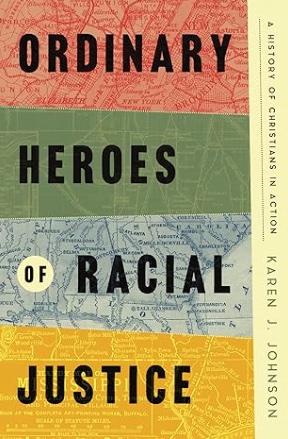
Karen Johnson has produced a book that hits the bullseye at the intersection of deep and practical. You need to read this book. Buy it if you are able, but be sure to read it.
This book helped me wrestle with some of racial justice’s big questions. Given the history Johnson explores in this book, how then shall we live? How can we all participate in the call for racial justice? Perhaps living in an intentionally integrated or even communal setting is a calling that works for someone newly married, newly retired, or newly divorced—or for a nuclear family for a decent portion of their lives. Perhaps the call to multicultural living means sending one’s children to the local Spanish immersion program at a Christian or public school—or maybe taking the traditional track while intentionally adding multicultural summer camps, trips, and neighborhood investments. Perhaps one’s tithing and giving patterns can evolve over time to compensate for other areas of one’s life—a sort of carbon-offset for racial reconciliation. Perhaps a certain kind of commitment to the spiritual discipleship of young kids means seeking a church home with robust children’s ministries, even if that means limiting multicultural options. Perhaps all of the above are wrong choices for some. Johnson’s book starts the conversation with plenty of thoughtful history, Scripture, sociology, and narratives.
Sometimes nonfiction books can overpromise and underdeliver, especially when those books purport to be both scholarly and accessible. Author Karen Johnson, the chair of Wheaton College’s History Department, achieves a delicate balance of sharing new stories from exceptional archival research while also making those stories eminently relevant to her readers, citing all the theology, sociology, and history that one would expect of a book like this while still weaving new stories into those frameworks. I left it with plenty of self-reflective questions, as well as greater awareness of my nation’s past and appreciation for the Church’s cloud of witnesses in the United States.
Ordinary Heroes of Racial Justice mirrors Jemar Tisby’s The Spirit of Justice in that it is a quartet of biographies about everyday Americans engaged in the “already but not yet” work of bringing racial justice to the church and the wider American society in the here-and-now—a reference to inaugurated eschatology that delighted this Neo-Calvinist reader. Some figures are less well-known, but Johnson’s admirable archival work unearthed fascinating new details of even familiar people. Johnson first investigates Catherine de Hueck, a Catholic Russian refugee who worked with African Americans in 1930s and 1940s Harlem. Next, she explores John Perkins—who just passed away in March of 2026 and is perhaps the most well-known of the bunch—who worked in rural Mississippi in the 1960s during the heart of the modern African American civil rights movement. Third is Clarence Jordan, of Cotton Patch Gospel fame, who formed the interracial Koinonia Farm in mid-century Georgia. Finally, Johnson explores Rock Church and Circle Urban Ministries in late-20th-century Chicago through the lives of Raleigh and Paulette Washington, along with Glen and Lonni Kehrein.
Johnson’s superb writing starts with her introduction, which lays out her goals and beliefs, any one of which would be admirable for a Christian historian. While defending histories and practices of racial justice, Johnson insists that “generations of Christians…have cared for people’s eternal and temporal needs [since] God’s people should be about salvation and shalom” (2). Johnson eschews duality, urging readers to address both salvation and shalom by seeing sin as both individual and corporate, meaning “that sin can reside in all the systems—economic, political, geographical, and even religious—that make up the context of our lives” (10). Second, in Augustinian language that should appeal to Reformed Journal readers, Johnson insists that “all truth is God’s truth,” meaning that Christian scholars should not fear engaging with wider scholarship on matters of history or racial justice (e.g., Critical Race Theory). The journey of this book will help readers see their context and spur current, courageous faithfulness born of past faithfulness (3–4). As she reiterates in the conclusion, Johnson wants to teach her students and readers “to discern the truth in stories, to see how context influences people’s thoughts and actions, to humbly recognize the limits of their knowledge, and to practice empathy rather than judgement” as they work for racial justice (317).
In the last part of the introduction, Johnson invites readers to watch as she wades into archives, interviews people, struggles with pre-conceived notions, and grows in “love, humility, and awe” (8). I especially appreciated her commitment to transparency, shown through both her accessible footnotes—intentionally at the bottom of pages rather than buried in endnotes or a bibliography—and her humble admissions of fallibility: several times she admits that the historical archive is incomplete or that she had to reexamine previous conclusions or assumptions. She also ends each chapter with a “Questions and Implications” section that could make this an interesting read for interested small groups, whether in church or the academy.
Allow me to give a taste of some of Johnson’s excellent chapters. Catherine de Hueck’s story should remind contemporary Christians about the importance of telling true stories about God as a God of justice (21), about the role churches played in furthering northern residential segregation (45–8), about the importance of telling stories of resilience and agency in the midst of oppression (50), and about the importance of proximity to others for learning how to serve (26–30).
Since every generation and culture has its blind spots, Johnson urges readers to use John Perkins’ biography to explore what orthopraxy might mean in their contexts: we should be “asking God what the gospel, which does not change, means in our time and place” (78–9). Perkins’ story teaches that “to fully understand the implications of the Gospel,” Christians need books and stories from different contexts since they “can fuel our prophetic imagination, helping us imagine a different way forward when we realize how we can inadvertently place limits on the gospel because parts of it do not mesh well with what we think life should be” (79–80). In a passage that should challenge the silence of some modern pastors who avoid discussions of the systemic and social aspects of the gospel, Johnson explains that “[n]ot speaking about race in a racially charged context [is] also a racial message” (111). The avoidance of the social aspects of the gospel, the so-called spirituality of the church doctrine, is still commonplace in some Reformed and Presbyterian circles and presents a challenge to the church’s witness in the 21st century just as it did in the 20th during the Civil Rights Movement (and in the 19th during abolitionist discussions). John Perkins’ story helps to avoid the elective application of the gospel based on one’s political tribe.
Johnson uses the story of Clarence Jordan to, among other things, complicate the stories of white allies to African Americans. Johnson models humility by openly comparing the existing sources, avoiding conclusive statements, and by talking directly about how this story “reveals the complexity of people in the past,” “provid[ing] insights into our own responses” to racial justice and “revealing how we [too] are culturally situated when it comes to issues of justice and righteousness” (192). This section can lead to valuable introspection among white anti-racist allies, including within Reformed circles, as we seek to be pragmatic and prophetic.
Finally, Johnson turns to Rock Church and Circle Urban Ministries on the south side of Chicago, a place where her own story collided with the history of racial justice struggles in the United States. I could tell this section was more personal for Johnson, who, in addition to her grounded research—present here as in other sections of the book—referenced personal relationships forged when she grew especially close to the people referenced in this section, relationships that began long before her research for the book. Karen Johnson and her husband, Eric, moved to the Austin neighborhood of Chicago in 2007 and joined Rock Church. Her interspersed autobiography provides useful anecdotes and updates throughout the history of those ministries.
I deeply appreciated Johnson’s use of Michael Emerson and Christian Smith’s magnum opus, Divided By Faith, which impacted Johnson during this last section as much as it impacted me. “Reading Divided By Faith changed my life,” Johnson states without hyperbole, “because I began to see that American society is shaped by race and that the practices and subtexts of my faith, paired with my racial context, limited my ability to see how that was working” (243).
One of Johnson’s final chapters discusses proposed action steps based on the history lessons learned in the book. One section that particularly stood out was the one on policy and relationships, which covered both the systemic solutions favored by those on the left and the relational solutions often espoused by those on the right (301). Johnson adds to this balance via detailed stories of Rock Church’s multicultural practices in the midst of the difficulties inherent in multicultural church ministry: relational solutions were not built on milquetoast conversations with casual church acquaintances. Instead, the relationships were built on intentional (albeit uncomfortable) conversations, deeply-rooted connections, and practices of humility and forgiveness on all sides (286-296).
Johnson and her husband eventually moved away from the Austin neighborhood after a job offer from Wheaton College, but she refuses to let herself—or her readers—off the hook. The call to racial justice remains, although its context may differ depending on vocational gifting, family season, or personal story (316–7).
This book thus provided both a challenge and comfort for me, challenging because we readers need to consider how our Buechnerian callings should all involve racial justice: as full-time missionaries are to the quotidian evangelism of all Christians, so too Christians involved in racial justice ministry do not have a monopoly on the call to build bridges (316). Yet, as someone who deeply values racial justice and who still attends a mostly white church and teaches at historically white educational institutions, I have struggled with complicity in what Dr. King called “the most segregated hour in American life [11 AM on Sundays].” I am grateful that Johnson’s book does not shame: she, too, felt a calling to teach evangelical students about the complexities of American history and contemporary sociology—a calling my mother, a career-long Christian educator, called being a “missionary to the close-minded.” Johnson’s commitment to family meant that a two-hour round-trip train commute was not feasible for that phase of her life, and yet she took steps to make sure the “dangers of the suburbs,” which fed her “tendency toward materialism, envy, and greed,” would not overwhelm her or her family (315).
Johnson’s book provides a wonderful panoply of stories and choices from which to learn, and her closing calls us to not “hide from the pain of the past” since we can “learn from the [hard-won] wisdom of those who came before us” and thus “be free to respond to pain in the present” (317–8).
Johnson’s book is for such a time as this.

5 Responses
How does Johnson use history, Scripture, and sociology to explore questions of racial justice?
Very well-organized and insightful review. This is important stuff. Thanks!
Thanks, Caleb, I’ll be sure to give this a read.
Thanks so much for this recommendation- we all need this read and especially now-
I’m grateful too for those who open doors for us to see beyond! Bravo!
Thank you, Caleb, for your review. I enjoyed and learn from your writing, and look forward to reading the book.