
A pink sunrise filters through the window. Coffee steams in my mug. I’m reading J.R.R. Tolkien’s The Lord of the Rings. I’ve reached a troubling scene.
“Soon all shall be burned,” Denethor, Steward of Gondor, laments. “The West has failed! It shall go up in a great fire, and all shall be ended. Ash and smoke blown away on the wind!”
Denethor believes the Dark Lord has captured the Ring of Power, that the battle to save Middle-earth is lost. Things are hopeless, so why fight on? Denethor abandons his duty, the defense of his city, and ends his life.
“Better to burn sooner than late, for burn we must.” His fatalism, the wizard Gandalf points out, is the work of the Enemy whose worst weapon is “dread and despair.”
I confess that some days I’m pulled toward Denethor’s pessimism.
“America has failed!” I fret. “It shall go up in a great fire, and all shall be ended!” How could I not think this? In the face of Trump’s blitzkrieg. American institutions have buckled. Prestigious law firms. Ivy League universities. Legacy media. Business tycoons. Congress. The Supreme Court. America’s core meltdown weighs on me.
I feel small. Weak. Depleted. How do I keep my tenacity—the word Kathryn Schoon-Tanis endorses for 2026?
Of course, I turn to the Bible. To the sacred stories of God’s great acts saving people from trouble, injustice, and oppression. Israel’s deliverance at the Red Sea. David’s defeat of Goliath. Daniel and friends rescue from lions and fire. Jewish return from Babylonian exile. Jesus’ release from death. These stories of liberation ground Christian hope. So, yes, I turn to them.

1892-1973
But this year I’ve also turned to one of my wisdom texts—Tolkien’s epic. I taught Lord of the Rings to college students, exploring the moral virtues—hospitality and trust, courage and wisdom, mercy and friendship—that enabled a group of small, reluctant heroes to surmount immense danger, destroy the Ring, defeat the Dark Lord and save Middle-earth. It’s a story of tenacity. The Fellowship’s main temptation is despair. That’s why, in his Letters, Tolkien indicates that the key to their success is hope.
Despair sees a negative future. When we think the future is closed, we become demoralized. When we think nothing will change, we give up. The medieval sin of sloth combined acedia (apathy, lack of caring, fatigue, lethargy) and tristitia (sadness, melancholy, weariness). The Latin word de-sperare means to ‘unhope’ yourself. Denethor’s resignation saps his energy. Since action is futile, he does nothing. What’s the point?
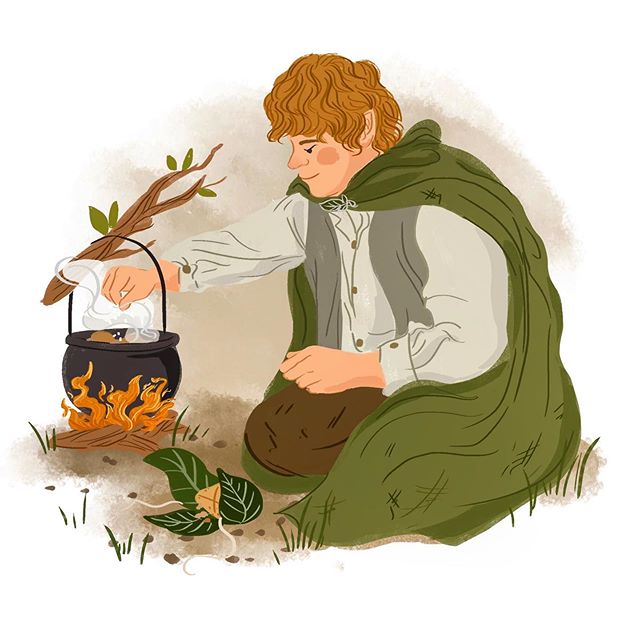
But then there’s Sam, Frodo’s faithful companion. Late in the Quest, weary and worn, Frodo collapses. Sam’s spirit fails too, as he looks out across the dark plain, full of orc encampments, which they have yet to cross. He’s defeated, beaten down, discouraged.
But wait . . . “Far above, the night-sky was dim and pale. There, peeping among the cloud-wrack, Sam saw a white star twinkle. The beauty of it smote his heart, and hope returned. The thought pierced him that in the end the Shadow was only a small and passing thing: there was light and high beauty forever beyond its reach. Putting away all fear, he cast himself into a deep untroubled sleep.”
Later, dazed with fatigue, Sam faces the herculean task of carrying Frodo up Mount Doom. He recalls the verdant Shire, visualizes faces he loves. He remembers why he’s doing this. “Even as hope died in him, it turned to new strength. Sam felt as if he was turning into some creature of stone and steel that neither despair not weariness could subdue.” Like a rubber band, he snaps back, energized. He reclaims his tenacity.
Hope sees a positive future. When we think the future is open, we become motivated. When we don’t accept a situation as final, we stand our ground and refuse to surrender. We act to bring about what we hope for. And by acting, we make a difference in whether the outcome we desire happens.
Hope is a Christian virtue—one that Tolkien, a committed Catholic, valued. Karl Donfried defines biblical hope as “the expectation of a favorable future under God’s direction.” It’s confidence in God’s coming Reign—a future of love, justice and peace. We’re viators—Josef Pieper says—people on the way toward a ‘not yet’ that doesn’t exist. When we hope, Richard Norris states, we reach out to that future, “acting to make the world in which we presently live look, if only a little bit, like the new creation which God is bringing.” Hope enables us to “not grow weary in doing what is right” (Galatians 6:9).
Nicholas Smith points out that hope isn’t a noun—something we find ourselves with, like eye color. Instead, hoping is a verb—something we do. The Bible commands us to cultivate hope: to seize it (Hebrews 6:18), hold fast to it (Hebrews 10:23), set our minds on it (1 Peter 1:13). There are practices for building hope: inspiring reading or films; gratitude journaling; meditation and relaxation exercises; regular periods of rest and renewal; taking small meaningful actions; connecting with supportive friends; celebrating progress.
As a pivotal battle begins, Frodo crumbles: “I can’t do this.”
“I know,” Sam responds. “It’s all wrong. By rights we shouldn’t be here. But we are. It’s like in the great stories. Full of darkness and danger they were. And how could the end be happy? How could the world go back to the way it was, when so much bad had happened? Folk in those stories had lots of chances of turning back, only they didn’t. They kept going because they were holding onto something.”
“What are we holding onto?” Frodo asks.
To which Sam answers: “That there’s some good in this world. And that it’s worth fighting for.”
“Hope,” Augustine of Hippo is claimed to have said, “has two beautiful daughters: anger and courage. Anger at the way things are and courage to see that things do not stay the way they are.” God grant us bright hope on our bleak days—resilient tenacity on our weak days.
3 Responses
“We’re Viators – people on the way to a not yet.” Love this. Thank you for bringing me back to Sam and Frodo and their relatable struggle against seemingly insurmountable odds. Grateful for this kind of insistent hope.
So eloquent and helpful. I will share this with many who need it as much as I do. Thank you!
“The Lord of the Rings” – truly a book of wisdom, especially from the mouth of Samwise, the only one who held the ring for a time and was able to give it back freely. The “ring of power” seems to have entranced too many today.