
In March the days are often still too short and the air is too cold, but when April comes, I’m cycling outside. Warm winds blow, the snow melts, the roads dry, and I can start riding in the flat farmlands south of Chicago. April holds boundless hope for shaking off the shackles of winter and reawakening the joy of riding.
Riding into the wind is difficult. Stiff spring winds can be relentless and pushing against them can feel futile. There’s no way forward other than to put your head down and pedal. The pace is slow, the wind roars, it feels like you’re always going uphill, and you long for a reprieve. But after an hour or two, when you turn back toward home, and the wind is at your back, suddenly the world is silent, the miles fly by, the speed is effortless, and your heart sings.
The church I serve went through a long season of riding with the wind. We were welcoming new members, baptizing babies in bundles, and it all felt effortless. At one point we had a hundred kids under seventeen and a hundred seniors over seventy who were active each week in congregational life. With the boundless hope of intergenerational life, our hearts were singing.
However, in 2020 the wind shifted and the road got pockmarked and rocky. Pandemic politics, folks unhitching during Covid, the denominational human sexuality debate, being forced into disaffiliation, and the fragility of nearby Trinity Christian College all began to take their toll. Six years later we’re not as robust or as hopeful as we once were. By most markers we’re still healthy and happy, but now we’re clearly pedaling into the wind.
Church folks like to credit church growth to the blowing of the Spirit. Healthy congregational life – measured by buildings, budgets, and butts in the seats – must be evidence of the blessing of God. When you have momentum and it feels like you’re winning, the ministry miles fly by. Missiologists tell us to identify where the Spirit is leading and to ride with that wind. Therefore, when the wind is at your back, you’re in God’s gracious groove; if you’re pushing against the wind, you must be doing something wrong.
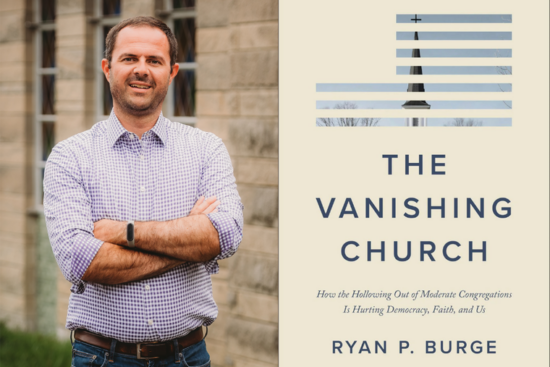
Ryan Burge writes that moderate Christian congregations are being hollowed out. In The Vanishing Church he makes a compelling case that the winds of contemporary culture and modern communication technologies have pushed people further to the right and further to the left – and those who blew left don’t attend worship as religiously. In his words,
Today, the Big Sort is nearly complete. The two Christian groups that have managed to maintain a robust membership, Catholicism and evangelicalism, have done so by drifting to the right. That’s certainly made a haven for cultural conservatives, but it has also tended to scare away people whose politics are further to the left. The mainline’s commitment to ideological diversity has left its denominations on the verge of collapse. Meanwhile, the nones have gone from little more than a rounding error to representing the most significant cultural shift in the United States over the last three decades, becoming the default landing spot for political liberals who can’t find a place in American Christianity.
I guess that offers some consolation. At least it puts our journey in a larger weather pattern. The winds we’re experiencing are not regional breezes, they’re global trade winds. It’s a reminder that we didn’t control what blew at our backs before and we don’t control the stiff winds we face now.
Therefore, while it’s easy to get discouraged, pull over, and call for a ride home, I’m reminded to just keep pedaling. The measures of congregational size, age diversity, and worship attendance are important, but they’re not the measure of a faithful church or a faithful pastoral life. I know beautiful healthy congregations that are buffeted by hard head winds and all sorts of good and gifted pastors who are serving dying churches.
Church is a social construct that takes all sorts of shapes, sizes, and cultural expressions. The congregational model with properties, programs, and a professional staff is just one expression. There’s no gospel guarantee that this particular church construct is designed to last. Many will be boarded-up in the blowing wind.
Cyclists can talk endlessly about watts, VO2 Max, heart rate, speed, and their FTP (Functional Threshold Power) numbers. They can wax lyrical about upgrading to a new carbon fiber bike and the benefits of some cool component, but in focusing on performance and data they can miss the joy of a good ride on a spring day. Sometimes you need to leave the cycling computer at home and just pedal.
Pastors and church communities can get stuck worrying about the measurables and in doing so miss the joy and beauty of community life. They can get lost in grading performance, counting people, and in doing so miss the grace of where the Spirit is blowing among us – even now.
Sailing along with the wind at your back can be both glorious and easily misleading – you can start to believe that you’re faster than you actually are. Riding when the weather shifts, the road is rough, and the wind roars is no less part of the journey.
No matter the conditions we’re called to proclaim a gospel of grace in Jesus, pray with the sick and the grieving, celebrate the sacraments, study scripture, listen for God’s voice, love our enemies, and serve one another.
Speed and size are not the point. The riding is the point – in sun, wind, and rain, on farm roads cutting through fields that are rugged and rutty after winter.
Cycling photo by Oleg Kukharuk on Unsplash

11 Responses
Oh yes, in so many ways.
Great article. Thank you. Your observations and insights are right on.
Roger
As a fellow biker and runner your article spoke to my years in ministry. The key is truly keep biking and running.
Once the wild weather clears, the bikes will come out. I didn’t get my ancient LeMond reconditioned for nothing. I do recall I never rode so much as during the pandemic — even to our outdoor services to hear you preaching in the parking lot—thanks for your ever-encouraging voice, Roger.
Well said, Roger! Just yesterday, as I pedaled along, I was wishing the west wind would let up. Thanks to you, I now have a way of appreciating it.
Thanks for your thoughts. Clearly where many of us are at.
What if the headwind is the Spirit too?
Just thinking about my own church ministry
Thanks, Roger. Very helpful and hopeful. I have to admit that most of my ministry I had a tailwind behind me. It wasn’t until toward the end of my ordained ministry — when I hit retirement and cancer — that I noticed some headwinds in church life, especially around political matters (around the time of COVID, as you note). I agree with Rodney Haveman’s comment that the headwind can come from the Spirit too — like Jesus being driven by the Spirit into the wilderness. Without that headwind, the joy of ministry can so easily slip into the complacency of ministry.
Thanks, Roger! A meaningful analogy, especially to a cyclist such as myself. I have had times when I had to stop and get my bearings so a crosswind would not blow me off the path, both on my bike and in ministry. On my bike, it meant putting my feet on the ground. In ministry, it was prayer and seeking the Spirit’s guidance.
Thank you so much, Roger. The essay itself was a warm spring wind at one’s back. Lovely metaphor, lovely writing, lovely application both to Hope & other churches, and to pedalers of all sorts, including this 73 year old trudger with walker.
Vintage Ted. Prayer as your recovering continues, with hopes that soon you will be a 73 year old trudger without the walker 🙂