
If you’ve been paying attention, you know that the membership numbers for the Episcopal Church have been on a downward slide steeper than President Trump’s approval ratings. And like every other mainline denomination in the United States, those who remain skew heavily older.
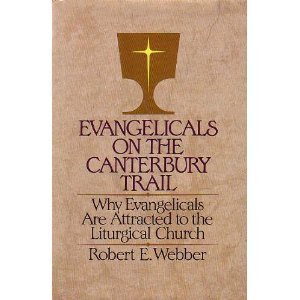
In 1985, worship guru Robert Webber wrote Evangelicals on the Canterbury Trail, suggesting that White evangelicals were seeking and shifting toward more liturgical, sacramental worship and historic church traditions. It now looks like few trod the trail Webber envisioned.
Nevertheless, in retirement, my wife and I have ended up at an Episcopal Church. And a handful of my retired ministerial colleagues have done the same. It’s hardly a trend, not really even anecdotal evidence. But here’s our experience.
Moving to Des Moines, we approached the search for a church cautiously and patiently. After nearly 40 years of serving as pastors, we had never really had the opportunity to “look” for a church. We wanted to take our time and do it well.
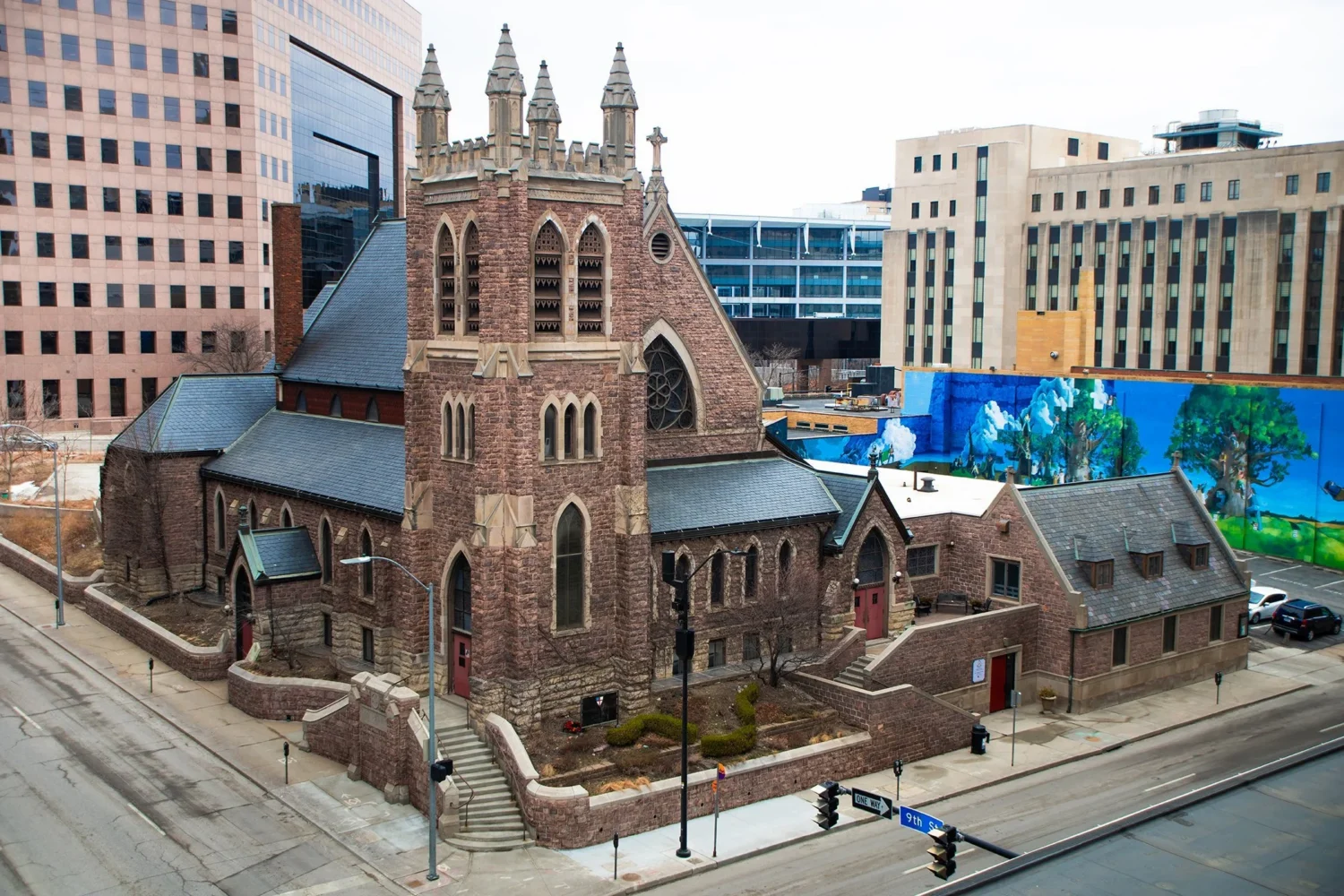
Our criteria were modest: a church within walking distance (the nearest Reformed Church in America congregation is a 20+ minute drive); welcoming and affirming of LGBTQ+ people; and preferably celebrating the Lord’s Supper weekly. Our options were a Presbyterian (PCUSA), a Lutheran (ELCA), and an Episcopal church. My aim here isn’t to compare them, but to share what ultimately drew us to the St. Paul’s Episcopal Cathedral in downtown Des Moines.
Don’t be overly impressed by “cathedral.” That simply means the bishop of the Diocese of Iowa calls it home. It’s a small, urban church with more than a few challenges.
Early on, in some “newcomer” settings, when asked why I was there, I said things like
- Words and beauty are important to me. Both are valued here.
- I get to say “God from God, Light from Light, True God from True God…” every Sunday.
- There are four substantial scripture readings and the Sacrament every week.
But, of course there was more.
It’s something of a cliché for Reformed folk to express a low opinion of Episcopal preaching. I’ll borrow a line I once heard from Ron Rienstra, “The more your liturgy does, the less your preaching has to do.” And it can be a relief to worship where the sermon is not the measure of the hour.
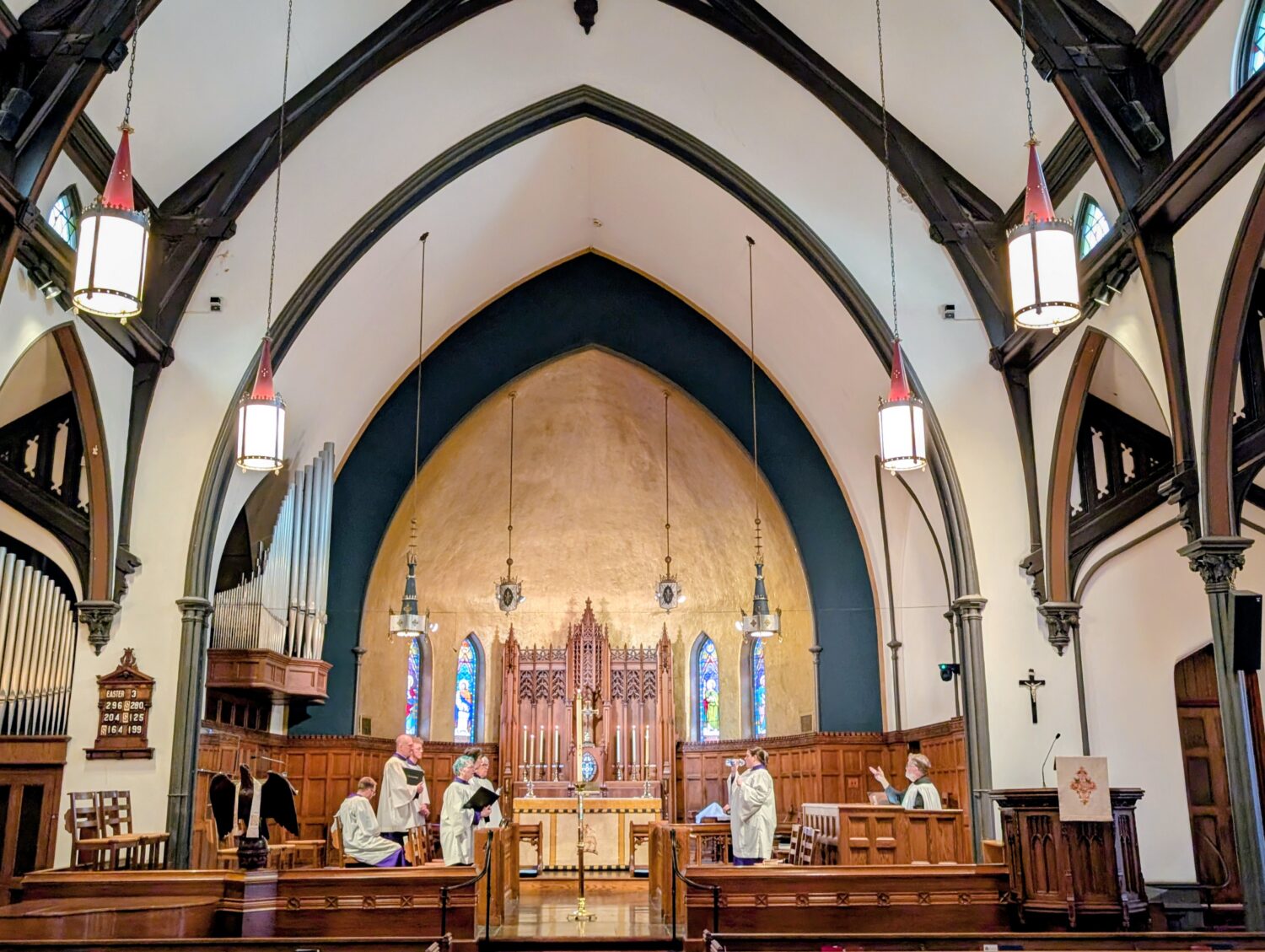
In for a penny. In for a pound. Early on, I decided that if I was going to worship at an Episcopal church, I was going to worship like an Episcopalian. That means kneeling, reverencing (bowing), crossing myself, communing from a common cup. These practices have become not only comfortable, but helpful and meaningful. I can’t even recall the pietistic protestations against them.
Like any church that has been around for a while, St. Paul’s has a mixed history. We haven’t gone digging for skeletons and scandals. Some will probably surface over time. One thing we have deduced from the presence of several older same-gender couples is that St. Paul’s was a bit of an early and quiet haven for LGBTQ+ people in the past. Today, we may cringe at what once was considered progressive and welcoming. Still, it’s a small facet of St. Paul’s story I appreciate.
Every Sunday, we pray for the Church and for church leaders — bishops, priests, pastors, and more. In retirement I especially value this. Before, this somehow seemed inward, self-serving, not missional — probably an indication of our paltry Protestant ecclesiology. Now I treasure a time to pray for former congregations, many ministerial colleagues, even denominations and institutions.
We also pray for the dead. I’m not concerned about trying to pray anyone out of purgatory. Nor do I sense that others are. But gratefully recalling my parents, grandparents, mentors, friends, beloved congregants at whose funeral I presided? It is a good and joyful thing.

St. Paul’s sits in the shadow of Iowa’s tallest building. Don’t laugh! It’s 44 stories, 630 feet high. And in the flat terrain of Iowa, it can be visible from miles away. It sounds odd, but when I see that tower from all sorts of vantage points, it reminds me to think of St. Paul’s, humbly present across the street. Like many downtown churches, it is an historic building, beset by many problems and too much deferred maintenance. Once, I heard our priest exclaim, “I’ve been here five years, and I don’t think I’ve ever gotten hot water out of this faucet!”
A friend once said of the congregation I served, “I love how they sing the Nicene Creed lustily, even though probably a third to half aren’t sure they’re actually onboard with it.” I took it as a compliment. I see something similar at St. Paul’s. Orthodoxy is upheld — but held lightly.
The people of St. Paul’s love tradition and language, ritual and history, the luminous and the quirky. At the same time, they are progressive, engaging, curious, and literate. These two impulses are partners, not opposites. “Like householders who bring out of their storehouse treasures new and old.” Actually, a similar dynamic is at work in the Reformed Journal.
Of course, over time, church becomes about more than what first drew you in. It is about conversations and coffee, familiar faces and friendships. And that is happening for us as well.
You may think I sound like a naive novice, looking at my new church home through rose-colored glasses. Believe me, I’m plenty aware of the difficulties and weaknesses.
The numbers don’t look good for mainline churches, and there are plenty of empty pews at St. Paul’s. Yet even in our short time there, we see a small but steady stream of newcomers — especially disillusioned Catholics and deconstructing evangelicals. And younger people. It isn’t only the grays and the gays anymore. Baptisms aren’t uncommon. That’s not to say our priest will soon be featured at church growth conferences. The “glory days” aren’t coming back.
But perhaps, rumors of our demise have been somewhat exaggerated.

16 Responses
I fell in love with the liturgy of the Episcopal Church when I was in high school. At that time they were transitioning into adopting a new prayer book. So I had some exposure to the 1928 Book of Common Prayer. Nonetheless, I found guided prayer meaningful along with the singing of much of the liturgy, the use of Anglican chant for Psalm singing and the radical welcome of many Episcopal churches. I like that it is a communion held together by common worship, rather than common doctrine. In 2021, I was confirmed as an Episcopalian. I’m glad you and Sophie have made your way over. The Episcopal Church in my area is not strong, but I am hopeful that with new leadership coming soon, things will change.
Tom, I’m glad you found a welcoming church home as an Episcopalian. I remember your musical talents at Christ Memorial Church during the Tim Brown/Wes Kiel years. Blessings. And Hi from Marilyn Houting.
Steve, thank you for this. I was raised (very loosely) Lutheran. What I remember most, and still love when worship leans in that direction, is the liturgy. There is something very calming in the ritual, rhythm and music. For me it prepares a place in my heart to hear the Word of God. Taize services do the same for me. I love my Reformed Church because it offers a mix —organ and guitar—silence and a joyful noise unto the Lord, for young and old which is probably one of the reasons why it is growing. Great preaching and welcoming Spirit helps.
When I was 15, my home church, Congregational, split over a political decision, and, when the anger expressed by both factions made a positive religious experience impossible, my parents took me to an Episcopal church. Kneeling between my two dear parents, saying the General Confession and realizing that I would be making mistakes my whole life but would be forgiven so that I could keep trying, I felt the peace that passes all understanding for the first time ever in a church. I’d known this sense of wonder and acceptance on canoe trips in the Boundary Waters of Minnesota, but it would be many years before I realized that these spiritual highs came from the same Source. I have been fascinated by the varieties of religious experience and the compassion they inspire ever since.
I love the wilderness correlation, Carolyn! Thanks.
While I was born to the Roman Catholic Church, for most of my late childhood and on I was in the RCA. I was formed in that tradition and educated at Hope c
College.
I think the Catholic in me was always drawn to the more liturgical side of the RCA. With the cultural political shifts around 2016/2017 I needed a home that was more liberal and felt more grounded in the tradition. This led me to the Episcopal Church.
A decade later, I have found a more flourishing faith grounded in our long Christian tradition through participation in our liturgy and community.
Steve-
Having grown up Catholic, the one time I went to an Episcopal church (Good Friday last year), I remembered the reasons I left the Catholic Church. While Episcopal isn’t for me, I am glad you found a church that works for you.
Thanks, Steve!
Best worship for us recently was the installation of the new Bishop of Canterbury! We miss the RCA communion liturgy and find the UCC liturgy in our present congregation lacking . . . We’re on a journey and may find our next home in the Episcopal Church. I’ve used their liturgy and prayer book for a long time, both in active ministry and retirement . . . Blessings on your way.
Thanks Steve! You articulated a lot of our transition to the episcopal church. I however miss celebratory hymns and meaty sermons. But then again Ron Rienstra put this in perspective for me.
You are spot on. The rich liturgy of the Episcopalians takes all the pressure off the sermon – which is a good thing for both the congregants and the rector.
Thanks for this lovely reflection. I also enjoy the liturgy and ritual in my local Anglican church.
In our sojourn from the CRC to distant lands (UCC, ELCA, brief intervals with Quakers and uncategorizable African churches) some of the most theologically and exegetically rich sermons were offered by our priest at our first Episcopal parish in Princeton NJ and in our current half-year parish in Grand Haven MI. There are very wise shepherds in many of the fields of the Lord.
I was raised a conservative Baptist. Joining the Episcopal Church 25 years ago saved me from two things that had increasingly come to bother me in evangelicalism. First, intellectualism. If I didn’t get something from the 35-minute sermon, the centerpiece of ‘worship,’ then church was a flop. But in the Episcopal liturgy there are many ways God can speak to me. Through candles and stained glass. Smells and bells. Physical movement. The Eucharist. Passing the Peace. Second, a-historicism. Evangelical churches I attended believed church history began with 19th century preachers D.L. Moody or Charles Spurgeon. There was no recitation of ancient creeds. No sursum corda from the second century. There’s something inspiring about saying words and prayers that God’s people have spoken in gathered ritual for centuries upon centuries. A sense of the communion of saints drawn together by a book of common prayer.
I’m wondering if it would be appropriate for the name of the Reformed Journal to be changed to the name “Formally Reformed Journal”. Many of the authors of the blogs and also the people who regularly comment are no longer members of a Reformed congregation or even still a Christian. Does the Reformed Journal actually reflect or value the unique emphasis and accent of the Refomed faith?
Lena, a good observation. I have been wondering the same thing. The Reformed Journal could use a Reformation.
Lena, I consider myself thoroughly “Reformed,” even if I am not currently attending a church with Reformed in the name. I suspect there are many, many Reformed people who do not live near a Reformed congregation and worship at all sorts of churches but still carry a Reformed perspective. Additionally, the Reformed influence on the Anglican tradition is not insignificant. Worship there for a while and you will note all sorts of Calvinist echoes. And while I trust you know this, “Reformed” is actually a very broad tradition. “Dutch Reformed” is hardly the sum of the Reformed tradition. Finally, I’d say a theme found consistently in the Reformed Journal is that many who still claim to be (Dutch) Reformed have traded their birthright for a mess of pottage known as American Evangelicalism.