
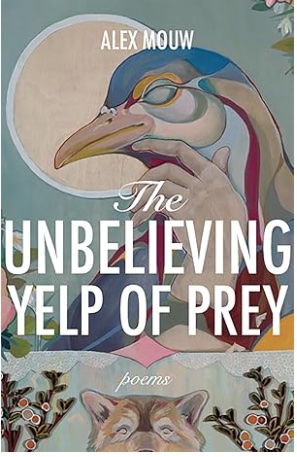
Urgency may not be a defining characteristic of good poetry, but good poems often meet the urgencies of the moment. In The Unbelieving Yelp of Prey, Alex Mouw explores needs whose scope reaches well beyond the purely personal to kinds of spiritual angst and longing many will recognize. He takes us to the shadowy outer edges of prayer where, as on ancient maps of the unknown world, “there be dragons.”
In “Of Modern Poetry” (1942), Wallace Stevens described the task of poets in his generation: to write “The poem of the mind in the act of finding / What will suffice.” Those lines offer a startling view of what it was to write poetry in the aftermath of a world war, in a generation informed by Freud, when disillusionment and painful self-consciousness challenged all comforting formulae. What had been “meet and right”—what had sufficed—gave way to irony and uncertainty in a climate of exhaustion and skepticism. T.S. Eliot wryly identified the tone of those years in “Ash Wednesday” (1930): “Consequently I rejoice, having to construct something / upon which to rejoice.” His poem ends in a final one-line stanza of redemptive lamentation: “And let my cry come unto thee.”
Stevens and Eliot offer a useful perspective not only on what it was to write then but also on what it is to write now against background noise that normalizes cruelty and greed and valorizes war crimes. Mouw focuses on related evils: disruption of natural ecosystems; growing landfills; profitable exploitation. They testify to the cost of awareness––the burden of knowing we are called to choose life even as we remain complicit in merchandising death. As an archaeologist of that awareness, Mouw takes us down to a stratum of consciousness where we recognize our own image in both predators and prey.
In the opening poem, from which the title is taken, the speaker pauses after several stanzas that linger on a nearby hawk waiting for voles “in their catacombs.” He declares, “This isn’t / exactly a prayer. It’s more / the unbelieving yelp of prey grabbed suddenly by a wolf . . . .” A similar note resonates throughout the following pages, where dissonance and spiritual anxiety run like live wires through what are “not exactly” prayers of longing and lamentation.
A few of them resound with ironic biblical allusion: “Psalm 139 from a Downtown Window” begins, “If I flop in the reeking koi pond, / you are there. . . .” And “Psalm 43 Driving Through the Heartland” arrives at haunting questions that are unsettlingly current: “Why are you doubled over, / oh my soul? And why so / limp within me?”
Others, in form or rhythm or repurposed phrases, invoke a lineage of poets who have spent their writing lives in the riparian zone between poetry and prayer: Donne, Herbert, Hopkins, Dickinson. For them, too, what was “not exactly prayer” seems, despite their resistances, to have become exactly that. One way or another, they found routes through dark woods into unpromising places where their thirst was slaked in unexpected and sometimes unwelcome ways. “Mine, O thou lord of Life, send my roots rain!” Hopkins writes at the end of a poem that begins with accusation and complaint. That final petition is a turning toward: the prayer comes not to solution, but to surrender. One of Mouw’s final lines takes a similar turn: “Imagine being unable to give thanks.” I don’t want to imagine it. I read the line and feel how bleak thanklessness would be and am moved, obliquely, toward gratitude.
To call the poems in this collection moving raises a question they don’t answer directly or easily. How do they move us? We are moved into unease, into uncomfortable, unaccustomed reckonings with a natural world “red in tooth and claw,” damaged and relentless, of which we are a part. We are moved by these “not exactly prayers” into intimate awareness of the body in pain and into moments of undignified distraction that may call us to surprising attention. Intermittently, though, and finally, they move us into a place of hard-won reassurance that prayer is our only recourse. To whom else shall we go? The question, answering itself, leaves us wrestling––assured, but unrelieved of discomforts that are, after all, the cost of incarnation.

3 Responses
Thank you Marilyn,
Thank you, Marilyn. I am choosy about investing in poetry collections–usually opting for checking them out of the library rather than risking resonating with only one or two out of scores. But after hearing Alex Mouw on the Reformed Journal’s poetry podcast, I bought The Unbelieving Yelp of Prey. I am happy to have it on my shelf. I admire its honest and range of form and content. Many poems lean toward lament or confession, but some, like “Wedding Pianist” and “A Short Catalogue of Miracles,” celebrate the joys of close observation.
Thank you. Alex is that uncommon poet whose intellect and heart are inseparable. Thank you, gentle, brave Alex.